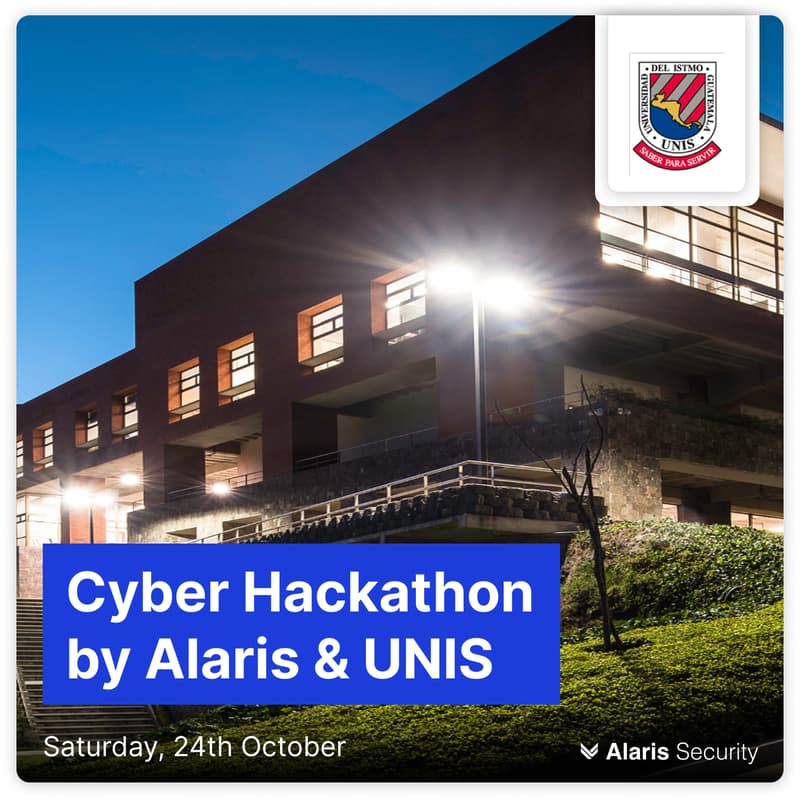

Cyber Hackathon by Alaris & UNIS
Join Alaris Security & UNIS for a one-day hackathon focused on automating security operations. Work in teams of 2–4 to build a working prototype, then present it to a panel of international judges in a two-minute demo.
The Challenge
Your challenge is to choose one task in a security operations centre (SOC) and find a better way to do it. You could automate phishing triage, connect related alerts, build an incident timeline, or tackle another problem you think deserves solving.
Use AI, code by hand, open source projects, or a combination. Show how your solution helps security analysts save time, make better decisions, or respond faster.
Prizes
1st Place
Custom Alaris Swag (Exclusive Guate Edition)
12-Month subscription to HTB
Featured winner spotlight
1hr career session with Alaris
Performance Certification
2nd Place
Custom Alaris Swag (Premium Guate Edition)
6-Month subscription to HTB
Social Media mention
Performance Certification
3rd Place
Custom Alaris Swag (Classic Guate Edition)
3-Month subscription to HTB
Social Media mention
Performance Certification
Event Timeline
The event runs from 8am to 5pm:
8:00–8:30: Check-in and team formation
8:30–9:00: Welcome and challenge briefing
9:00–12:00: Build session
12:00–12:30: Lunch break
12:30–3:30: Build session
3:30–3:45: Submissions and demo preparation
3:45–4:30: Team demos
4:30–5:00: Judges deliberate, awards, and closing
Event Rules
Keep it simple. Build something meaningful.
Teams of 2–4 people. Solo participation is also welcome.
Build during the hackathon. Projects must be developed during the event. Pre-existing projects cannot be submitted, but existing tools, libraries, and frameworks may be used.
AI is encouraged. Use AI tools as much as you'd like. Just document what you used and why. You must be able to explain and understand what you've built.
Third-party tools are allowed. You may freely use open-source libraries, frameworks, APIs, and external services.
Use real or simulated security data. Publicly available datasets, synthetic security events, and simulated environments are permitted. External datasets must be properly cited.
Don't fabricate results. All performance claims, findings, and statistics must be accurate. Simulated results must be clearly identified as such.
Build responsibly. Do not test against systems, networks, or accounts without authorization. Never expose credentials, passwords, or API keys in your code or repositories.
Submit both deliverables. Every team must provide:
Working demo: A functional prototype demonstrating how your solution automates an aspect of Security Operations (SOC).
Technical write-up: A brief explanation of the problem, solution, architecture, and technologies used.
Present your project. Each team gets 2 minutes to pitch and demonstrate its solution to the judges. Participation in the final presentations is mandatory to qualify for prizes.
You own what you build. Participants retain ownership of their projects and intellectual property.
Respect everyone. Treat fellow participants, judges, and organizers with respect. Collaboration and knowledge-sharing are encouraged.
Judges' decisions are final. All judging outcomes and prize decisions are final.
Have a question about what's allowed? Ask the organizers before making assumptions.
Bring your laptop and charger. Come with a team or meet teammates at the event.
Please read the event rules before registering. Preparation details and updates will be shared through Luma.