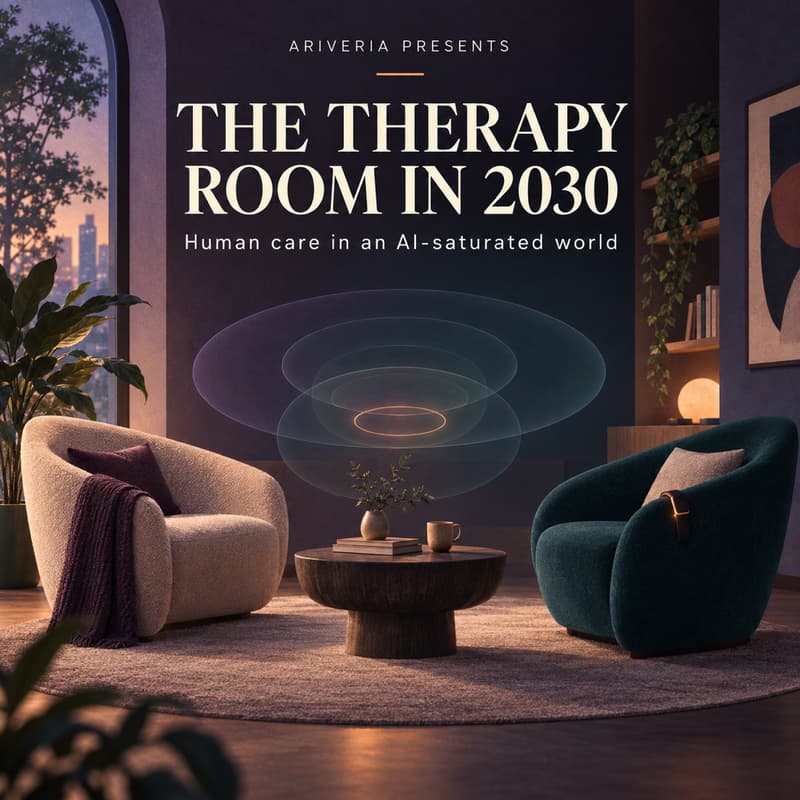
The Therapy Room in 2030: AI, Human Roles and the Future of Mental Health Care
Imagine that it is 2030.
Maya’s watch notices that she has slept badly, that her voice sounds different and that she has stopped taking her usual evening walk. She speaks to it on the way home. It remembers what happened before her last appointment, responds naturally and helps her put the week into words.
With her permission, the system prepares a summary for her therapist: recurring themes, behavioural patterns, possible risk signals and a suggested focus for the next session.
By the time Maya enters the therapy room, the technology has already influenced what was noticed, what was remembered, how the problem was described and what the practitioner sees first.
So who is the client now? What does the practitioner already know? Whose interpretation enters the room? What can be delegated, and what should remain distinctly human?
About the workshop
The Therapy Room in 2030 is a participatory, research-informed futures workshop for psychologists, counsellors, psychotherapists, clinical social workers, practice leaders and others working in mental health and wellbeing.
This is not a prediction exercise, a technical class or a product demonstration. We will use a plausible 2030 scenario to examine choices that professionals and organisations are beginning to face now.
Together, we will explore a future in which AI is conversational, multimodal and continuously available; moves across phones, watches, glasses, homes and healthcare systems; develops longer-term memory; and appears increasingly confident, empathic and knowledgeable.
We will ask what happens when clients use AI before, between and instead of professional care, and when practitioners receive AI-generated summaries, risk flags, recommendations and documentation.
What we will explore
How AI may change what the client brings into therapy and what the practitioner knows before a session begins
How the roles of client, practitioner, organisation and technology may need to be renegotiated
A 2030 reinterpretation of the seven-eyed model, with AI’s influence traced through the client, practitioner, relationship, supervision and wider system
Six emerging roles for AI: private personal tool, care-team member, professional assistant, monitored digital intervention, emotional companion and invisible everyday infrastructure
What should remain distinctly human when parts of care can be automated
How to design a future system that preserves agency, makes influence understandable and names the responsible human
What you will do
Participants will work with a fictional 2030 case, examine the system from several professional perspectives and design an ideal model of AI-supported care.
Your group will define:
What the system may do
What it must never do
What information it may observe, remember and share
What the person can correct, delete, pause or refuse
When responsibility must pass to a named human
How someone can leave the system and reach human help
What you will leave with
Participants will receive a practical eight-question discussion tool for evaluating future, and present-day, uses of AI in mental-health care. It can be used with a proposed tool, workflow, service or client scenario to make hidden assumptions and responsibilities easier to see.
Who should attend?
This workshop is intended for:
Psychologists
Counsellors and psychotherapists
Clinical social workers
Clinical supervisors
Clinic owners and practice leaders
Professionals working in mental health, wellbeing and digital care
No technical background is required. Whether you are interested, uncertain or sceptical about AI, you are welcome.
Facilitators: Ariveria Team
Nicholas Ng - Chief Executive Officer and Chief Product Designer
Nicholas leads Ariveria’s product direction and experience design, with a focus on how technology can support reflection while keeping agency, relationships and professional care at the centre.
Neil Gupta - Chief Technology Officer
Neil leads Ariveria’s engineering and technical architecture, including the responsible translation of emerging AI capabilities into practical user experiences.
Together, Nicholas and Neil bring a product-and-technology perspective to the opportunities, limitations and difficult design choices surrounding AI in mental-health care. They will facilitate the discussion rather than present themselves as clinical authorities.
About Ariveria
Ariveria is a Singapore-based mental-health technology team creating thoughtful tools and learning spaces for a changing mental-health landscape.
Its guided-reflection application is designed to support people between important conversations, including between professional sessions. Developed with input from mental-health professionals and informed by established psychological frameworks, Ariveria helps users capture events, reflect on their experiences and return to future conversations with greater clarity. It is intended to complement, not replace, professional care.