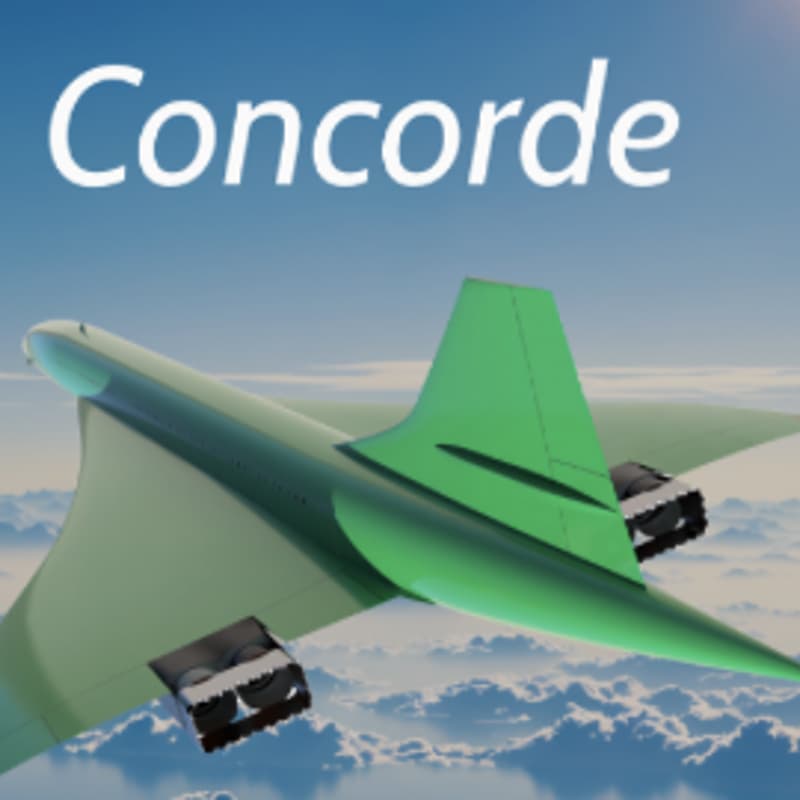
Fly high-Fly fast-Fly clean: The New SuperSonic Concorde, is the first green, & sustainable aircraft in the World.
The American Association of SuperSonic Aircraft Manufacturers and the Concorde corporation have jointly presented the Scientific case for Clean Sustainable Aviation for years, and now are sharing their combined intelligence with the World...
Concorde: First Supersonic Passenger Aircraft in the World to Return in 2029
\\
Kevin Derby, Aviation A2Z, June 26, 2025
WASHINGTON- The iconic Concorde is preparing to return to commercial skies by 2029, marking 60 years since its first historic flight.
Fly-Concorde Limited aims to relaunch supersonic passenger service from the United States under a groundbreaking aviation policy shift.
On June 6, 2025, at Washington Dulles International Airport (IAD), U.S. President Donald J. Trump signed the “Concorde Bill,” lifting the long-standing ban on supersonic flight over land. This regulatory reversal unlocks a new era of innovation in high-speed, sustainable air travel.
Photo: By Pedro Aragão – Gallery page https://www.jetphotos.com/photo/6199717Photo https://cdn.jetphotos.com/full/2/48102_1205412375.jpg, CC BY-SA 3.0, https://commons.wikimedia.org/w/index.php?curid=28990565
Concorde Supersonic Jet to Return by 2029
After decades of silence, Concorde is on track to become the world’s leading supersonic passenger aircraft once again.
The recently signed executive order clears regulatory airspace that had long blocked overland supersonic travel due to sonic boom and environmental concerns. The new legislation positions the U.S. as a leader in next-generation aerospace innovation and sustainability.
The new Concorde will remain true to its iconic silhouette but will be 50% lighter and use advanced composite materials and Sustainable Aviation Fuel (SAF), cutting emissions by 80%.
It will cruise at 75,000 feet, significantly higher than conventional commercial jets, while operating faster, quieter, and cleaner than the original.
The interior will reflect minimalist Japanese aesthetics, developed by leading sustainable architects. Every feature, from cabin design to propulsion systems, will incorporate cutting-edge aerospace technologies rooted in decades of research and development.
ALSO READ: Trump Lifts 52-Year Long Ban on Supersonic Flights in the US
Photo:- By Pedro Aragão – Gallery page http://www.airliners.net/photo/British Airways/Aerospatiale-British-Aerospace-Concorde/0695725/LPhoto http://cdn www.airliners.net/aviation-photos/photos/5/2/7/0695725.jpg, CC BY-SA 3.0, https://commons.wikimedia.org/w/index.php?curid=26974222
Leadership, Legacy, and Supersonic Breakthroughs
At the helm of this supersonic revival is Dr Pano Churchill, CEO and Founder of The Concorde Corporation, based in the City of Seattle, in the Washington state.
A triple PhD from Oxford and an expert physicist, Dr Churchill is credited with solving the long-standing sonic boom challenge. His patented Sonic Boom Suppression technology, granted in May 2025, enables Concorde to fly overland without disturbing ground-level communities.
Dr. Churchill is a direct descendant of Sir Winston Churchill, whose original Concorde initiative was launched as a post-World War II peace project. Now, his legacy continues through the rebirth of this aviation legend, targeted for launch on its 50th anniversary.
Patricia Bader-Johnston, Vice President and Chief Development Officer at Fly Concorde Limited, emphasizes the aircraft’s broader vision: “Concorde is set to become the global benchmark for sonic boom suppression and sustainability.”
Financial Innovation
Fly-Concorde is also innovating on the financial front. It has introduced Concorde Coin (CSSC), a stablecoin backed by Concorde’s aviation assets and operations.
With blockchain technology gaining global traction, CSSC is designed to attract investors aligned with futuristic, environmentally responsible air travel ventures.
This digital currency initiative aims to fund development while enabling broader engagement in Concorde’s mission. The move reflects growing synergy between aerospace advancement and decentralized finance.
Globally recognized as a pinnacle of aviation excellence, the Concorde brand is now valued at approximately $270 billion. The upcoming relaunch aims to restore its reputation as the epitome of luxury air travel, now aligned with modern values of environmental stewardship, digital innovation, and safety.
Photo: EnElAire
History of the Supersonic Era
The Old Concorde, was a joint marvel by British Airways (BA) and Air France (AF), revolutionized high-speed air travel with its supersonic performance. Operating primarily between London Heathrow (LHR), Paris Charles de Gaulle (CDG), and New York John F. Kennedy Airport (JFK), Concorde represented the peak of technological ambition in commercial aviation.
The aircraft’s inaugural transatlantic flight occurred on September 26, 1973, marking a new era of rapid travel. Despite initial global fascination, the Concorde’s commercial future was constrained by high operational costs, limited routes, and its eventual involvement in a fatal accident in 2000.
Birth of a Supersonic Dream
Concorde’s development began with the 1962 treaty between France and the UK, aiming to share the cost and innovation challenges of producing a supersonic transport (SST).
British Aerospace and Aérospatiale collaborated on the aircraft’s frame, while Rolls Royce and SNECMA developed its powerful Olympus 593 engines. This cooperation marked a defining moment in European aerospace engineering.
After its maiden flight on March 2, 1969, the Concorde entered commercial service on January 21, 1976. British Airways (BA) initially operated the London (LHR) to Bahrain route, and Air France (AF) flew from Paris (CDG) to Rio de Janeiro (GIG). Shortly after, both airlines launched regular services to Washington Dulles (IAD) and New York JFK (JFK), offering transatlantic flights in under three and a half hours.
Although capable of cruising at Mach 2.04 (2,179 km/h), the Concorde was never economically viable. Only 14 production aircraft entered commercial service, with persistent financial losses leading to route reductions until JFK remained the only regular destination. The aircraft’s sonic boom and high noise levels also restricted route expansion.
Photo: By clipperarctic – Tupolev TU-144, CC BY-SA 2.0,
https://commons.wikimedia.org/w/index.php?curid=28485878
Tupolev Tu-144, Copy of Concorde?
The Tupolev Tu-144, the world’s first supersonic transport (SST) aircraft, was a milestone in Soviet aerospace engineering. Designed by legendary aircraft designer Andrey N. Tupolev and his son Alexey, the Tu-144 symbolized the USSR’s ambition to lead in high-speed aviation during the Cold War era.
First flown in December 1968 and surpassing Mach 1 in June 1969, the Tu-144 predated Concorde’s first supersonic flight. It was publicly unveiled in Moscow in May 1970 and stood as a technological marvel with futuristic design elements and record-breaking performance.
Despite its technical achievements, the Tu-144’s career was marred by high-profile incidents. A tragic crash during a demonstration at the 1973 Paris Air Show raised early concerns. Though the aircraft began mail service on the Moscow–Alma-Ata route in 1975 and passenger service in 1978, another fatal crash that same year led to its commercial withdrawal.
Only 55 passenger flights were completed before Aeroflot ceased its SST operations. The aircraft’s high operating costs, limited range, and reliability issues made it commercially unsustainable.
While its commercial role was short-lived, later Tu-144 variants were used in experimental flight programs. Notably, in the 1990s, a modified Tu-144LL flew under a joint Russian-American program to advance next-generation supersonic transport technology.
Final Years and Grounding
On July 25, 2000, Air France Flight 4590 (AF4590), a Concorde departing from Paris Charles de Gaulle Airport (CDG) to New York JFK, crashed shortly after takeoff.
A burst tire punctured a fuel tank, igniting a fire that led to engine failure. The aircraft crashed into a nearby hotel in Gonesse, France, killing all 109 on board and 4 on the ground.
This tragedy, combined with growing maintenance costs and declining passenger numbers, marked the beginning of the end.
Air France retired its Concorde fleet in May 2003, and British Airways followed in October 2003, officially concluding the era of supersonic commercial aviation.
Stay tuned with us. Further, follow us on social media for the latest updates.
www.TheNewConcorde.com
www.Fly-Concorde.com
Also, please join us on LinkedIn groups, on X, and other Social, & Youtube Chanels, for tlatest SuperSonic Aviation Updates.
Subsequently, follow us on Google News