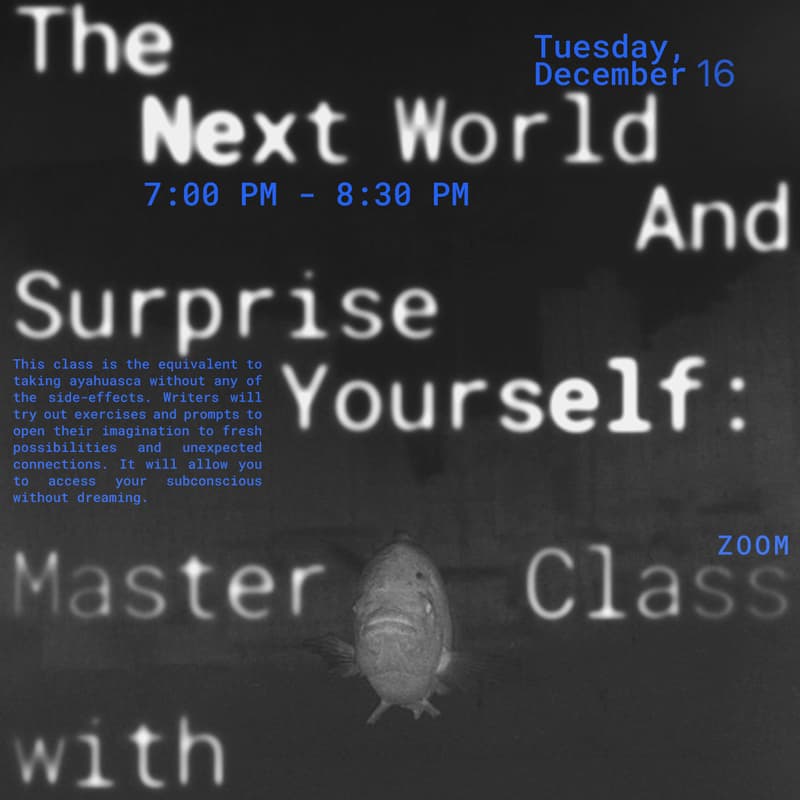

How to Write the Next Word and Surprise Yourself Part II: Master Class with John Yau
Due to popular demand, we've decided to create a second installment for the class! Please feel free to sign up, whether you are a returning student or not.
This class is the equivalent to taking ayahuasca without any of the side-effects. Writers will try out exercises and prompts to open their imagination to fresh possibilities and unexpected connections. It will allow you to access your subconscious without dreaming.
Participants should bring a laptop or tablet, as well as pen and paper.
John Yau, a poet, art critic, and curator, has published over 50 books of poetry, fiction, and art criticism. Born in Lynn, Massachusetts in 1950 to Chinese emigrants, Yau attended Bard College and earned an MFA from Brooklyn College in 1978. His first book of poetry, Crossing Canal Street, was published in 1976. Since then, he has won acclaim for his poetry’s attentiveness to visual culture and linguistic surface. In poems that frequently pun, trope, and play with the English language, Yau offers complicated, sometimes competing versions of the legacy of his dual heritages—as Chinese, American, poet, and artist. A contributor for Contemporary Poets wrote: “Yau’s poems [are] often as much a product of his visual sense of the world, as his awareness of his double heritage from both Oriental and Occidental cultures.” Yau’s many collections of poetry include Corpse and Mirror (1983), selected by John Ashbery for the National Poetry Series, Edificio Sayonara (1992), Forbidden Entries (1996), Borrowed Love Poems (2002), Ing Grish (2005), Paradiso Diaspora (2006), Exhibits (2010), and Further Adventures in Monochrome (2012). Yau’s work frequently explores, and exploits, the boundaries between poetry and prose, and his collections of stories and prose poetry include Hawaiian Cowboys (1994), My Symptoms (1998), and Forbidden Entries (1996).
Past Publications
Diary of Small Discontents
This collection brings together work from half a century of writing by John Yau. Preoccupied with forms and musical structures, Yau’s work includes sestinas, sonnets, pantoums, and lists, as well as invented forms. Employing both strict and open-ended frameworks, Yau creates multi-faceted poems that can shift abruptly from humor to outrage and consider topics including Chinese American identity, school shootings, invented countries, and haunted memories. Some poems are grounded in an autobiographical voice, while others take on the voices of other characters, including contemporary artists and a fictional Chinese private eye.
Further Adventures in Monochrome
John Yau's Further Adventures in Monochrome is an electric ride through a sophisticated funhouse of visual and sonic wonders. Like a painter who revels in the physicality of paint, Yau takes an artist's delight in words as words. In his serial poem "Genghis Chan: Private Eye," he evokes to bitingly humorous effect the voice of a hard-boiled detective novel as the poems range across cultural criticism and the act of seeing, while in his "Ideograms" he puts the visual space of the page to work, all while taking themes of ethnicity and identity into uncharted territory.
Borrowed Love Poems
If the "I" cannot be representative, what or who can it represent? In John Yau's new collection, Borrowed Love Poems, the reader encounters artists (Hiroshige and Eva Hesse), poets (Marina Tsvetayeva and Georg Trakl), actors (Boris Karloff and Peter Lorre), and memorable figures (a retired wrestler and a private eye named Genghis Chan). Each becomes a spectral, sonorous presence inhabiting the polymorphic body of the page, a shadow of a shadow lit from within. Yau's poems are dazzling explorations of the multiple, shifting sands of identity, of the fictional, fake, factual, and autobiographical selves that pass like ghosts through the empty space known as "I." Able to seamlessly merge a strict yet eccentric methodology with wild flights of the imagination, Yau moves into a rich, complex realm, where the flickering edges of consciousness-the dream state-become poetry.