
Applied Frontier #2: TBD | Frontier Labs
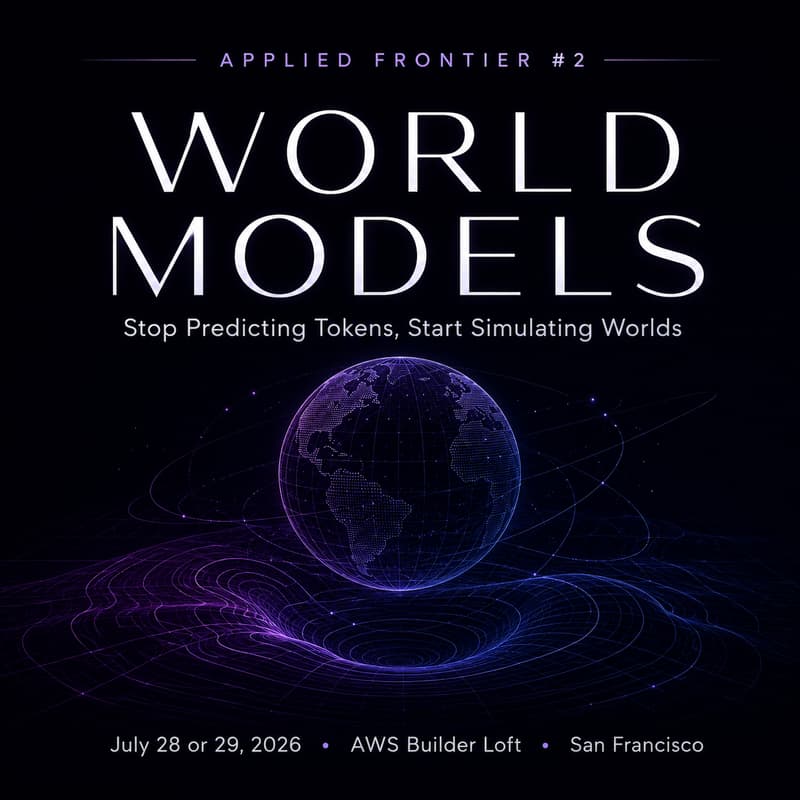
Applied Frontier #2: World Models
Stop Predicting Tokens, Start Simulating Worlds
Applied Frontier is an intimate technical gathering for builders, researchers, founders, and engineers working at the edge of AI systems.
The second edition goes deep on World Models, the shift from AI systems that predict the next token to AI systems that learn an internal model of reality, then use that model to predict, plan, and act.
For the last three years, the frontier has been dominated by language. Models learned the world through text, images, video, and human description. They could describe a falling glass, but they did not truly understand what happens when it tips past its center of mass. They could generate a room, but they could not reliably simulate what changes when an agent moves through it.
That gap is now becoming the main event.
Fei-Fei Li has called spatial intelligence one of AI’s next frontiers. Yann LeCun has argued that next-token prediction alone is not enough, and that the missing piece is a model of the world that can be run forward to support planning.
Across the field, the question is becoming sharper:
Can we build models that do not just describe reality, but simulate it?
A world model is a learned simulator. Give it a state and an action, and it predicts what happens next. Some world models create interactive environments you can walk through. Some help robots reason about physical consequences. Some generate synthetic worlds for training and evaluation. Some predict abstract future states instead of rendering every pixel.
The core question is not whether these systems look impressive.
The question is whether they are useful when an agent has to act.
What We’ll Discuss
The four bets on one frontier
We will compare the major directions emerging in world models: interactive simulation, spatial intelligence, predictive representation learning, and physical AI infrastructure.
This includes systems like DeepMind’s Genie 3, Decart’s real-time world models, World Labs’ Marble, Meta’s V-JEPA, and NVIDIA Cosmos.
Each is making a different bet about what it means to model the world, what should be generated, what should be predicted, and what is actually useful for agents.
Generative vs. predictive world models
One camp generates the future in pixels and bets that realism will lead to understanding.
Another predicts abstract latent state, arguing that most pixel detail is irrelevant for planning and control.
That choice changes everything downstream: training data, evaluation, compute, memory, action conditioning, coherence, and whether the model can actually support decision making.
From watching to acting
A world model earns its name when an agent can plan against it.
We will discuss what it takes to move from passive video generation to action-conditioned simulation, from beautiful rollouts to useful counterfactuals, and from “this looks real” to “this helps an agent choose the right action.”
Worlds as infrastructure
World models are becoming infrastructure for robotics, self-driving, embodied agents, games, synthetic data, and closed-loop testing.
We will talk about scenario generation, coverage, long-tail events, digital twins, robot training, simulation-based evaluation, and the stubborn sim-to-real gap that still breaks the best demos.
Where world models leak
World models often fail in subtle ways.
Physics can look right while being wrong. Object permanence can drift. Long-horizon coherence can collapse. Agents can exploit simulator errors. Visual realism can hide causal nonsense.
The deeper question is still open:
Are these systems learning the structure of the world, or are they predicting pixels well enough to fool us?
Who This Is For
This is for a limited group of deeply technical people actively building, researching, or seriously exploring world models and physical AI.
You should come if you are working in AI engineering, video generation, robotics, reinforcement learning, simulation, 3D, graphics, embodied agents, synthetic data, autonomous systems, or infrastructure for evaluating AI in closed-loop environments.
Come with something real: a model you are building, a sim-to-real failure, an evaluation problem, a robotics story, a synthetic data pipeline, a hard research question, or a strong opinion about where the field is wrong.
How This Works
This is not a networking meetup.
Applied Frontier is designed as a high-signal technical discussion with a small group of serious builders. The goal is to reason together, challenge assumptions, compare architectures, and surface the problems that do not show up in polished demos.
Expect a focused room, technical conversation, and direct discussion around what is working, what is breaking, and what needs to exist next.
Why It Matters
Language models learned the world secondhand, through what humans wrote, labeled, recorded, and uploaded.
World models try to learn it more directly, through observation, interaction, prediction, and simulation.
That shift matters because the next generation of AI systems will not only answer questions. They will move through environments, operate machines, control software, drive robots, test decisions, and plan under uncertainty.
Two models can be trained on the same footage and appear equally impressive in a demo. One may learn enough structure to support planning. The other may only learn to render plausible frames.
The demo may not know the difference.
The engineer does.
Event Details
Date: Tuesday, July 28 or Wednesday, July 29, 2026
Time: 5:30 PM to 8:30 PM
Location: AWS Builder Loft, 525 Market St, 2nd Floor, San Francisco, CA 94105
Format: Technical discussion and small group builder exchange
Capacity: Limited
Access: Advance registration required. Attendees should bring a valid physical photo ID for check-in.