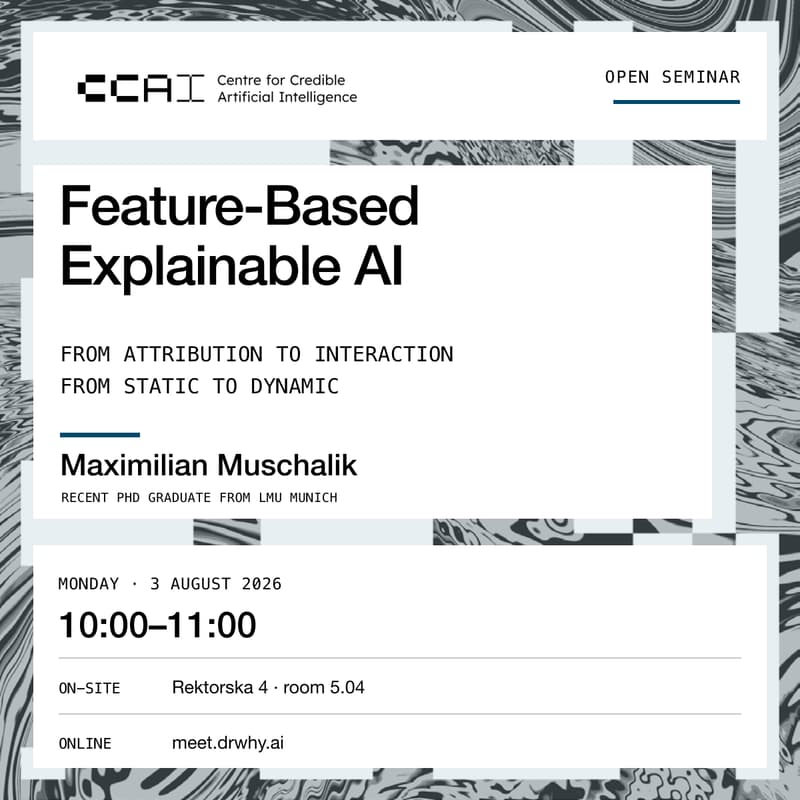
Open Interpretability Seminar: Maximilian Muschalik
Title: Feature-Based Explainable AI: From Attribution to Interaction, From Static to Dynamic
Bio: Maximilian Muschalik recently completed his PhD in Machine Learning and Artificial Intelligence at LMU Munich, supervised by Prof. Dr. Eyke Hüllermeier as part of the interdisciplinary TRR 318 project "Constructing Explainability." His research focuses on explainable AI, with particular emphasis on Shapley values, Shapley interactions, and explaining model change in dynamic environments. He is the creator and maintainer of shapiq, a widely used Python framework for feature attribution and interaction, and his work has appeared at leading machine learning venues such as NeurIPS, ICML, ICLR and others.
Abstract:
The increasing complexity of modern machine learning models poses significant challenges for their transparency and accountability. Explainable artificial intelligence (XAI) seeks to make black-box models understandable to human users, and among its approaches, feature-based explanation methods play a central role by relating a model's prediction back to its inputs. Attribution techniques, most prominently Shapley values, quantify the contribution of individual features and are grounded in strong theoretical foundations. Yet with advanced deep learning models such as multi-modal architectures, explanations limited to single features often fail to capture the complex mechanisms driving predictions, many of which arise from interactions among features. Shapley interactions generalize the classical attribution framework to higher orders, offering a flexible trade-off between faithfulness and complexity, but their use is limited by severe computational challenges. At the same time, most existing XAI techniques implicitly assume static models trained once on fixed data. In many real-world scenarios, data arrives sequentially as continuous streams and models are trained incrementally, so traditional explanations quickly become outdated and misaligned with current model behavior. Explanation methods must therefore update alongside incremental models in data stream environments.
This talk covers recent work that advances feature-based explainability along both dimensions. The first part moves from attribution to interaction, introducing SHAP-IQ for approximating any-order Shapley interactions, along with model-specific algorithms TreeSHAP-IQ and GraphSHAP-IQ that compute exact Shapley interactions by leveraging structural properties of tree-based models and graph neural networks, all consolidated in the unified software library shapiq. The second part shifts from static to dynamic explanations, presenting iSAGE and iPDP, which incrementally maintain global feature importance scores and feature effect estimates for models operating on evolving data streams. Together, these methods provide both theoretical advances and practical tools for faithful, flexible, and efficient feature-based explanations, extending the scope of XAI from attribution to interaction and from static to dynamic.