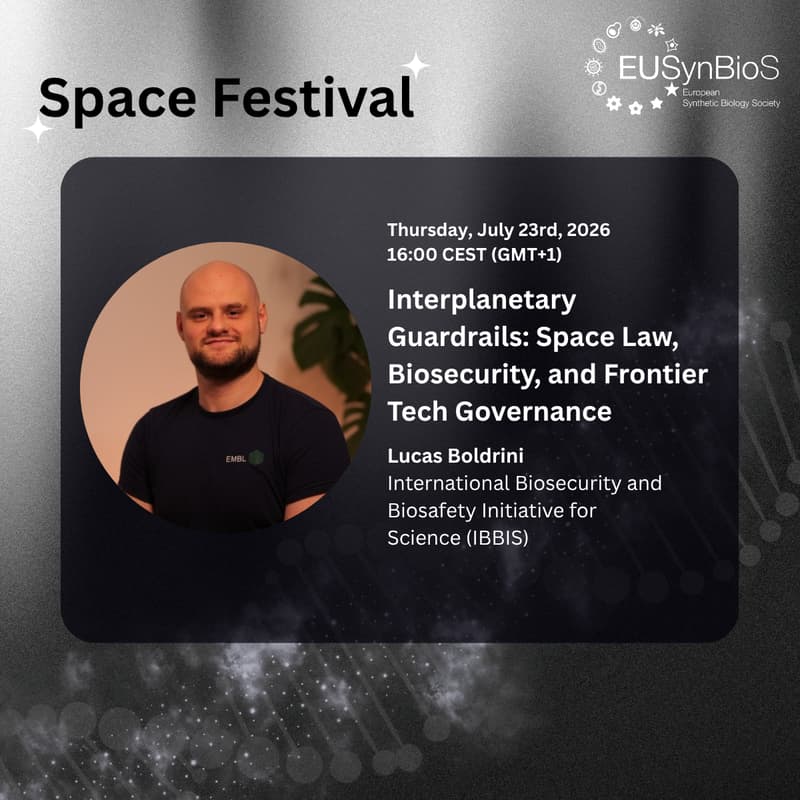

Interplanetary Guardrails: Space Law, Biosecurity, and Frontier Tech Governance
What happens if an engineered microbe mutates unpredictably under cosmic radiation? How do we prevent Earth-born biological contamination on Mars, or protect Earth from extraterrestrial samples? As private companies and global nations race to synthesise biology for the high frontier, the risk of dual-use biological hazards moving off-planet increases exponentially. Without international guardrails, the interplanetary bioeconomy could quickly become a wild west.
Welcome to the closing session of Week 4 — Cosmic Governance: Generative AI & Interplanetary Biosecurity.
Join us for an indispensable, high-level briefing titled "Interplanetary Guardrails: Space Law, Biosecurity, and Frontier Tech Governance," featuring Lucas Boldrini, Technical Consultant at the International Biosecurity and Biosafety Initiative for Science (IBBIS).
Lucas operates at the absolute centre of this global challenge. Drawing from his unique trajectory, from launching stratospheric biology probes to representing synthetic biology at the United Nations Committee on the Peaceful Uses of Outer Space (COPUOS), he will break down how international space law and planetary protection protocols must evolve. Lucas will reveal the inner workings of modern biosecurity frameworks, showing how tools like IBBIS’s "Common Mechanism" software screen DNA synthesis globally to stop hazardous genetic materials before they ever reach a lab, or a launchpad.
What you’ll learn:
SynBio at the UN: Inside the diplomatic and regulatory battles at COPUOS to establish rules for the responsible use of genetic engineering beyond Earth.
The DNA Firewall: How open-access screening software dynamically identifies potentially dangerous genetic sequences and enforces digital biosecurity guardrails.
Near-Space Testing: Lessons from designing high-altitude stratospheric probes to test biological payloads under extreme near-space conditions.
Planetary Protection: The legal and biological frameworks required to safely manage commercial space exploration and dual-use deep technologies in orbit.
Whether you are a deep-tech founder navigating international compliance, a synthetic biologist, or an aerospace policy enthusiast, this session will show you how we protect both Earth and the cosmos as biology goes interstellar.
🎤About the speaker
Lucas Boldrini - Technical Consultant, IBBIS & Founder, iGEM Space Initiative
Lucas Boldrini is a biotechnologist, space operations specialist, and global biosecurity expert. Armed with a Master’s degree in Multidisciplinary Research from the Barcelona Institute of Science and Technology (BIST) and a degree in Biotechnology from UFSCar, Lucas serves as a Technical Consultant at the International Biosecurity and Biosafety Initiative for Science (IBBIS) in Paris. At IBBIS, he drives dual-use governance and leads key components of the Common Mechanism, a global, open-access software tool used to screen DNA synthesis and flag hazardous genetic threats.
Lucas’s extensive leadership in space biology includes a nearly three-year tenure as Team Experience Manager at the iGEM Foundation, where he oversaw operations for 9,000+ global participants and founded the iGEM Space Initiative. In this role, he formally represented iGEM at the United Nations (COPUOS), delivering statements on off-world biological responsibility, while managing strategic collaborations with NASA, ESA, CNES, and DLR. His background also includes paleogenetics research, neurobiology publications in Scientific Reports, and serving as Scientific Coordinator for Zenith Aerospace, where he managed the assembly and recovery of seven high-altitude stratospheric probe missions.