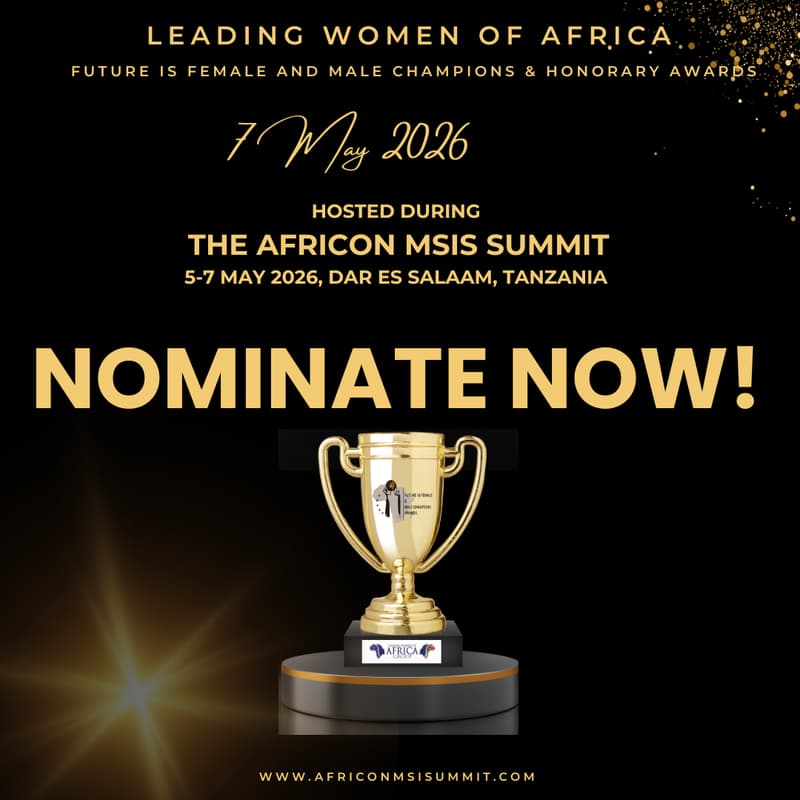

NOMINATE NOW: The Future Is Female, Male Champions & Honorary Awards, Tanzania 2026 - Nomination Form
NOMINATE
Do you know a woman, man or institution promoting gender equality in Africa?
Are you a beneficiary of programmes initiated by a visionary woman or man within your country, company or community?
Leading Women of Africa (LWA) invite you nominate an visionary woman, man or institution that is actively promoting gender equality as an important key in a solid foundation in the Africa we want.
TIMELINE
PLEASE NOTE: This is a self-funded Distinguished Awards. While nominees are not required to pay any fee to attend the Awards Ceremony, each nominee is required to cover her/his own travel costs.
Thank you for your decision to nominate well-deserved leaders for these Awards.
ABOUT THE LWA AWARDS
1. LWA Future is Female Awards
Celebrating women leaders who demonstrate exceptional leadership, resilience, and impact in advancing women’s empowerment and Africa’s socio-economic development through collaboration, innovation, and systemic change.
2. LWA Men Champions Awards
Established in 2015 and endorsed by the late Dr. Kenneth Kaunda, former President of Zambia and Patron of LWA, these awards recognise male leaders who have demonstrated sustained commitment to recognising women as equal partners in political, social, and economic development.
“The 21st century is the time for men to look at women as equal partners in political, social and economic development.” — Dr. Kenneth Kaunda
A. COMPETING AWARDS CATEGORIES
The LWA Future is Female & Men Champions Awards recognise both individuals and institutions whose leadership, policies, and practices have demonstrably advanced women’s empowerment, gender equality, and inclusive development.
I. PUBLIC SECTOR CATEGORY (INDIVIDUAL & INSTITUTION)
1. Most Gender-Focused Head of State Prime Minister Speaker of Parliament
(1 Female | 1 Male)
Description:
Recognises national leaders who have demonstrated exceptional political will and leadership in advancing gender equality through governance, policy reform, and institutional transformation.
Assessment Criteria:
Representation of women in Cabinet, Parliament, and senior public service
Allocation of strategic portfolios and decision-making authority to women
Gender-responsive budgeting and national gender policies
Public sector employment equity
Procurement and economic inclusion of women-owned enterprises
Advocacy for women’s rights and protection mechanisms
2. Most Gender-Focused Minister Governor Mayor
(1 Female | 1 Male)
Assessment Criteria:
Gender-responsive policies and programmes within their portfolio
Measurable impact on women at national or sub-national level
Budget prioritisation for women-focused initiatives
Institutional reforms advancing women’s participation
3. Most Gender-Focused Public Institution
(National, Regional or Local Government Institution)
Description:
Recognises a public institution that has embedded gender equality into its policies, leadership structures, operations, and service delivery.
Assessment Criteria:
Existence and implementation of a Gender Equality Policy & Action Plan
Women’s representation in senior leadership and decision-making roles
Gender-responsive budgeting and reporting
Procurement from women-owned enterprises
Impact of institutional programmes on women and girls
Monitoring, evaluation, and accountability mechanisms
II. CORPORATE SECTOR CATEGORY (INDIVIDUAL & INSTITUTION)
1. Most Gender-Focused CEO / Chairperson
(1 Female | 1 Male)
Assessment Criteria:
Women on boards and executive committees
Leadership pipeline and succession planning for women
Workplace equity, parental policies, and inclusion frameworks
Enterprise and supplier development focused on women
Measurable social and economic impact
2. Most Gender-Focused Head of Procurement
(1 Female | 1 Male)
Assessment Criteria:
Percentage of spend directed to women-owned enterprises
Supplier development and capacity-building initiatives
Sustainability of gender-responsive procurement strategies
3. Most Gender-Focused Head of Corporate Social Investment (CSI)
(1 Female | 1 Male)
Assessment Criteria:
Percentage of CSI budget allocated to women-focused programmes
Scale, sustainability, and reach of funded initiatives
Community-level transformation outcomes
4. Most Gender-Focused Corporate Institution
(Private Sector Company or State-Owned Enterprise)
Description:
Recognises a corporate institution that has demonstrated systemic commitment to gender equality across governance, operations, supply chains, and community investment.
Assessment Criteria:
Gender diversity at board and executive levels
Gender-responsive HR and workplace policies
Procurement from women-owned businesses
Enterprise and supplier development programmes for women
Transparent reporting on gender impact
Long-term sustainability of initiatives
III. CIVIL SOCIETY CATEGORY (INDIVIDUAL & INSTITUTION)
1. Women’s Rights Advocate of the Year
(1 Female | 1 Male)
Assessment Criteria:
Policy influence and legislative advocacy
Public awareness and mobilisation
Protection and empowerment of women and girls
Sustainability and scale of impact
2. Humanitarian Excellence Award
(1 Female | 1 Male)
Assessment Criteria:
Impact in GBV prevention, health, education, or humanitarian response
Innovation and reach of interventions
Systems change and long-term outcomes
3. Most Gender-Focused Civil Society Organisation
(NGO, Foundation, or Development Organisation)
Description:
Recognises a civil society institution whose programmes, advocacy, and partnerships have delivered measurable and sustainable outcomes for women and girls.
Assessment Criteria:
Strategic focus on women’s empowerment
Programme reach and measurable impact
Policy influence and advocacy outcomes
Institutional sustainability and governance
Partnerships with government and private sector
IV. ENTREPRENEURSHIP & YOUTH (INDIVIDUAL)
1. Most Gender-Focused Entrepreneur
(1 Female | 1 Male)
Assessment Criteria:
Women in ownership, leadership, and workforce
Investment in women-owned enterprises
Skills development, mentorship, and job creation
Community socio-economic impact
2. Most Influential African Youth Leader
(1 Female | 1 Male)
Assessment Criteria:
Leadership innovation and influence
Impact on women and youth
Advocacy and social transformation
B. HONORARY (NON-COMPETING) AWARDS
The Honorary Awards are conferred by Leading Women of Africa (LWA) in recognition of exceptional leadership, legacy, and strategic contribution to advancing gender equality, inclusive development, and Africa’s transformation agenda.
These awards are by invitation and selection only and are not subject to public nomination or competition.
Each Honorary Awardee will receive a bespoke citation reflecting their unique contribution and legacy.
1. African Individual Honorary Award
Description:
This award recognises an African leader whose vision, leadership, and sustained contribution have significantly advanced gender equality, governance reform, peace and security, education, economic inclusion, or social transformation on the continent.
Eligible Recipients May Include:
Heads of State or Government
Former Heads of State or Government
Senior public servants or policymakers
Traditional leaders
Distinguished business leaders
Renowned advocates or thought leaders
Selection Considerations:
Demonstrated long-term commitment to women’s empowerment
Influence on policy, institutions, or national development outcomes
Legacy impact beyond a single programme or term of office
Alignment with AU Agenda 2063 and SDGs
Ethical leadership and public credibility
2. African Institutional Honorary Award
Description:
This award recognises an African institution that has demonstrated systemic, sustained, and measurable commitment to advancing women’s empowerment and gender equality through policy, practice, and institutional culture.
Eligible Institutions May Include:
Government ministries, agencies, or authorities
Regional or continental African institutions
Public entities or state-owned enterprises
African private sector institutions
African foundations or development organisations
Selection Considerations:
Institutionalisation of gender equality (policies, structures, budgets)
Women’s representation in leadership and decision-making
Long-term impact on women and communities
Accountability, transparency, and sustainability
Replicable models of institutional best practice
3. International Individual Honorary Award
Description:
This award recognises a global leader or international personality whose leadership, advocacy, or philanthropy has made a significant and sustained contribution to advancing gender equality and development in Africa.
Eligible Recipients May Include:
International statespersons or former leaders
Global philanthropists
Multilateral or international organisation leaders
Global advocates for women’s empowerment
Selection Considerations:
Depth and consistency of engagement with Africa
Tangible outcomes for women and girls
Respect for African ownership and partnership
Ethical, inclusive, and impact-driven leadership
Contribution to long-term systemic change
4. International Institutional Honorary Award
Description:
This award recognises an international institution whose work in Africa has delivered measurable, transformative, and sustainable outcomes for women’s empowerment and gender equality.
Eligible Institutions May Include:
Multilateral organisations
Bilateral development agencies
International foundations
Global development or humanitarian institutions
Selection Considerations:
Integration of gender equality into institutional strategy
Scale and sustainability of impact in Africa
Partnerships with African governments and institutions
Accountability, learning, and reporting mechanisms
Contribution to systemic and policy-level change
JUDGING & GOVERNANCE
Competing categories
Independent, multi-sectoral judging panel
Transparent scoring system
Judges’ decision is final
LWA reserves the right not to award a category
Honorary categories
· Honorary Awardees are selected by Leading Women of Africa, in consultation with its Advisory Council and partners
· No application or nomination fees apply
· Awards are conferred at the AFRICON 2026 Awards Ceremony
· Each award is accompanied by a customised citation reflecting the recipient’s unique contribution and legacy
BENEFITS OF PARTICIPATION
Continental and international recognition
Enhanced national, institutional, and corporate profile
Strengthened partnerships and visibility
Contribution to Africa’s gender and development agenda
CONFIDENTIALITY & ETHICS
All submissions treated as confidential.
No sponsor or LWA contractor eligible for nomination.