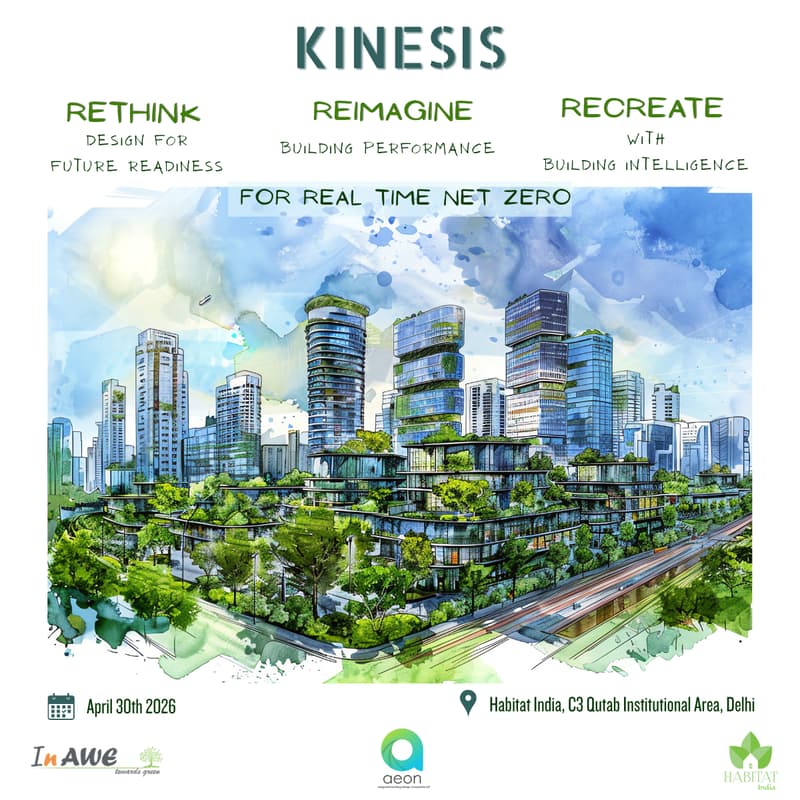
KINESIS
KINESIS
Can Buildings Achieve “Real Time Net Zero” ?
How do we “Move the Needle” for the clean transition?
Can we “Reimagine Building Performance” !
Can we “Rethink Design” for Future Readiness !
Can we “Recreate with Building Intelligence” !
The Challenge - Redefining Performance
Demystifying Building Performance Standards and shifting the focus from design intent to actual, measurable impact in our Built Environments.
The Challenge of our Times – The Gigaton Burden
We are no longer preparing for a changing climate; we are already living in it. The past 11 years (2015–2025) officially rank as the warmest period on record, 2024 taking the title as the single hottest year ever recorded.
The Indian context - Operational Emissions from Buildings
Buildings already account for 35% of the nation's total energy use, with operational emissions now constituting 70% of a building's lifecycle carbon footprint.
According to NITI Aayog’s 2026 insights, 86% of the building stock that India will have in 2070 is yet to be built. We aren't just building for today; we are locking in energy consumption patterns for the next 50 years.
BAU - This "lock-in" of inefficient infrastructure could contribute to potential GDP loss of up to 24.7% by 2070 due to climate risks.
Severe heatwaves are expected to increase 30-fold by the end of the century. Without intervention, cooling will drive 50% of peak electricity demand growth by 2030.
The Operational Carbon Footprint of Buildings
Moving the focus from preliminary design intent to actual, measurable performance over an asset's lifecycle.
Why do we continue to design buildings purely for static compliance ?
When do we make buildings perform to achieve REAL time NET ZERO ?
If there are disconnects between predicted outcomes on paper and operational data in practice, can these be resolved through real time monitoring and automated action.
The Way Forward
To prevent our assets from becoming stranded liabilities, we must treat "Sustainability as a Strategy" (SAAS) not just as good intent, but as a driver of operational efficiency and economic savings.
About the Session
This session explores the crucial role of Building Performance Standards in bridging the gap between Net Zero metrics and operational reality. It brings together distinct perspectives across design, policy, and facility management to understand how buildings can be designed, operated, and actively monitored to meet evolving performance benchmarks over time.
What to expect:
● Decoding BPS: Understanding Building Performance Standards and their role in broader climate and Net Zero goals.
● The Profit Logic of Performance: Shifting from design-based compliance to performance-based accountability that drives ROI.
● Data-Backed Operations: The importance of continuous monitoring, real-time data, and systems benchmarking.
● Breaking Silos: Aligning design, operations, and long-term maintenance for sustained, high-impact performance.
● Granular Metrics: Integrating occupancy, energy consumption, and operational carbon metrics into daily decision-making.
An exclusive session with the different stakeholders in the Built Environs, and we look forward to hosting change makers, leaders and the strategists catalysing the Net Zero transition.
You're invited!
A deep dive into operationalizing Net Zero buildings, ensuring they perform for achieving the Net Zero goals.
Location:
Habitat India, C 3 Qutab Institutional Area, New Delhi
Time: Thursday, April 30th, 4pm - 6pm
Register: