
GEO for Travel: How to Show Up in ChatGPT and AI Overviews
According to Semrush, AI Overviews now appear for 88% of the commercial keywords it tracks in Google, and, by some estimates, about one in six search queries now goes to a chatbot (ChatGPT first) instead of Google. The conclusion is simple: if you are not in LLM answers, you are missing customers.
For travel websites and services that have always relied heavily on SEO and organic traffic, this is a game-changer. How can they adapt to the new reality, and what should a GEO strategy for travel look like:
How to measure your brand’s presence in AI answers: the methodology, and why it’s harder than it looks
GEO market myths and fairy tales: what not to spend money on
What you can do to influence AI answers, and which of those options are right for you
How to run content on your own channels and in third-party media
How to understand whether your actions worked or it’s just noise
Travel-industry case studies: what actually worked to improve visibility in AI answers
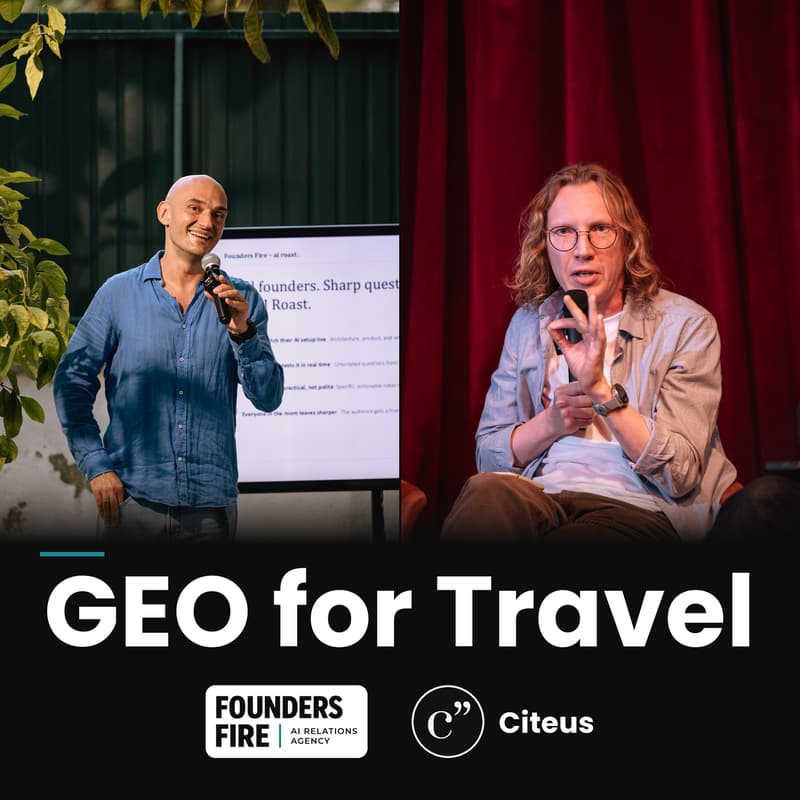
We will discuss it in our webinar with two experts who have hands-on experience in GEO for the travel industry.
Vitaly Gradoboev, co-founder of Citeus. Vitaly advocates for a higher standard of evidence in GEO, both in measurement and in optimization. Citeus draws on the best research available today to bring an evidence-based approach to GEO. The team uses special sandboxes to test GEO tactics before rolling them out. This is especially relevant for big websites that have already invested heavily in SEO, where GEO experiments are hard and costly. Vitaly and Citeus have deep, hands-on expertise in GEO for travel.
Vsevolod Belchenko, founder of the GEO agency Founders Fire, PR pro and former journalist. GEO is largely about content, storytelling and positioning. In short, it is about having the right message and amplifying it through different content channels. His expertise is highly relevant for the travel industry, where many players need to reinvent their positioning and then communicate it consistently, for both humans and LLMs.