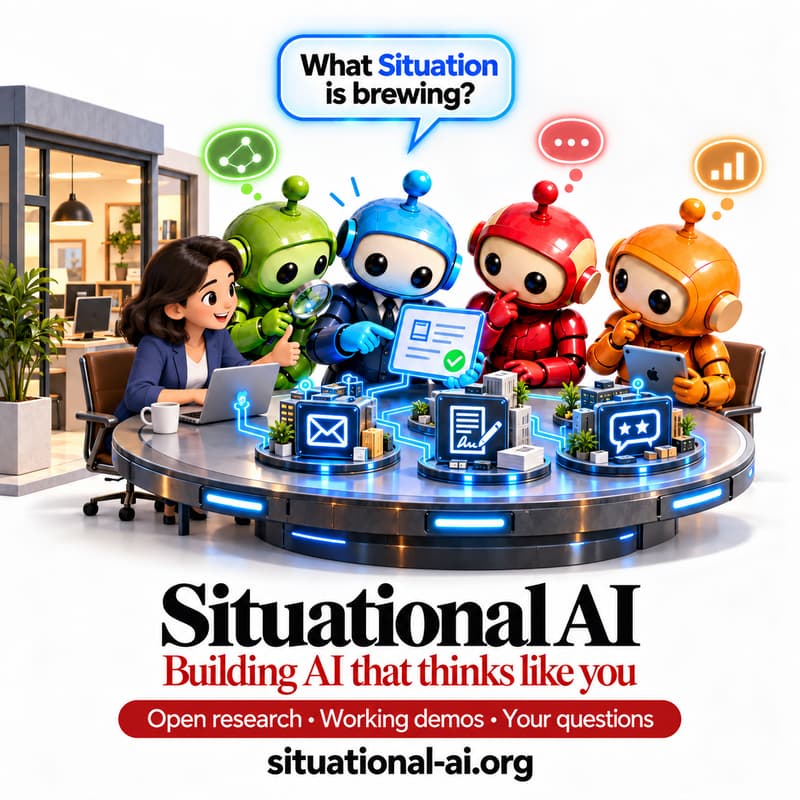
Situational AI Open Research & Technology Forum
Situational AI: The World Does Not Arrive as Prompts
An Open Research & Technology Forum
AI has become remarkably good at reasoning once it is told what problem to solve.
But the real world doesn't arrive as prompts.
A customer becomes frustrated. A payment fails. A project begins slipping. A supplier misses a commitment. A conversation changes direction. An opportunity appears.
Before an intelligent system can decide what to do, it has to recognize what situation is emerging, why it matters, to whom it matters, and what the moment calls for.
This is the question behind Situational AI.
It Started as a Hypothesis
Over the past year, Mindspace AI has been exploring a simple but potentially important idea:
What if “situation” becomes a first-class computational primitive for intelligent systems?
Instead of requiring every intelligent action to begin with a human prompt, could an AI system continuously:
Recognize → Interpret → Reason → Act → Observe → Learn?
Could it recognize situations as they emerge from events, conversations, state, history, goals and responsibilities?
Could situations be represented, compared and remembered?
Could explicit situation recognition reduce the amount of context an AI system needs?
Could it help smaller models become more capable?
Could an AI system learn not merely from information, but from situations it has encountered and the outcomes of its responses?
We don't claim to have all the answers.
That's why we're opening the work.
From an Idea to Five Student Explorations
This summer, five UT Dallas students had the opportunity to explore different aspects of Situational AI through an engagement initiated by Mindspace AI.
On October 22, they will share what they investigated, questioned and built.
Krishang Reddy Mandala will examine the evolution of Situational AI, compare it with related approaches, and explore its relationship to established work on Situation Awareness, including Mica Endsley's model.
Sabareesh Dinakaran will explore a computational question: if a system can explicitly recognize its situation, could that reduce repeated context and prompt requirements—and potentially make smaller AI models more useful?
Sai Jagadish Manchikanti will demonstrate RiskPulse, an application incorporating Situational AI concepts into identifying and responding to emerging risk situations.
Yuvan Muruganatham will demonstrate another working application exploring how situation-centric intelligence can be incorporated into real systems.
Avani Thripati will host the evening and share the student perspective on the exploration.
These are not demonstrations intended to prove a finished theory. They are early experiments intended to help us ask better questions.
From Research to Real AI Coworkers
Mindspace AI CEO & Co-Founder Prasad Pillai will introduce the Situational AI hypothesis and demonstrate how these ideas are being explored in BotsWork, where AI coworkers must operate continuously across real business activities rather than simply wait for the next prompt.
The evening will move from:
The Hypothesis → The Foundations → The Computation → The Experiments → The Real World
An Open Invitation
Situational AI is being opened as a research program—not presented as a finished answer.
We invite researchers, faculty, students, AI engineers, entrepreneurs, business and operations leaders, and anyone interested in the future of intelligent systems to participate.
Come to understand it.
Come to question it.
Come to challenge it.
Come to build on it.
PROVE IT. DISPROVE IT. BUILD IT. IMPROVE IT.
Bring a question.
Bring an experiment.
Bring a real-world situation.
October 22, 2026
Crow Museum of Asian Art
The University of Texas at Dallas
Edith and Peter O'Donnell Jr. Athenaeum
Presented by Mindspace AI
Research · Student Explorations · Live Demonstrations · Open Discussion · Networking
Learn more about the research at situational-ai.org