REFLECT PRACTICE REFLECT 1 - Articulating positionality: the invisible labour of access in academic writing
Writing for academic publication can be an important way to develop one’s creative practice and research, yet rigid expectations and opaque processes can set out barriers to exploring and engaging with writing for journals. These barriers, when recognised, addressed and redefined can become productive sites for potential experimentation and growth. In this workshop, Martine will explore examples from her own practice as well as other writers and artists, leading a discussion on the importance of reframing how we view the relationship between access and academic writing.
Facilitator: Dr Martine Rouleau, producer, researcher, curator, and project manager working with the Decolonising Arts Institute at the University of the Arts, London (DeAI)
Free to attend, but registration is required.
Please email the team at decolonisingartsinstitute@arts.ac.uk if you have questions about access.
REFLECT PRACTICE REFLECT, 21 May - 4 June
This session is part of the REFLECT PRACTICE REFLECT online workshop series facilitated the Decolonising Arts Institute at the University of the Arts, London (DeAI) and taking place at 12-1pm GMT on the following Thursdays:
21 May 'Articulating positionality: the invisible labour of access in academic writing' with Dr Martine Rouleau
28 May 'The occluded practice of peer review' with Dr Victoria Odeniyi
REFLECT PRACTICE REFLECT is part of BREAKING THROUGH: Support for global majority researchers and creative practitioners navigating the journey to scholarly publication, a programme co-organised by the UAL Decolonising Arts Institute (DeAI) and the Feminist Review Collective hosting weekly online workshops from 30 April to 5 June 2026. All events are free to attend, but registration is required.
Click here for the full programme and links to register.
CONTRIBUTORS
Dr Martine Rouleau is a producer, researcher, curator, and project manager working with the Decolonising Arts Institute at the University of the Arts, London. She works with artists, museums and galleries in the UK to develop and deliver practice-based research and public engagement partnerships, displays and exhibitions, including research output. Her curatorial research and practice focus on the development of artists, the structures of art education in and out of formal settings, and the collaborative, interdisciplinary processes that reflect, mediate and question art education. She completed a PhD in 2008 at the London Consortium with a thesis entitled ‘Challenging the parergon: How public art institutions negotiate their boundaries’ Previously, she did an MA in Semiotics and Photography, and a BA in Education.
The UAL Decolonising Arts Institute (DeAI) seeks to challenge imperial legacies, ongoing colonial violence, and disrupting ways of seeing, listening, thinking, and making to drive cultural, social and institutional change. We imagine the Institute as a decentred, disruptive, evolving and porous space. As the Institute evolves, we aim to amplify local and global movements to decolonise and address the complex genealogies and geographies of postcolonial, decolonial and intersectional thinking and practice.
The Feminist Review Collective edits and publishes Feminist Review, a pioneering interdisciplinary journal that explores gender in its multiple forms and interrelationships with other social categories and systems of power, publishing accessible knowledge and timely interventions that build on the work of Black, Indigenous, decolonial, and transnational feminist struggles. Publishing since 1979, Feminist Review has a global editorial board and readership, and currently prints and distributes in partnership with Sage Publications Ltd. The Feminist Review Collective is committed to inspiring exchanges of ideas and explorations of praxis that address, disrupt, and break through structural violence to make and nurture communities, connections, and ways of sharing knowledge founded on mutual respect, kindness, and care. We are committed to building, living, and extending a space of radical feminist practice that places care at its heart.
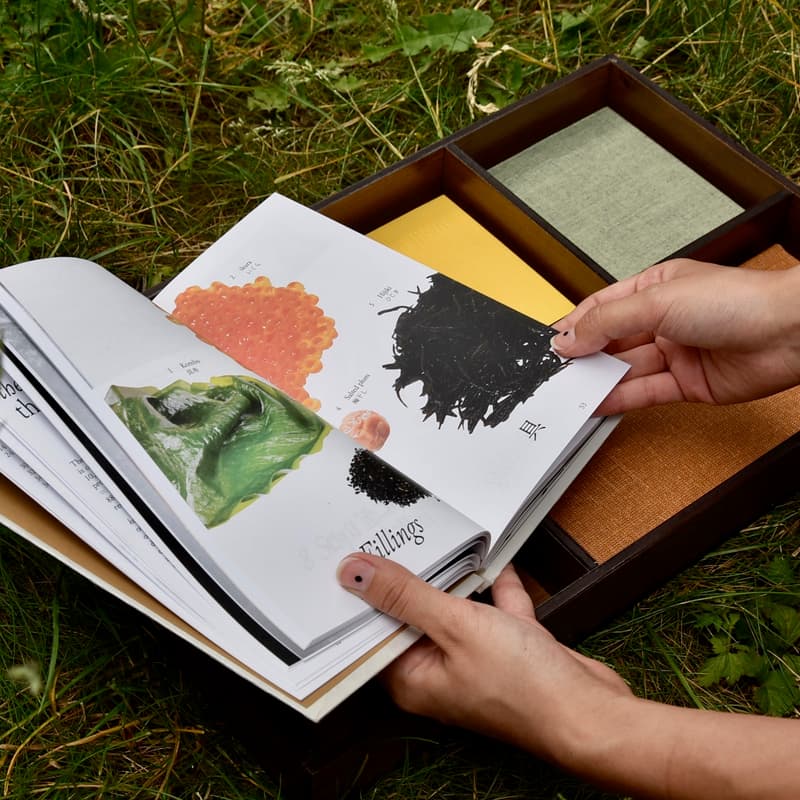
Image credit: Obentō no Jikan, Otomi Larcher, 2022 MA Graphic Communication Design, Central Saint Martins, UAL