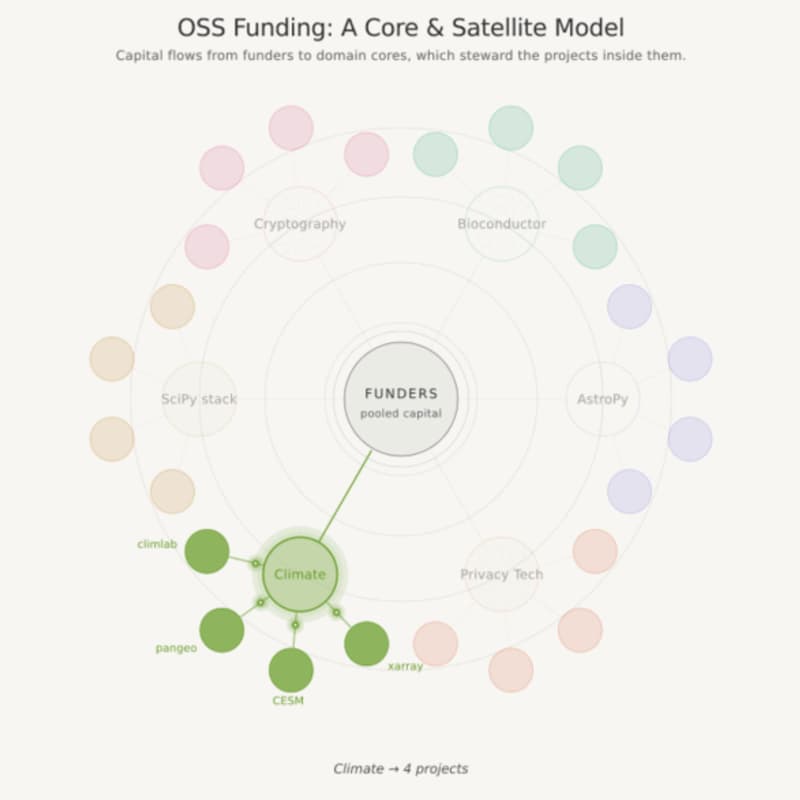

Sustainable Open Source Funding Infrastructure: A Core & Satellite Model for OSS Funding in the Age of AI
Purpose
Open source software underpins global digital infrastructure, yet its funding remains fragmented, ad hoc, and chronically insufficient. This curated working session convenes up to 30 practitioners, funders, researchers, and infrastructure builders to design a shared architecture for sustainable, evidence-based OSS funding.
This workshop will commence a series of working groups that will showcase their results at the Institute of Open Science Practices (IOSP), October 12-15th, Leiden, 2026.
The Problem
Funders require stable points of contact and interfaces to the broader open source ecosystem. Meanwhile, the landscape is populated by countless projects and platforms, each surfacing different data in different ways. A funder who wants to support, say, open source astronomy research software should not need to understand every package in that domain. They need to know that a trustworthy, accountable, visible group already does, and that they can direct funding there with confidence.
The Proposal: Core & Satellite
Rather than funding individual projects in small amounts, funders coordinate mid- to high-dollar commitments through “cores”: domain-level ecosystems (e.g., astronomy software, AI, bioinformatics) that have organized themselves around explicit protocols for governance, operations, finance, and data visibility. A core maintains the stable, standardized projects its domain depends on, and is accountable to funders for how resources flow through it.
“Satellites” - individual projects that are niche, new, or experimental - orbit a core and benefit in three concrete ways: they draw on its shared infrastructure (CI, packaging, docs, review), gain a legitimacy signal that makes them visible to users, contributors, and funders who would otherwise never find them, and receive pass-through funding under the core’s allocation rules.
The same protocols define how satellites are absorbed into the common layer, sunset, or ejected. Foundations for this proposal include academic research, live examples from communities such as Bioconductor, AstroPy, and The Image Cooperative, and direct input from funders whose allocation processes this structure is designed to serve.
Workshop Objectives
By the end of the day, participants will produce:
A draft schema: a nested core-and-satellite schema (v0.1) describing OSS projects and domain cores in a way that supports funding decisions across mechanisms.
A governance sketch: an outline of what governance could look like, plus draft stakeholder engagement strategies and rollout plans for the first one or two pilot cores.
Two seeded working groups: one technical (schemas, dependency mapping, tooling) and one social (governance, community buy-in, policy), with a defined scope of work through a follow-up convening four months out.
Agenda
Full-day working session, approximately 12:00–5:00 pm. Lunch at 12:00, workshop begins at 1:00, light drinks and snacks to close.
Lunch [1 hour]
Introductions [15 min]
Context setting [45 min]: funder observability challenges, the core-and-satellite proposal, and foundations for this model (academic grounding, community examples, funder perspectives).
Schema discussion [2.5 hours]: initial sketch shared in advance, full-group reactions (possibly via a live Polis conversation), breakouts on funder utility, community governance, and rollout design, then reconvening to share across groups and produce an initial problem-and-blocker map.
Next steps [30 min]: sketching working groups and desired outcomes ahead of the next workshop, with clear async commitments rather than forced live sign-ups, and a shared communication group to continue the conversation.
Working Group Deliverables
In the weeks and months following the workshop, the two working groups will produce
A datapoint landscape document mapping data requirements across allocation methodologies.
A schema specification v0.1, open for community comment.
Up to three MVP cores, with IOSP deliverable targets (Oct 12-15).
A comparative review of allocation methodologies, including the tooling required to build dependency graphs across project ecosystems.