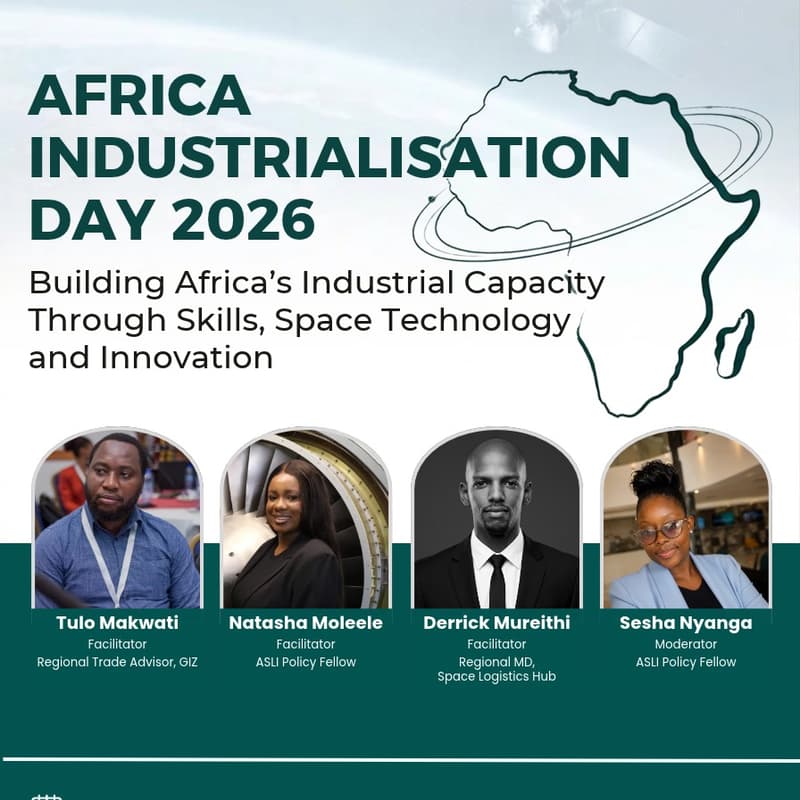
Commemoration of Africa Industrialisation Day 2026
African Industrialisation Day, observed annually on 20 November, provides an opportunity to reflect on the continent’s progress towards structural economic transformation and the development of competitive, productive economies. As African countries seek to expand intra-African trade and retain greater value within their economies, a central challenge is to strengthen domestic productive capabilities and build industries that can compete in regional and global markets.
The space sector is a case study for examining how skills, technology, innovation, and governance interact. The African Union's Outer Space Policy and Strategy highlights the role of space technologies in supporting development across critical sectors. Beyond using these technologies, a domestic space industry can create opportunities across different value chains - upstream, midstream and downstream.
However, access to space technologies does not automatically translate into domestic industrial capacity. Countries need to develop the skills, enterprises, research capabilities, investment ecosystems, and institutional frameworks needed to adapt, commercialise, and derive economic value from it.
Furthermore, national space laws and regulatory frameworks establish the rules and institutional conditions under which governments, businesses, investors, and research institutions can participate in space-related economic activities. By providing regulatory clarity and appropriate safeguards, they can help facilitate investment, encourage innovation, support local enterprise development, and build the domestic capabilities required for a competitive industry.
In commemoration of the African Industrialisation Day 2026, the African Space Leadership Institute (ASLI) is organising a roundtable to discuss kills, technology, innovation, and governance interact. In particular,
➡️ how skills, technology, innovation, and governance strengthen Africa’s industrial capacity
➡️ how national regulatory frameworks can create, or constrain, the conditions for investment, private-sector participation, innovation, and local capabilities
➡️ Identify the regulatory barriers facing African enterprises and the opportunities for local businesses to create value through space-related technologies, services, and applications
➡️ Explore how the AfCFTA and regional value chains can support the move from technology adoption to local value creation
➡️ Identify practical actions that governments and other stakeholders can take to strengthen domestic capabilities