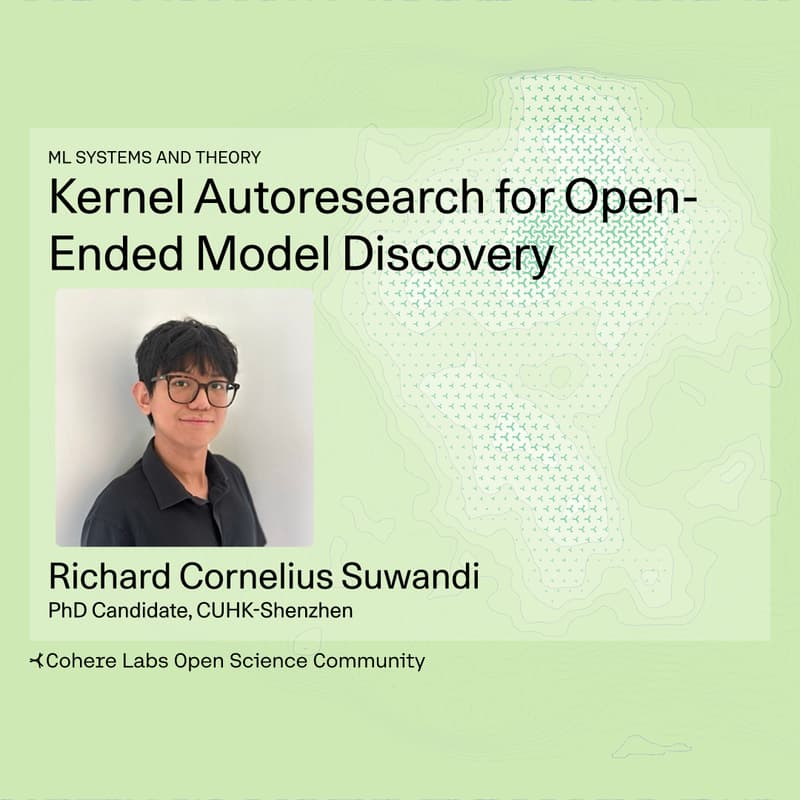

Richard Cornelius Suwandi - Kernel Autoresearch for Open-Ended Model Discovery
Kernels encode the inductive biases of many machine learning models, but designing them automatically involves a trade-off. A fixed grammar of base kernels guarantees validity but limits what can be found. Free-form programs written by LLMs remove that limit but often break: in our tests, 22–58% of LLM-generated kernels that pass simple numerical checks fail at different scales or dimensions. In this talk, I'll present Kernel Autoresearch (Kernaut), where coding agents write kernels as programs, while construction contracts make sure every accepted kernel is valid. A quality-diversity archive keeps strong kernels with different behaviors, and novelty screening pushes agents toward genuinely new ideas. The discovered kernels transfer to unseen tasks, from black-box optimization to enzyme kinetics, without further LLM calls, and remain interpretable programs that humans can refine. I'll close with what this suggests for agent-driven scientific and algorithm discovery more broadly.
Paper: https://arxiv.org/abs/2610.10394
Richard Cornelius Suwandi is a PhD candidate at the School of Artificial Intelligence, CUHK-Shenzhen. His research focuses on building autonomous AI research systems that can discover new algorithms and models for various scientific applications. He co-developed OpenEvolve, a popular open-source evolutionary coding agent inspired by Google DeepMind's AlphaEvolve. He is also a co-founder of the Institute for AI-Driven Discovery of Algorithms (AIDDA), a community and research network for AI-driven discovery.