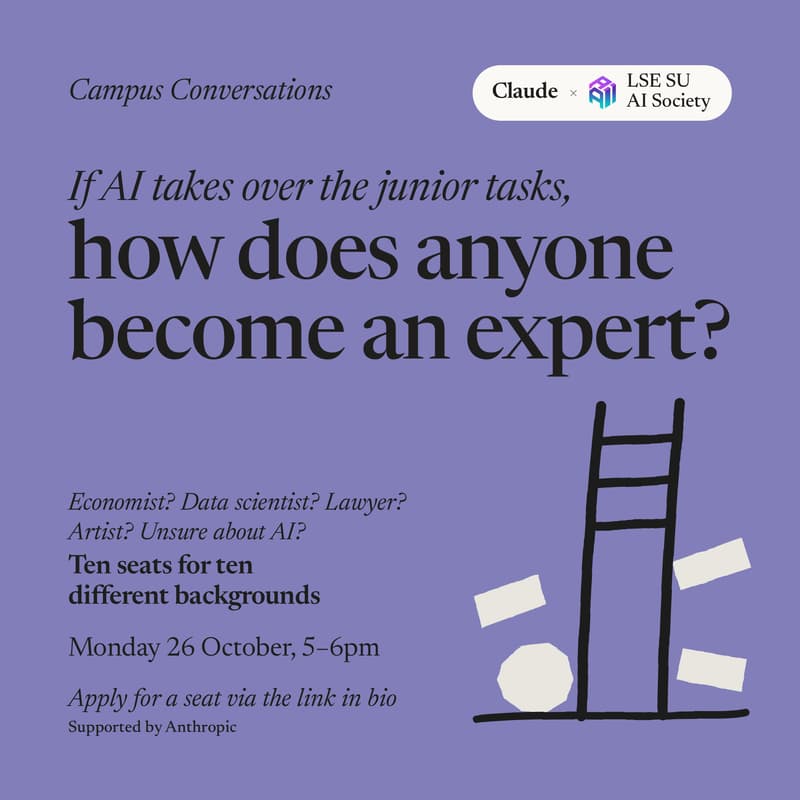

Claude Campus Conversations | Claude X LSE AI Society
Every expert started with boring work: the analyst rebuilding the same spreadsheet, the research assistant buried in a literature review, the junior developer whose first pull request got torn apart. That work was tedious, and it was how people learned. It’s also exactly what AI is now good at.
So what happens to the ladder when the bottom rungs disappear? Will people find another way up, or will only a few get the chance to build expertise? For LSE students about to step onto that ladder, this isn’t abstract.
The conversation
On Monday 26 October, from 5 to 6pm, a table of ten will work through this question together. There’s no panel, no slides and no screens. We’ll start with short personal stories, move into open conversation, and finish with what each of us is still thinking about. The Chatham House Rule applies, so you can say what you actually think.
This is the first of LSE’s Campus Conversations, co-hosted with the LSE SU AI Society.
Why I’m hosting it
I’m Alina. I’m Pakistani, I grew up in the UAE, I did my undergrad in strategic management at McGill University in Montreal, and I’m now in London doing an MPA in Data Science for Public Policy at the LSE. I care a lot about how AI changes the way people and institutions grow, and I’d rather work through it with people from various different backgrounds who can bring light to new perspectives.
Who we’re looking for
This only works if the room isn’t an echo chamber. We want economists and data scientists, lawyers and artists, and people who use AI every day alongside people who avoid it. You don’t need a technical background. If you’re sceptical about AI, we especially want to hear from you.
How to apply
There are only ten seats. The application is a few quick questions about your background and what draws you to the question.
This event is supported by Anthropic. It’s a discussion, not a product event: there are no demos and nothing to sell.
Note: this event is for postgraduate students only