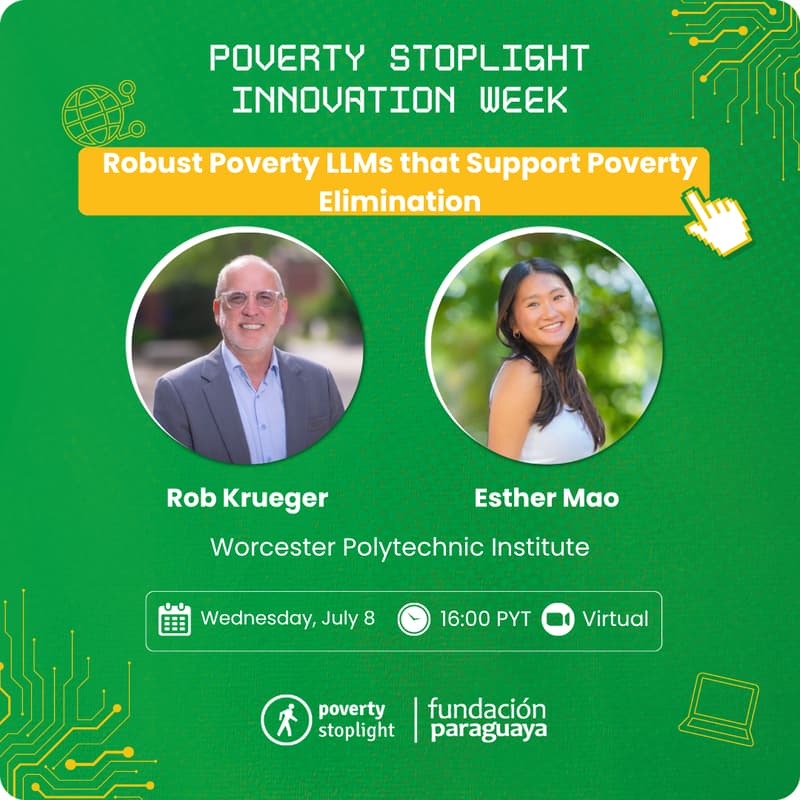

Robust Poverty LLMs that Support Poverty Elimination | LLMs Robustos para la Eliminación de la Pobreza
The past decade has been marked by a decline in support and funding for initiatives in the humanitarian and development sector, best exemplified by the dismantling of USAID in early 2025. These trends have left knowledge and funding gaps that further highlight the need for new approaches in addressing global poverty. We deployed a novel, integrated approach for finetuning a foundational large language model on a diverse range of international development data, with the hope that this work could be used as a policymaking tool to better inform more effective poverty and development solutions.
Robert Krueger and Esther Mao of Worcester Polytechnic Institute will share work connected to inste^d, an AI-driven platform designed to help policymakers and aid organizations better understand multidimensional poverty and identify more targeted, evidence-based interventions. Drawing on WPI’s interdisciplinary strengths in social science, policy, data science, and project-based research, the session will examine how large language models and diverse international development datasets can support more effective poverty diagnosis, policy design, and resource allocation.
Rather than relying only on income-based measures or top-down assumptions, this conversation will focus on how AI can help surface patterns, context, and community priorities in ways that strengthen human agency and improve decision-making. Participants will consider both the promise and responsibility of using AI as a tool for more responsive, beneficiary-centered poverty alleviation.
This session will be held in English with simultaneous Spanish audio translation.
La última década ha estado marcada por una disminución del apoyo y el financiamiento para iniciativas en el sector humanitario y de desarrollo, ejemplificada claramente por el desmantelamiento de USAID a principios de 2025. Estas tendencias han dejado vacíos de conocimiento y financiamiento que resaltan aún más la necesidad de nuevos enfoques para abordar la pobreza global. Implementamos un enfoque novedoso e integrado para el ajuste fino (finetuning) de un modelo de lenguaje de gran escala fundacional, utilizando una amplia gama de datos de desarrollo internacional, con la esperanza de que este trabajo pueda utilizarse como una herramienta de formulación de políticas públicas para orientar soluciones más efectivas de pobreza y desarrollo.
Robert Krueger y Esther Mao, del Worcester Polytechnic Institute, compartirán su trabajo relacionado con inste^d, una plataforma impulsada por IA diseñada para ayudar a los responsables de políticas públicas y a las organizaciones de ayuda humanitaria a comprender mejor la pobreza multidimensional e identificar intervenciones más específicas y basadas en evidencia. Basándose en las fortalezas interdisciplinarias de WPI en ciencias sociales, políticas públicas, ciencia de datos e investigación basada en proyectos, la sesión examinará cómo los modelos de lenguaje de gran escala y diversos conjuntos de datos de desarrollo internacional pueden apoyar un diagnóstico de la pobreza, un diseño de políticas y una asignación de recursos más efectivos.
En lugar de depender únicamente de medidas basadas en el ingreso o de supuestos impuestos desde arriba, esta conversación se centrará en cómo la IA puede ayudar a identificar patrones, contexto y prioridades comunitarias de manera que fortalezcan la agencia humana y mejoren la toma de decisiones. Los participantes considerarán tanto el potencial como la responsabilidad de utilizar la IA como una herramienta para una eliminación de la pobreza más receptiva y centrada en los beneficiarios.
Esta sesión se llevará a cabo en inglés con traducción simultánea de audio al español.