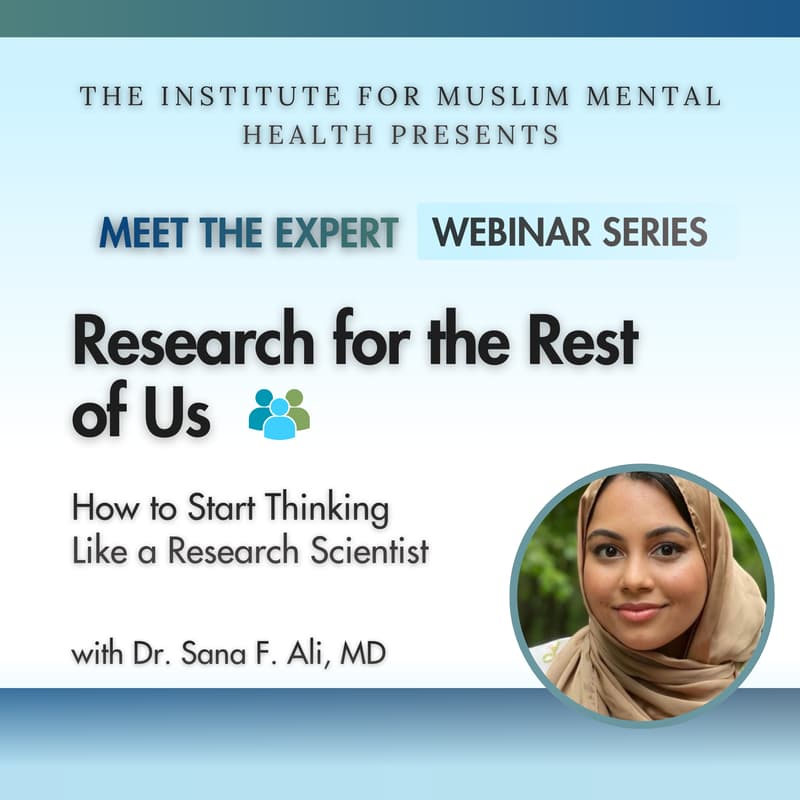
Research for the Rest of Us: How to Start Thinking Like a Research Scientist
The Institute for Muslim Mental Health Presents: Meet the Expert Webinar Series
Research for the Rest of Us: How to Start Thinking Like a Research Scientist
Featured Speaker: Dr. Sana F. Ali, MD
Many meaningful research questions begin outside traditional research environments. Clinicians, educators, and community professionals often notice patterns, gaps in care, or unanswered questions in their daily work.
This interactive session introduces practical ways to approach research with a scientist’s mindset — even without formal research training.
Participants will learn how researchers and peer reviewers evaluate evidence, what makes a strong study design, and how everyday observations can develop into meaningful research questions.
Participants will explore:
How peer reviewers evaluate research abstracts
Common reasons research studies are rejected
How to critically assess research claims
How everyday observations can become research questions
Practical ways to begin thinking like a researcher
Participants are encouraged to come with a research question, observation, or problem they have noticed in their clinical, educational, or community work. Selected ideas may be used as examples during the session discussion.
We invite clinicians, mental health professionals, students and trainees, community leaders, and anyone interested in understanding how research works to attend.
You don't need to be a research scientist to think like one. Research begins with curiosity, careful questioning, and the willingness to explore meaningful problems.
About the Speaker
Dr. Sana F. Ali, MD is a clinician-scientist focused on culturally informed care and implementation research. Her work explores how mental health systems can better integrate faith, culture, and community contexts to improve access and effectiveness of care. She is also committed to global health capacity-building through nonprofit leadership, mentorship, and strengthening resources for the mental health professional community.
I find community mental healthcare compelling because it contextualizes mental health through culture and systems, and that broader lens makes care more accessible, relevant, and sustainable.