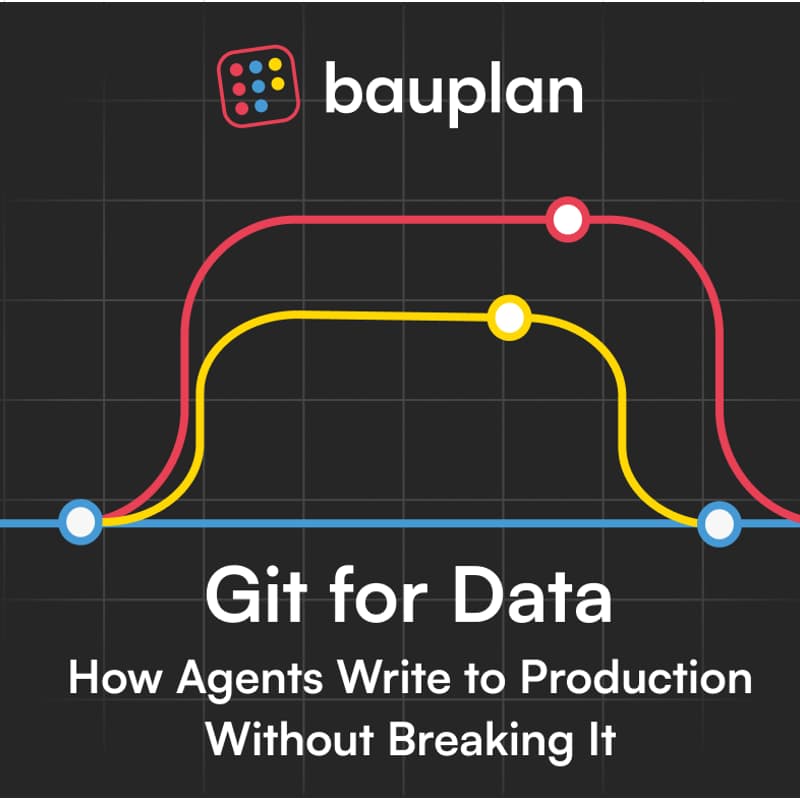
Git for Data: How Agents Write to Production Without Breaking It
Software solved this problem a long time ago. The way you let thousands of untrusted contributors change the same fragile system without breaking it is git: you give each one a branch, let them work in isolation, test the change, review the diff, and merge.
Data never got it. A pipeline writes straight to a table, an ingestion job overwrites a partition, and when something is wrong the only recovery is a backup and an apology. We lived with that because the people writing data were few, careful, and slow.
Agents are none of those things. They are fast, numerous, and non-deterministic. An agent will write a pipeline, ingest a file, backfill a column, and reshape a table with no human in the loop, and it will sometimes be wrong.
Git-for-data brings branching, isolation, atomic merge, and time travel to the production data, so an agent can do its work on a zero-copy branch that is invisible to production until a check, a human, or another agent says it can be merged.
In this webinar, we will define what git-for-data actually is (not version control bolted onto files, but cheap branches, commits, and merges over tables in object storage) and walk through what it unlocks once agents are the ones doing the work.
Branch isolation turns every risky operation into a sandbox. Write-audit-publish turns data quality from a dashboard you check after the fact into a gate that data must pass to merge.
Every agent action becomes a commit: reproducible, auditable, and reversible with a rollback instead of a restore. And because branches are cheap, many agents can work in parallel, each on its own branch, without stepping on each other or on production.
Through a real example, the session will show parallel agents working on data on their own branch.
The discussion will close with a forward look at a stack where humans stop being the bottleneck on data safety: where agents operate continuously on branchable data, every change is gated, versioned, and reversible by default.