Introduction to Blockchain & Ethereum Staking
Introduction to Blockchain & Ethereum Staking
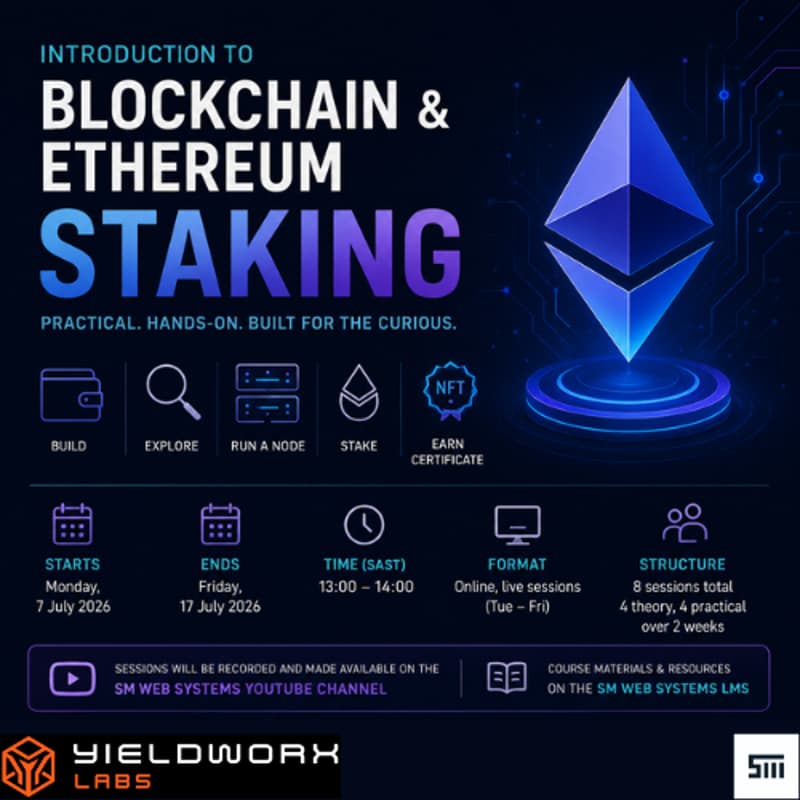
Practical. Hands-On. Built for the Curious.
Have you ever wanted to understand how blockchains actually work - not just the buzzwords, but the real mechanics beneath them? This is your chance.
This is a free, practical, project-based course designed to take you from zero to running your own Ethereum node and participating in real staking infrastructure. Whether you are a developer, a curious professional, or someone who has heard about Web3 and wants to finally understand it from the ground up, this course was built for you. No prior blockchain experience required. Just bring your curiosity.
Over two weeks, you will move through theory and practical sessions in tandem - learning how blockchains work, creating your first wallet, reading the public ledger, setting up a validator node, and joining Lido's Community Staking Module on testnet. Every concept is grounded in a real task, and every student walks away with working knowledge, hands-on experience, and an NFT certificate to prove it.
This course is a collaboration between Yieldworx Labs and SM Web Systems.
Course Schedule
Starts: Tuesday, 8 September 2026
End Date: Friday, 18 September 2026
Time: 13:00 to 14:00 (SAST)
Format: Online, live sessions - Tuesday to Friday, 4 sessions per week
Structure: 8 sessions total - 4 theory, 4 practical - delivered over 2 weeks
Cost: Free
Sessions will be recorded and made available on the
SM Web Systems YouTube channel
. Course materials and supplementary resources will also be hosted on the SM Web Systems Learning Management System (LMS). Each session includes a recorded 20-minute lesson, slides, and a 1-hour live session with Q&A.
What You Will Learn
Session by Session
Week 1
Session 1 - Theory | Course Intro & Intro to Blockchain
What you will learn in this course and why it matters. What is a blockchain? How does a distributed ledger differ from a traditional database? Core properties: transparency, immutability, ownership, and decentralisation. Foundations of cryptography: public and private keys, hashing, digital signatures, mnemonic seed phrases (BIP39), and key derivation - because not your keys, not your coins.
Session 2 - Practical | Connecting to the Blockchain
Your wallet is your decentralised identity. In this session you will choose, create, and secure a wallet following real-world best practices. You will use a testnet faucet and send your first crypto transaction - the same one you will trace on the public ledger in Session 4.
Session 3 - Theory | Proof-of-Stake Blockchains & Ethereum Fundamentals
Bitcoin vs. Ethereum - why it matters. How blocks are structured, how hashing chains them together, and how state transitions work. Introduction to the EVM, smart contracts, DeFi, NFTs, and DAOs at a conceptual level. Gas and EIP-1559. EOA vs. contract accounts. Intro to Dapps. Bonus: Layer 2s.
Session 4 - Practical | Reading the Public Ledger
Blockchain explorers demystified. You will use Etherscan to trace the transaction you made in Session 2, read block data, and connect the theory from Session 3 to what you see on-chain. By the end of this session, the ledger will feel familiar, not foreign.
Week 2
Session 5 - Theory | Staking & Validator Operations
Flavours of staking and how validator selection works in Ethereum's Proof-of-Stake system. What is a validator, and what does it actually do? Consensus and execution layer explained (EL/CL). The 32 ETH requirement, effective balance, activation and exit queues. Rewards breakdown - base rewards, priority fees, MEV. Penalties vs. slashing: inactivity leak vs. malicious behaviour. Cloud vs. bare metal. Node types: full, archive, and light clients. Client diversity - why it matters for network health (Geth, Nethermind, Lighthouse, Prysm, and more).
Session 6 - Practical | Set Up Your Own Node
Hands-on node setup using binaries and consensus client documentation. Spinning up a validator. Confirming your node on Beaconcha.in. Key generation using the deposit CLI or Launchpad and understanding withdrawal credentials. What you cannot finish in class becomes homework. Resources: launchpad.ethereum.org and beaconcha.in.
Session 7 - Theory | Becoming a Node Operator
Validator duties in depth: proposing blocks and attesting every epoch. Understanding your metrics and what good uptime looks like. Monitoring for slashing risk. Opportunities in the space - from solo staking to professional node operations.
Session 8 - Practical | Participate in Lido CSM
What is Lido and how does the Community Staking Module work? Joining CSM on testnet, step by step. Best practices, ongoing resources, and how to continue after the course ends.
What You Will Build & Do
Create and secure your first Web3 wallet
Send a real testnet transaction
Read and interpret live blockchain data on Etherscan
Set up and run an Ethereum node from scratch
Spin up a validator and confirm it on Beaconcha.in
Join the Lido Community Staking Module on testnet
Tools and Technologies
Students will work with: Ethereum testnets, MetaMask or equivalent wallet, Etherscan, Ethereum client software (execution and consensus layer), the Ethereum deposit CLI, Beaconcha.in, and Lido's Community Staking Module. A setup guide will be shared before the course begins.
Your Certificate
Students who complete the course will receive a verifiable NFT certificate of completion - a digital credential you can share on LinkedIn or in any portfolio, stored permanently on the blockchain.
Your Instructors
Robert Drage is the Co-Founder of Yieldworx Labs and a Web3 Product Marketing Manager who spent four years at SSV Labs building narratives, campaigns, and go-to-market strategies for Ethereum staking infrastructure. As Content Specialist and then Product Marketer at SSV, he educated node operators, developers, and community members on distributed validator technology (DVT) from testnet through mainnet, and executed partnership campaigns with Kraken, Lido, and Ether.fi. He has moderated over 30 live community calls, secured 20+ podcast placements, and spoken at leading global Ethereum events. Robert brings the rare ability to take deeply technical infrastructure and make it genuinely understandable - and he has been doing it for audiences exactly like the one in this course.
Petrus Maas is the Co-Founder of Yieldworx Labs and a Linux system administrator with a background spanning web development, infrastructure, automation, and blockchain technologies. He holds a Blockchain Specialization certification and brings hands-on experience with CI/CD processes, Kubernetes, Python-based security solutions, and production-grade system deployments. At MEGS, he reduced brute force attacks on a client network by over 80% and engineered a high-availability Kubernetes cluster from repurposed hardware. Petrus bridges technical complexity and practical solutions, and as co-founder of Yieldworx Labs, he is one of the driving forces behind bringing this course to life.
Mukhtar Meer is the Founder of SM Web Systems, a Johannesburg-based development studio and venture incubator that bridges the gap between emerging talent and real-world, production-grade technology projects. He is a Super Ambassador for the Stellar Development Foundation and brings over a decade of experience across blockchain, AI, EdTech, and operations. Mukhtar has served as a Technical Training Instructor at The Knowledge Academy, delivering courses across Linux, programming, blockchain, and cybersecurity to professionals globally - including dedicated modules on Bitcoin, cryptocurrency, and blockchain technology. He has also held senior roles at Deep Knowledge Group and Velocity AI, and holds an MS in Marketing Management and Business Intelligence. Through this course, SM Web Systems and Yieldworx Labs are taking a deliberate step into Ethereum education, connecting the next generation of node operators and validators with a broader ecosystem of technology, community, and opportunity. Mukhtar organises and supports the programme, making sure learners have the resources and community they need to succeed.
Who Should Attend
This course is open to all ages and all backgrounds. Whether you are a developer, a student, working in finance or technology, or simply curious about how Ethereum actually works under the hood, you are welcome here. No prior blockchain experience is needed, though basic computer literacy is helpful.
Enrollment is open. Register to secure your place and join the community.
Organised by Yieldworx Labs and SM Web Systems (Pty) Ltd. Building the builders of tomorrow.