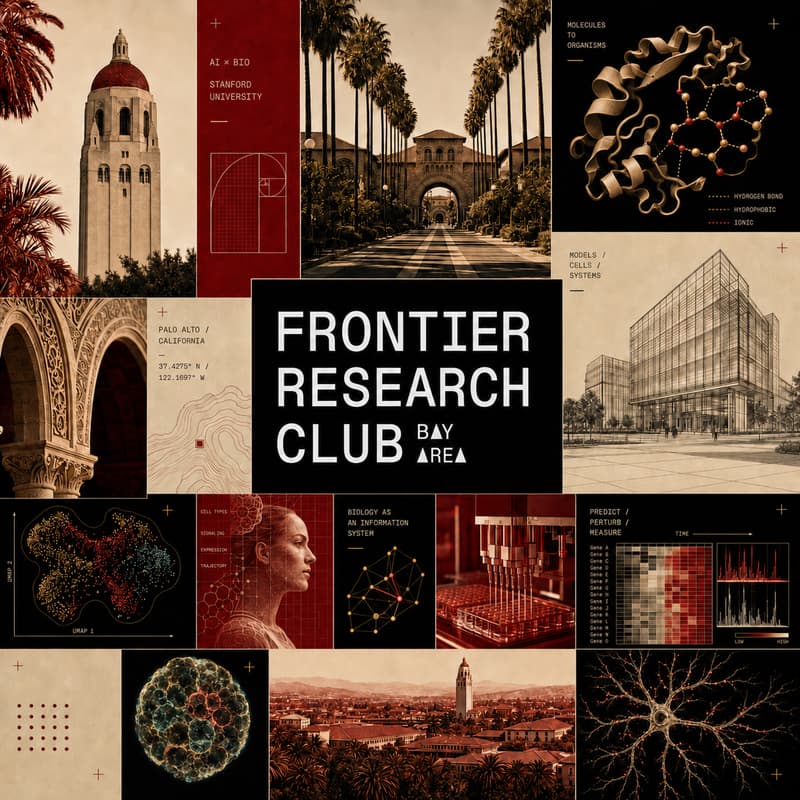


Bay Area Frontier Research Club #16 | AI × Bio: Virtual Cells at Stanford
Introducing the Frontier Research Club AI × Bio Track — and opening it on the question the field is arguing hardest about right now: can you simulate a cell?
Modern biology has become a computational science. Virtual cells, single-cell genomics, perturbation prediction, protein and molecule design — questions that used to take a lab a decade are being reframed by people who read a genome the way engineers read a codebase. This track puts the researchers doing that work in one room with the founders building on it and the investors backing it.
The virtual cell is the sharpest version of that shift. If a model can predict what a cell does under an intervention nobody has run yet, the experiment stops being the unit of discovery and becomes the thing you spend to confirm. That's a large claim, and the field is nowhere near settled on how to test it — what counts as generalization, what counts as a genuinely held-out perturbation, whether today's benchmarks measure anything a biologist would act on. That disagreement is the night.
Same bar as every FRC session: concrete work, real methods and results, short talks so most of the evening goes to questions and critique. What's new is the subject — biology at single-letter resolution, argued over dinner.
The Frontier Research Club is a curated forum for rigorous, technical discussion at the frontier of AI. We convene researchers from the frontier labs, Stanford, Berkeley, and the teams building in production to examine concrete work — papers, methods, and results — with a bias toward assumptions, evaluation methodology, failure modes, and what would count as convincing evidence.
Each session features 2–3 talks selected for rigor and discussion value. Presentations are intentionally brief so the majority of time is reserved for questions and critique. Papers and supporting materials are shared in advance to ensure a high-baseline conversation.
Agenda
5:30pm: Doors open
5:30pm – 6:30pm: Networking + light dinner
6:30pm – 8:00pm: Research presentations + discussion
8:00pm – 8:30pm: Networking
Presenters & topics
Talk 1 — From Tokens to Cells: Where Foundation Models Break on Biology
The field has spent three years importing architectures from language modeling into single-cell biology. The results are more complicated than the headlines.
This talk centers on scGeneScope (NeurIPS 2025, Datasets & Benchmarks Track) — a treatment-matched dataset built with Microsoft Research pairing 627,000 transcriptomic profiles with 716,000 Cell Painting images across 28 mechanisms of action, split to simulate discovery under realistic laboratory variability. The result: on mechanism-of-action identification, classic fit-to-data methods consistently beat zero-shot foundation models, and naive multimodal integration didn't reliably help.
It closes on what that implies for architecture — including whether distribution-oriented approaches like flow matching are the better direction — and on what result would change the conclusion.
Akram Baharlouei is a Senior Staff Machine Learning Engineer at Altos Labs, working at the intersection of machine learning and single-cell biology. She presented scGeneScope at NeurIPS 2025 as part of Altos's Institute of Computation — the team that also released PerturBench and won the Arc Institute's Virtual Cell Challenge with a generative flow-matching model, judged most reliable across evaluation criteria among 50 finalists. Before Altos she spent a decade in large-scale ML systems at Meta and Qualcomm. PhD, Electrical and Computer Engineering, George Mason University.
Talk 2 — From Prediction to Intervention: What a Useful Virtual Cell Must Prove
If today's models struggle to beat simple baselines, what would one have to do before a biology team actually changes an experiment because of it?
This talk argues backward from that decision: where the line sits between correlation, forecasting and causal prediction, which predictions are experimentally testable, and what a computational claim tethered to the laboratory looks like in practice. It closes on one falsifiable claim and the protocol that would settle it — the argument being that a virtual cell earns its keep not by replacing the bench, but by making the next experiment more deliberate.
Logan Nye, MD is co-founder and CEO of Galen, a San Francisco company building models to help biology teams decide which intervention to pursue next, currently focused on durability and exhaustion in engineered cell therapies. He holds an MD, pursued graduate study in computer science at Carnegie Mellon, and worked in clinical AI at Harvard Medical School and Massachusetts General Hospital before founding Galen with Kushagra Agarwal.
Who's in the room
The room includes researchers and teams from Altos Labs, 10x Genomics, Genentech, AstraZeneca, Merck, AbbVie, Johnson & Johnson, Gilead, Arcus Biosciences, Natera, Twist Bioscience, OmniAb, Gordian Biotechnology, ArteraAI, Merge Labs, Microsoft Research, and Google DeepMind — alongside faculty, postdocs and PhD researchers from Stanford, UCSF, Berkeley, MIT, Harvard, CMU and Oxford, and investors backing the category.
Want to present your work?
If you have a research paper you’d like to discuss at one of our next sessions, please submit it for consideration.
Submit your paper here!
Who should attend
Experimental biologists — single-cell, perturbation screens, functional genomics, wet-lab work that generates the data these models train on
Computational biologists and bioinformaticians
ML researchers working on biological data — foundation models, generative models, causal inference, benchmarking
Drug discovery and translational teams from pharma and biotech
Research engineers and lab automation people building the layer between the model and the bench
Founders building in AI × bio, and the investors backing them
Capacity is limited.
We will take photos and short video clips for event recap and promotion. By attending, you consent to being photographed and recorded, and to the use of those images and clips by the organizers on social media and other event marketing channels.
🌐 Connect with Frontier Research Club
Luma Calendar: luma.com/frontiersyndicate
YouTube: FrontierResearchClub
LinkedIn: frontier-research-club
Instagram: @frontierresearchclub
Email: kristopher@frontiersyndicate.vc
Hosted by
The Frontier Syndicate is a venture community connecting frontier tech researchers, builders, and investors through curated convenings and early-stage capital.
Across the Bay Area we run a recurring series of research forums, builder nights, and intimate investor dinners — and we back exceptional companies emerging from the labs, communities, and technical networks we convene. The AI × Bio Track is our first vertical extension of that series, built for the people turning biology into a computational discipline.