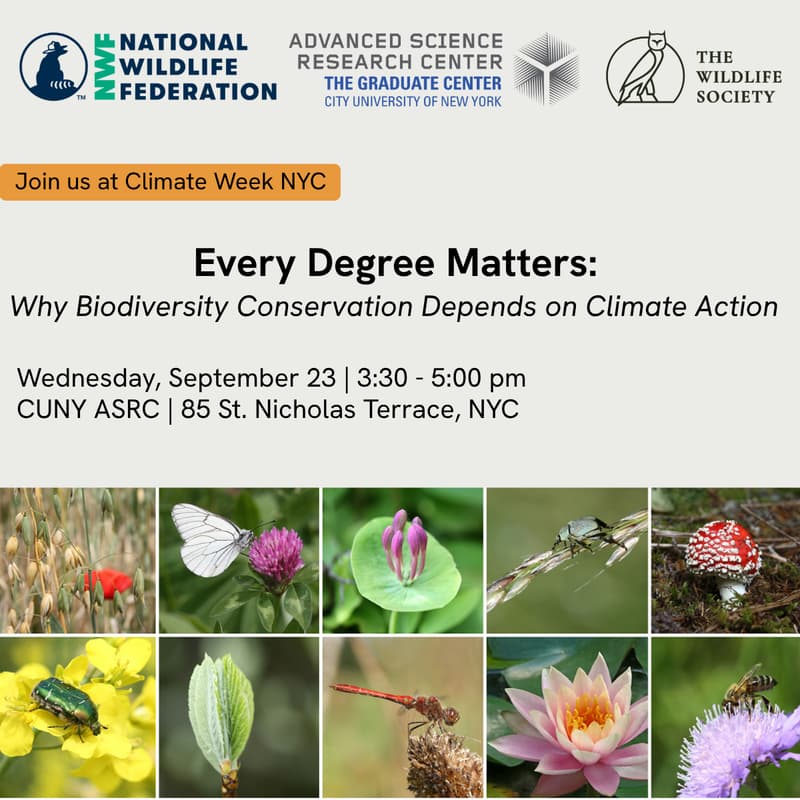
NYCW 2026 | Every Degree Matters: Why biodiversity conservation depends on climate action
Rapid biodiversity loss and accelerating climate change are connected crises. Under the worst case scenarios for greenhouse gas emissions in the 21st century, up to 30 percent of wildlife species could go extinct. Weather and climate influence almost every aspect of animal life and behavior, from reproduction and life cycles to species interactions and distribution. Yet all too often, wildlife conservation and climate action have been treated as separate disciplines, with separate solutions.
Join the National Wildlife Federation, The Wildlife Society, and CUNY's Advanced Science Research Center Environmental Science Initiative to discuss the urgency of climate action for conservation – what the latest science says about the intersection between climate change and biodiversity, and what solutions are available to both help wildlife adapt to climate change, and to mitigate future effects, and why every fraction of a degree matters for species.
Speakers include:
Dr. Peter Groffman, Professor, Environmental Sciences Initiative, CUNY ASRC
Peter’s research focuses on terrestrial biogeochemistry with a focus on nitrogen dynamics, especially gases. Projects have ranged across multiple scales from microbial/molecular scale analyses to field/ecosystem scale measurement of fluxes using geochemical and isotope approaches, to landscape and regional scale work using remote sensing, geographic information systems and simulation models. Much of his research is focused at two National Science Foundation funded Long Term Ecological Research sites; Hubbard Brook, New Hampshire and Baltimore, MD. During his career, he has authored over 300 publications, with more than 85 as primary author. Peter was a Convening Lead Author for the 2013 U.S. National Climate Assessment Chapter on Ecosystems, Biodiversity and Ecosystem Services and a lead author for the Second (Wetlands) and Third (North America) Assessment Reports of the Intergovernmental Program on Climate Change (IPCC).
Dr. Diane Pataki, Chief Scientist and Vice President for Science, National Wildlife Federation
Trained as an ecologist, Diane's work has spanned the impacts of climate change on ecosystems, the role of human and biological processes in air and water resources, and interactions between urbanization, landscape management, and biodiversity. Her recent projects have been focused on nature-based solutions for sustainable cities and communities. Diane has a B.A. in environmental science from Barnard College and an M.S. and Ph.D. in ecology from Duke University. She is the former Director of the Arizona State University (ASU) School of Sustainability, the founder and former Chief Strategy Officer of the ASU-led and National Science Foundation-supported Southwest Sustainability Innovation Engine (SWSIE), and a Foundation Professor in the ASU School of Sustainability. She has also served as the Associate Vice President for Research, Associate Dean, and Professor of Biology at the University of Utah, and the founding director of the University of California, Irvine Center for Environmental Biology and the Steele-Burnand Anza Borrego Desert Research Center.
Dr. Amanda Rodewald, Garvin Professor and Senior Director of Center for Avian Population Studies, Natural Resources and the Environment Section, Cornell University
Amanda Rodewald is a professor in the Ashley School at Cornell University, where also she directs the Center for Avian Population Studies at the Cornell Lab of Ornithology and is a faculty director with the Cornell Atkinson Center for Sustainability. She leads an international program that focuses on conserving species and systems amid a wide range of socio-ecological challenges. Amanda has published >210 scientific papers, 12 book chapters, and numerous popular articles or commentaries and has mentored 10 post-docs and 39 graduate students. In addition to her research, Amanda works closely with practitioners and decision-makers to move science to action and develop practical and innovative approaches to conservation that can accommodate social and ecological needs. Much of this work leverages the Cornell Lab’s flagship projects like eBird, Merlin, and BirdCast. She also is a fellow of the American Association for the Advancement of Science and the American Ornithological Society and has served multiple terms on the Science Advisory Board of the U.S. Environmental Protection Agency, has testified before Congress about conservation issues, and chaired two U.S. State of the Birds Reports.
Sarah Grimké Aucoin, Chief of Education & Wildlife, NYC Parks
Sarah’s tenure in NYC Parks spans 25 years of innovation and programmatic expansion in the areas of environmental education, outdoor adventure, active conservation and wildlife management. As Chief of Education & Wildlife, she oversees the Urban Park Rangers, Teaching & Learning Support, and the Wildlife Unit, whose mission is to promote coexistence between people and urban wildlife in New York city. As an informed resource for citizens and policymakers, the Wildlife Unit serves as an ambassador for New York City's diverse wildlife communities and seeks to create a future where wildlife is a familiar, understood, and indispensable part of New York City's urban landscape. She has a rich and accomplished academic background that includes a Bachelor of Arts degree in Biology from the University of California – Santa Cruz, and a Master of Science degree in Ecology from the University of Louisiana. She is an accomplished writer and researcher, having written and published a number of peer-reviewed monographs on subjects including the behavior of larval amphibians, the philosophy of declining amphibian populations, and the sexual bias in studies of animal behavior. Sarah has been a member of The Wildlife Society and the Urban Wildlife Working Group since 2015, and a board member of the Urban Wildlife Working Group since 2018.
Dr. Novem Auyeung, Director of Research & Monitoring, NYC Parks' Natural Resources Group
Novem and her team monitor and assess natural resources in New York City parks; advise on their protection and conservation; build relationships with external research partners and programs; and use research and data to inform natural resources management. Since 2013, she has also been part of the NYC Urban Field Station, a collaboration between NYC Parks, USDA Forest Service, and Natural Areas Conservancy that fosters knowledge coproduction across disciplines, connecting research on urban socio-ecology systems to on-the-ground implementation. Her current research is focused on the outcomes of urban forest and wetland restorations, the socio-ecological benefits of urban green and blue spaces, and biocultural stewardship approaches to urban land management. She is also a co-author of the 5th NYC Panel on Climate Change report. Novem is a soil biogeochemist by training and has also published papers on climate change effects on soil nutrients and microbial communities. Novem holds a Bachelor’s in Environmental Science from Brown University and a Ph.D. in Forestry and Natural Resources from Purdue University.
Corina Newsome, Conservation Scientist, National Wildlife Federation
Corina is a wildlife biologist and science communicator who works to advance conservation science, policy, and implementation that is rooted in environmental justice. Corina’s research has focused on answering landscape ecology questions that inform habitat management for birds imperiled by climate change. Her fascination with birds extends beyond her research and into the communities where she lives and works, serving as beautiful vehicles through which she connects herself and others to the world around them. Corina’s advocacy work has ranged from advancing climate action in faith communities, to mobilizing scientists and members of the public across the country to protect the integrity and science capacity of federal conservation programs. Recognizing the power of representation in her own career trajectory, Corina is committed to increasing the visibility of Black science professionals for the next generation of STEM experts, and centering the leadership and perspectives of Black, Indigenous, and communities of color in wildlife conservation, environmental education, and exploration of the natural world.