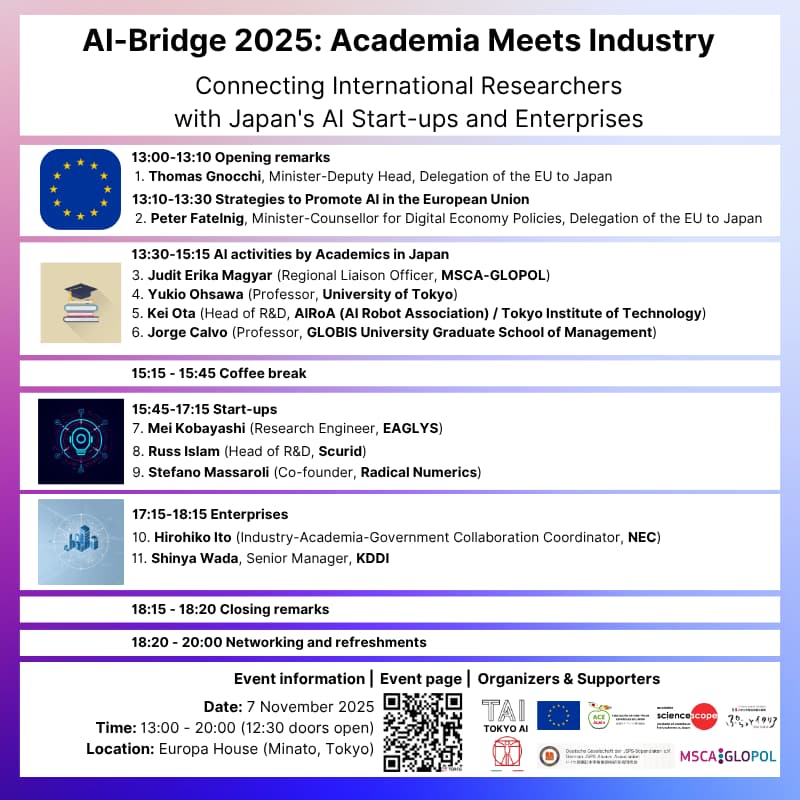

EU-Japan AI Bridge - Connecting International Researchers with Japan's AI Ecosystem
Join us for the 2nd edition of the "EU-Japan AI Bridge," an event that brings together international researchers based in Japan and Japan's AI startups and enterprises.
Description
This event aims to bridge international researchers with the Japanese AI industrial and startup ecosystem. We expect more than 100 participants from academia and industry, including researchers, startups, and enterprise representatives. The day will feature presentations, discussions, and a networking session with startup booths, accompanied by refreshments provided by Europa House.
The program is structured around the following focus areas:
AI safety, security, and privacy
Data spaces, data flow, and data formats
AI innovation and technology transfer
HiRes Event Banner: link (to be added).
Agenda
12:30 – 13:00: Arrival, registration, and coffee
13:00 – 13:10: Official greetings and opening remarks (Thomas Gnocchi, Minister-Deputy Head, Delegation of the European Union to Japan)
13:10 – 13:30: Strategies to Promote AI in the European Union (Peter Fatelnig, Minister-Counsellor for Digital Economy Policies, Delegation of the European Union to Japan)
13:30 – 13:45: Marie Skłodowska-Curie Actions (MSCA) in Academia-Industry Cooperation (Judit Erika Magyar, Regional Liaison Officer, MSCA-GLOPOL)
13:45 – 15:15: Academia session
(3 speakers x 20 minutes presentation + 8 minutes discussion + 2 minutes transition to the next presenter)
Chance Discovery: Uncovering Future Opportunities Through Shared Image of Knowledge (Yukio Ohsawa, Professor, University of Tokyo)
The AI-Readiness and Market Dynamics Disruption Index (AIM-DDI) and Two Case Studies (Jorge Calvo, Professor, GLOBIS University Graduate School of Management)
From Data to Action: Toward an Open Foundation for Embodied AI (Kei Ota, Head of R&D, AIRoA (AI Robot Association) / Tokyo Institute of Technology)
15:15 – 15:45 Coffee Break
15:45 – 17:15 Start-up session
(3 speakers x 20 minutes presentation + 8 minutes discussion + 2 minutes transition to the next presenter)
Federated Learning: Collaborative Training of High-quality AI Models (Mei Kobayashi, Research Engineer at EAGLYS)
Hardening the Hardware: Securing the Edge with AI (Russ Islam, Head of R&D at Scurid)
An Automated Factory for AI (Federico Berto, Member of Technical Staff at Radical Numerics)
17:15 – 18:15 Enterprise session
(2 speakers x 20 minutes presentation + 8 minutes discussion + 2 minutes transition to the next presenter)
NEC’s Growth Strategy: Expanding New Business Areas through Digital Ethics and Open Innovation (Hirohiko Ito, Industry-Academia-Government Collaboration Coordinator, NEC)
Empowering generative AI at KDDI through strong AI governance (Shinya Wada, Senior Manager, KDDI)
18:15 – 18:30 Closing remarks
18:30 - 20:00 Networking, food, and startup fair
During the networking session, a group of AI research-focused startups will have stands for attendees to approach and discuss their work.
Organizers
The event is organized by AIRJ and Tokyo AI (TAI), with the support of ACE Japon, JSPS Germany, and ScienceScope, with the collaboration of MSCA-GLOPOL and patronage of the Delegation of the European Union in Japan. Sponsored by Inpoint Japan.
Speakers
Speaker: Judit Erika Magyar (Regional Liaison Officer, MSCA-GLOPOL)
Talk title: Academia-Industry Collaboration in MSCA
Talk abstract: The Horizon Europe funding programme and, within that, the Marie Skłodowska-Curie Actions (MSCA) place a strong emphasis on collaboration between the academic and non-academic sectors, including industry. This inter-sectoral mobility is a central principle of the MSCA and aims to boost innovation, enhance researchers' skills, and improve long-term employability. Several MSCA initiatives specifically encourage partnerships between academic research institutions and industry partners, including small and medium-sized enterprises (SMEs).
Speaker bio: Judit Erika Magyar has been serving as Regional Liaison Officer at MSCA-GLOPOL since June 2025. Prior to her current post, she worked in project management and lectured extensively at universities in Europe and Japan. Having spent 20 years in the latter, she has a thorough knowledge of the local academic, research, and innovation scenes. Since 2020, she has also been acting as the Country Representative of EURAXESS Japan, promoting the European Union as an excellent destination for early, mid-, and advanced career researchers of any discipline.
Speaker: Yukio Ohsawa (Professor, University of Tokyo)
Talk title: Chance Discovery: Uncovering Future Opportunities Through Shared Image of Knowledge
Talk abstract: Chance Discovery focuses on identifying early signs of emerging opportunities and risks, contrasting with machine learning’s emphasis on past data. Its aim is to guide “the next move” by uncovering new markets, services, and preventive strategies through cross-domain data integration rather than optimizing existing tasks. Applications include generating consumer motivations from sales data, finding new treatments in medical data, detecting earthquake risks, improving processes through quality data, and analyzing GPS logs to measure “Nigiwai” for tourism, infection control, and urban planning. A key element is forming a clear, shared image of the knowledge to be gained, since people connect through shared visions of data use. By narrowing data selection around this vision, creativity and practical value emerge. The talk highlights past achievements in chance discoveries through the lens of “Feature Concepts,” which enables image sharing, a perspective underpinning these approaches.
Speaker bio: Yukio Ohsawa (Member, IEEE) received the Ph.D. degree in engineering from The University of Tokyo in 1995. He was a Professor with The University of Tokyo, in 2009, after positions with Osaka University, University of Tsukuba, and JST. He pioneered Chance Discovery and Data Market Design, publishing 30 edited books, including “Living Beyond Data” (Springer), in 2022. He has organized international workshops, including IEEE ICDM’s MoDAT series. His research develops human-centered data utilization methodologies implemented across multiple industries and government ministries. He is a member of the Engineering Academy of Japan, in 2021, and the JSAI Director, from 2017 to 2018. He is a fellow of academic societies, including AAIA in 2022 and the Web Intelligence Academy in 2024. His awards include the MEXT Young Scientists’ Prize in 2005 and the JSAI Achievement Award in 2022. He maintains active research in sports analytics while personally excelling in swimming competitions.
Speaker: Kei Oita (Head of R&D, AIRoA (AI Robot Association) / Tokyo Institute of Technology)
Talk title: From Data to Action: Toward an Open Foundation for Embodied AI
Talk abstract: As humanoid robots begin to enter our daily environments, the need for generalist systems that can perceive, reason, and act from natural language instructions, much like humans, has become one of the most critical challenges in AI and robotics today. Vision-Language-Action (VLA) models have shown remarkable promise toward this goal, yet their true potential is limited by the scarcity and fragmentation of large-scale, high-quality real-world data. The AI Robot Association (AIRoA) is addressing this challenge by launching an unprecedented global initiative to collect one million hours of robot operation data across hundreds of humanoids. Our mission is to create the world’s largest open robot data ecosystem, where datasets, models, and benchmarks are freely accessible to everyone, including researchers, developers, educators, and hobbyists. In this talk, we will introduce AIRoA’s vision, explain how large-scale open data can accelerate the next generation of embodied AI, and present our approach to building a global and collaborative infrastructure for data-driven robot intelligence. We aim to foster a new era of collective progress in which every researcher, engineer, and robot contributes to advancing embodied AI in the real world.
Speaker bio: Kei Ota is the Head of R&D at the AI Robot Association (AIRoA) and a visiting researcher at RIKEN AIP. His work bridges robotics, machine learning, and large-scale system design for data-driven AI robots. Before joining AIRoA, he served as a Senior Expert at Mitsubishi Electric, contributing to advanced AI and robotics innovation. He earned his Ph.D., M.S., and B.S. from Tokyo Institute of Technology, and his research has been presented at top international conferences, including ICML, RSS, CoRL, and ICRA. His recent work explores contact-rich manipulation using tactile sensing, autonomous assembly, and large-scale Reinforcement Learning.
Speaker: Jorge Calvo (Professor, GLOBIS University Graduate School of Management)
Talk title: The AI-Readiness and Market Dynamics Disruption Index (AIM-DDI) and Two Case Studies
Talk abstract: The keynote will present the AI-Readiness and Market Dynamics Disruption Index (AIM-DDI), an integrative framework designed to assess both an organization’s internal capabilities for AI adoption and the external market dynamics shaping AI-driven disruption. Based on quantitative analyses of over 750 organizations across multiple industries, the AIM-DDI combines ten dimensions—five internal (strategy, data infrastructure, talent, implementation, and governance) and five external (customer expectations, competitor maturity, regulatory environment, industry disruption, and talent ecosystem). The presentation will summarize findings from three peer-reviewed studies: (1) the theoretical foundations of the AIM-DDI as a dual-axis framework linking AI readiness with market disruption potential; (2) the empirical validation of the model through statistical analysis (Cronbach’s Alpha = 0.878; N = 765) and its application to the Beauty Cluster Industry Association in Spain; and (3) a B2B case study applying AIM-DDI to 176 firms, (R² = 0.486) between internal readiness and external alignment, highlighting key governance and talent ecosystem challenges. The session will conclude with reflections on the framework’s implications for AI policy, strategic planning, and innovation ecosystems, offering evidence-based guidance for both academic and industrial audiences seeking to balance AI readiness with competitive disruption.
Speaker bio: Jorge Calvo is the Deputy Dean and Professor of Strategy and Digital Transformation at GLOBIS University Graduate School of Management (Tokyo) and Academic Director of the AI in Business Transformation at ESADE Business School (Barcelona). Author of several books on innovation and AI strategy, his latest work, co-authored with Carlos Escapa (AWS- Director AI Strategic Alliances) — “The AI-Driven Business: Leading, Competing and Thriving in the Age of Artificial Intelligence” (2025) — was published this month (https://amzn.asia/d/9SRsqRu)
Speaker: Mei Kobayashi (Research Engineer, EAGLYS)
Talk title: Federated Learning: Collaborative Training of High-quality AI Models
Talk abstract: Federated learning is the study of methods to enable multiple parties to collaboratively train machine learning/artificial intelligence (AI) models, while each party retains its own raw data on-premise, never sharing it with others. We will review some variations of the original federated learning model and discuss challenges in deploying the framework in real-world scenarios.
Speaker bio: Mei Kobayashi graduated from Princeton University with a Bachelor's Degree in Chemistry and the University of California, Berkeley with a Master's Degree and Ph.D. in Mathematics. She was a Senior Researcher and Technical Advisor at IBM Research, where she conducted research with colleagues on: simulations of airflow in low-end DASDS and wafer manufacturing factories; multimedia data analysis; wavelet-based technologies; and analysis of customer call center data. Following her retirement from IBM, she joined NTT as a Manager and Data Science Specialist, where she was the founding co-manager of the digital transformation of the Customer Services Division. She is currently a Senior Researcher at EAGLYS, a start-up focused on delivering data security, analysis, and AI services.
Speaker: Russ Islam (Head of R&D, Scurid)
Talk title: Hardening the Hardware: Securing the Edge with AI
Talk abstract: With the proliferation of edge devices in highly sensitive industrial environments, the costs of cybersecurity disasters are only increasing. More and more organizations find themselves managing ever-growing fleets of devices deployed in homes, in factories, and even in space. Securing all of this hardware is an incredibly challenging but important task. AI can play a crucial role in monitoring, fingerprinting, and protecting devices by learning how to distinguish between normal operational patterns and abnormal (i.e., compromised) behaviors. By leveraging hardware-level protections widely available in modern systems with the software-level adaptability of AI, as we do at Scurid, businesses and governments can safely and securely expand into new technologies and strengthen their existing systems.
Speaker bio: Russ Islam is the head of R&D at Scurid, an IoT security startup focusing on industrial applications, including manufacturing and space. In addition to his current work on embedded programming and hardware security, he has worked on industrial robotics, computer vision, and smart homes at other startups in Japan. Russ is also pursuing a doctorate in physics at the University of Tokyo, where he conducts theoretical research on soft matter, active matter, and reinforcement learning.
Speaker: Federico Berto (Member of Technical Staff, Radical Numerics)
Talk title: An Automated Factory for AI
Talk abstract: Demand for custom intelligent systems is exploding across devices, modalities, and domains. We don’t think intelligence will live in a few monolithic models; it will be many tailored models—across industries and scales—that interoperate. Yet building them is still slow and capital-intensive because today’s process is largely manual. Radical Numerics is building an automated factory for AI: infrastructure environments that agents and human experts operate in parallel to search over architectures, data, training recipes, and evaluation. The system closes the loop—propose, train, test, and iterate—so teams explore orders of magnitude more ideas, reach bespoke capabilities faster, and stay compute-aware. We frame “recursive self-improvement” not as a black box but as a systems-engineering problem: robust evaluations, guardrails, and orchestration that make automated AI development practical and reliable.
Speaker bio: Federico Berto is a Member of Technical Staff at Radical Numerics Inc. (Japan), where he focuses on agentic AI for recursive self-improvement and efficient architectures. He recently completed his Ph.D. in Industrial and Systems Engineering at KAIST, with a thesis on foundation models for combinatorial optimization. He is also a founder of the AI4CO open-research community.
Speaker: Hirohiko Ito (Industry-Academia-Government Collaboration Coordinator, NEC)
Talk title: NEC’s Growth Strategy: Expanding New Business Areas through Digital Ethics and Open Innovation
Talk abstract: This talk introduces NEC’s growth strategy through advanced technology development and expansion into new business areas, with a focus on open innovation with responsibility. It highlights how NEC bridges research and industry by applying cutting-edge AI technologies to real-world challenges, fostering responsible innovation and collaborative partnerships.
Speaker bio: Hirohiko Ito joined NEC in 2008 to promote open innovation with a long-term perspective. After contributing to business model research at an industry-academia NPO, he returned to NEC and participated as an initial team member in the launch of NEC’s India Research Lab. There, he supported new business development in transportation and logistics through local hackathons and partnerships. Since 2020, he has coordinated various industry-academia-government collaborations, including joint research on AI ethics with the University of Tokyo.
Speaker: Shinya Wada (Senior Manager, KDDI)
Talk title: Empowering generative AI at KDDI through strong AI governance
Talk abstract: While generative AI offers tremendous benefits, AI also comes with persistent risks and concerns. This talk will outline KDDI’s approach to utilizing generative AI and its broader business strategy. It will also highlight KDDI’s AI governance initiatives, which serve as a strategic safeguard to accelerate the responsible and effective use of generative AI.
Speaker bio: Joined KDDI in 2007 and engaged in a wide range of roles from international network operations to corporate resource management. Seconded to KDDI Research in 2015, where he led R&D in IoT, time-series data analysis, and multimodal AI. Returned to KDDI headquarters in 2023 and currently drives company-wide AI initiatives, including group-level AI strategy, joint development of AI models with partners, GPU infrastructure development, and cross-organizational AI governance.
Startups
Araya
Araya is a pioneering Japanese AI company dedicated to integrating cutting-edge artificial intelligence, neurotechnology, and robotics, into business and daily life to create an exciting future for humanity. Led by CEO and neuroscientist Ryota Kanai, Araya develops advanced AI algorithms and products, including deep learning, edge AI, and autonomous AI, with a distinctive focus on the scientific study and implementation of consciousness by combining neuroscience and information theory.
Braid
Founded in late 2020 in Tokyo, Braid is committed to expanding human creativity and engineering by building the technology for the future of design through a blend of mathematics, physics, computer science, and human ingenuity. We are scientists and engineers, designers and inventors, problem solvers and troublemakers, leveraging all the scientific tools and ideas to make sure we develop the highest quality and best-performing designs possible.
Cross Labs
Founded by Cross Compass in the spring of 2019, Cross Labs seeks to uncover the mathematical bases of all intelligent processes, observable both in nature and in artificial environments. By acquiring this understanding, Cross Labs aims to design new tools to solve problems in the industry, thus bridging the gap between industrial and academic research, by promoting fundamental and applied science in connection with the technological needs of future society.
EAGLYS
At EAGLYS, our mission is to provide customers with a private platform for analysis of data through secure computing and AI. We securely collect customer data and provide the infrastructure for utilizing data and AI. When necessary, we will conduct research and development of fundamental technologies for our customers to enable secure data collaboration and predictive, AI-based data analysis. Our vision is to "become a hub that connects data lying dormant in the world and enriches society with collective intelligence."
LegalOn Technologies
LegalOn Technologies is a global leader in legal AI solutions, trusted by more than 7,500 companies and law firms worldwide. The company empowers legal teams to review and negotiate contracts faster, with greater accuracy and confidence. Operating across Japan and the United States, LegalOn is the first AI company from Japan to surpass ¥10 billion in annual recurring revenue (ARR) and has raised over $200M from leading investors including SoftBank and Goldman Sachs. It also has one of the largest and most global AI teams of any startups in Japan. LegalOn combines LLMs, intelligent Agents, a proprietary Legal Document Graph that structures and connects complex legal information, and intelligent AI-driven workflows. In partnership with OpenAI, the company is redefining the legal AI landscape and developing innovative solutions for the future of legal work.
Noeon
Noeon Research is a deep-tech AI startup in Tokyo building artificial general intelligence from first principles. While mainstream AI labs scale opaque neural networks, Noeon pursues a radically different technological path: an AGI architecture that is trustworthy, interpretable, and safe by design. The company demonstrates that "there exists a safer way to AGI than extrapolating scaling laws." Noeon's approach draws on mathematical category theory, discrete knowledge representation, and computational linguistics to create a unified reasoning framework. Rather than incrementally tweaking existing neural nets, the company fundamentally rethinks how an intelligent agent should represent knowledge, plan actions, and learn from experience. By grounding AI in rigorous mathematical foundations and explicit, inspectable structures, Noeon aims to prove that transparency and general intelligence are not mutually exclusive—offering a paradigm shift for AI development in high-stakes domains.
Outer Rim Exploration
Outer Rim Exploration Inc. (ORE) is a UC Berkeley-backed deep tech company focused on solving a fundamental bottleneck in mineral exploration - a critical need as countries around the world are racing to bring to market new resources in the coming years. Their portable muon sensors enable rapid exploration of both inaccessible terrain and active brownfield sites through the creation of high-fidelity subsurface density maps, reducing cost by an order of magnitude while increasing the speed and safety of exploration.
Radical Numerics
Radical Numerics is building the infrastructure for recursive self-improvement in AI, an automated factory for developing intelligent systems. As demand for custom AI across devices, domains, and scales grows, Radical Numerics enables both agents and humans to co-design models through environments that search, train, test, and iterate autonomously. Instead of a few monolithic models, the company envisions a network of specialized AIs that interoperate. Its technology systematizes how AI builds AI: optimizing architectures, data, and training recipes, while embedding guardrails and evaluations that make automation practical and reliable.
Scurid
At Scurid, our mission is to ensure trusted data & decisions — from space to factory floors. We enable each device—whether a mobile robot on a manufacturing line or a satellite in orbit—to carry a verified digital identity, anchoring all sensor readings, video streams, and control signals to a hardware-rooted origin. With our platform, the complete data flow is fingerprinted and traceable, so when a factory AGV reports “task done” or a defence sensor transmits “anomaly detected,” you know the device, the context, and the data path are genuinely trusted and uncompromised. By combining hardware-anchored identity, tamper-evident data lineage, and AI-enabled anomaly detection, Scurid helps manufacturers, robotics integrators, aerospace and defence organisations scale large fleets of autonomous systems with full confidence in their data and decisions.