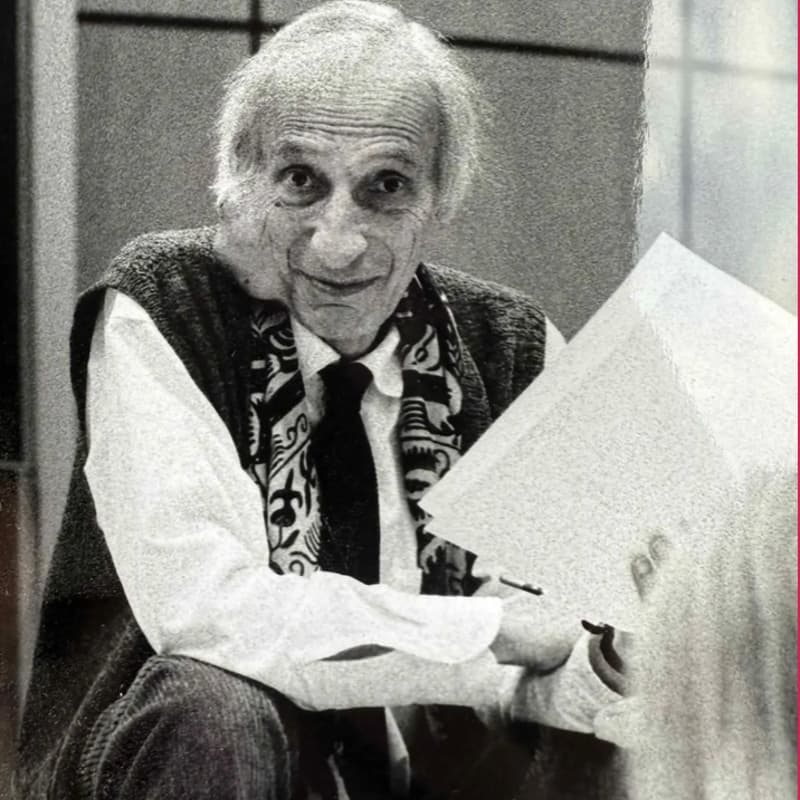
Illich At 100: We Are Holding A Birthday Party For Breakfast
A 100th birthday party for a man who is no longer around, and whom most of us never met. And we are holding this party across six different continents. You are welcome to join and celebrate.
I “met” Ivan Illich fairly recently thanks to Douglad Hines [If you haven’t met him yet go to FAQ where you can find more about him]
First, as he recommended me, I read ‘Ivan Illich in conversation’ by/with David Cayley, and I was hooked by the way Ivan meandered Cayley’s invitations, then I read ‘Deschooling Society’ and I recognised the profound sense of critic toward a safeguarding institution, the obligatory rite of passage to become a modern human, that my mum, a teacher from the late 50’s to the 80’s in Spain, would speak of at home. When I read ‘Medical Nemesis’ my disregard for ‘the medial establishment [which] has become a major threat to health’ found home again. When ‘Gender’ voiced my own scepticism toward ‘equality’ and ‘inclusion’ as part of the mechanisms of modern literacy, the self-regulating part of it, I started to groan, because I don’t have words for this prayer, so I groaned. With the possibility to celebrate in conspiracy his 100 birthday, I joined to the communal prayer, and because the waged work and the shadow work takes my evening weekends away from me, and because I have a ritual on Sunday mornings that allows me to sit and have conversations that don’t belong to any of those categories, I thought… What about a shared Sunday breakfast where we can have a long conversation with his texts? So here is the invitation:
Come and have breakfast with Ivan Illich’s work, or reflect on what his work has done to you, or maybe we choose a word from one of his texts and explore what does it mean for us, or maybe… just come and join and have breakfast with us, as he used to, we will set an extra place for the stranger who might arrive on Sunday September 6th at 09:00 UK time at Second Home on Gaelic Lane, Aberdeen.
Some FAQ:
Who was Illich?
Born in Vienna in 1926, Ivan Illich was many things. The son of a Jewish mother, fleeing the Nazis as a teenager. A Catholic priest who delighted in the local, hybrid traditions of Latin America, defended them against modernisation and fell out with the Vatican.
Founder of a centre in Cuernavaca, Mexico which became a kind of “free university” and crossing point for ideas from North and South.
A social thinker whose critiques of institutions made him famous in the 1970s, who outlived his fame and spent his later years gathering circles of friends with whom to explore the hidden assumptions on which the modern world was founded. A man whose work is finally reaching the “hour of its legibility”– as the philosopher Giorgio Agamben has suggested – in the years since his death in 2002.
What did he write?
Illich is best known for the short books hewrote in the 1970s: Deschooling Society, Tools for Conviviality , En ergy and Equity and Medical Nemesis . These books shone a light on the ways in which the systems of modern industrial society become counterproductive: beyond a certain point, schooling systems make us less capable, health systems create sickness, prisons create criminality.
What did he stand for?
Illich’s thinking is hard to pin down. He doesn’t fit the usual political or academic categories, but his influence has spread in many directions: from the environmental movement and “degrowth”, to the critique of international “development”, to the Zapatistas and Asset-Based Community Development. He’s read by hackers and technology critics, philosophers and theologians, farmers and musicians.
Where should I start?
You could try one of those books from the 1970s, or David Cayley’s Ivan Illich: In Conversation , which begins with an introduction to his life and work. Or explore the selection of shorter texts we’ve included on the Illich at 100 webpage.
Why are you organising this?
It started with a plan for an event in Sweden, hosted by Dougald Hine, Anna Björkman and Ayșem Mert. Word spread and people began talking about making a long journey to take part, but we decided it would be more appropriate to share an invitation to host local gatherings. So far, people have offered to host these in over 80 places on six continents.
Some of us are old friends of Illich, others newcomers to his work.