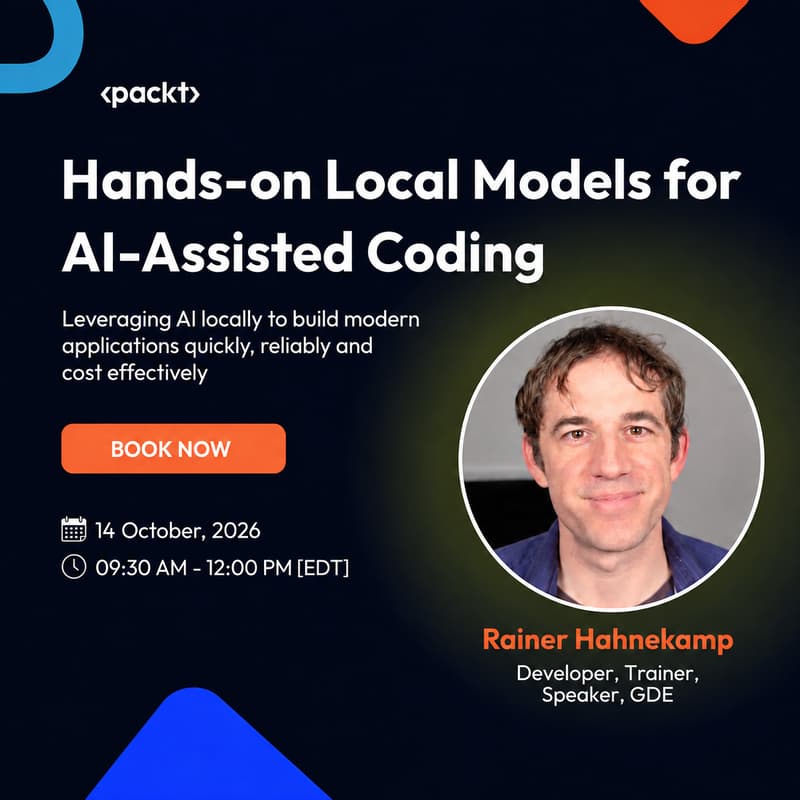

Hands-On Local Models for AI-Assisted Coding
Software developers typically use tools such as Claude Code or Codex with the vendors’ paid models. As usage grows, however, the associated costs can become significant.
Both tools can also connect to models running locally and avoid subscription fees or per-token charges. Agentic software development is demanding, though, so choosing the right model, hardware, and setup is important.
This workshop dives deep into what developers can realistically expect in terms of quality, what hardware they need, and how to configure Claude Code or Codex to work with local models.
By the end of the workshop, you’ll be able to:
Understand which local LLMs are suited for software development and how to build with them
Have an overview of the costs for the infrastructure
Configure your coding agents, like Claude Code/Codex to connect to your local LLM
Meet Your Instructor
Rainer Hahnekamp
Co-founder and AI Engineer at Soverius AI
Rainer is co-founder and AI Engineer at Soverius AI, and a Google Developer Expert (GDE), with fifteen years building mission-critical enterprise systems.
He specializes in local LLMs and everything it takes to run them in production - retrieval, harness and loop engineering, agents, and the UI they generate - so a company's data and source code never leave the building.
He has an academic foundation in Unsupervised Machine Learning from the University of Vienna.
You should walk away with:
Real-world examples of local AI:
developing
performance enhancement
configuration
A clear understanding of how to connect development and operations through AI-native workflows with real working examples that you can follow
Live Q&A with the speaker to explore implementation ideas and real-world concerns
You’ll also receive:
✔ full workshop recording
✔ certificate of completion
This workshop is ideal for:
Senior software engineers
Enterprise executives and decision-makers: Concerned with data governance, operational independence, and long-term cost predictability.
Prerequisites
Prior knowledge: You should have experience in AI-assisted development
Students and AI enthusiasts: Interested in exploring the latest local AI capabilities and hardware requirements for their own setups.