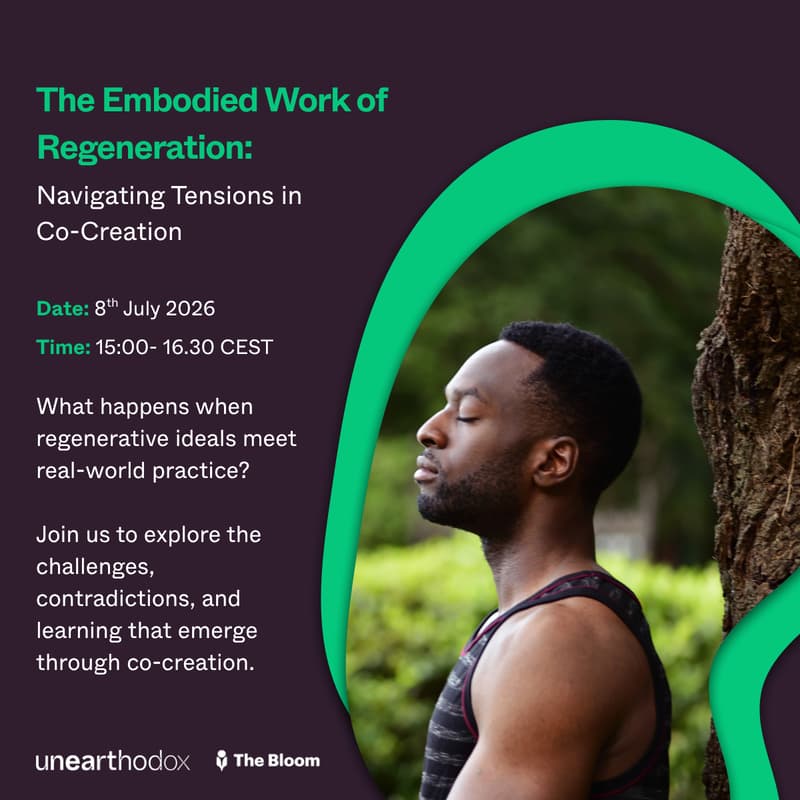

The Embodied Work of Regeneration: Navigating Tensions in Co-Creation
Do you navigate the complex space of systems change and regeneration?
Join us for a conversation that turns inward to ask: What really happens when regenerative ideals meet the friction of real-world practice?
Using the creation of the Anthology of Regenerative Futures as a case study, we'll celebrate the joy co-creation can bring and surface the tensions that emerged throughout the process because we believe that while the challenges are often glossed over, they hold profound learning potential for anyone engaged in collaborative, transformative work.
We’ll dive into three critical tensions:
Epistemic Plurality vs. Institutional Translation: How do we honour multiple ways of knowing while navigating dominant formats and expectations?
Relational Depth vs. Delivery Pressure: What happens when slow trust-building collides with fast timelines, contracts, and output demands?
Emergence vs. Structure: Can we maintain openness while meeting the need for clarity, boundaries, and direction?
We will also pay special attention to embodiment. While often used across many contexts, its meaning remains unclear. This session is an opportunity to unpack what embodied regenerative work actually looks like in practice: Why does it matter? How is it important? And how did it specifically manifest within our co-creation process?
🎯 Who Should Join?
Nature, conservation, climate and social impact practitioners, organisers, facilitators, and researchers working at the intersection of collaboration, transformation, and justice who want to be part of an honest reflection on what works, what doesn't, and what it truly takes to build something meaningful together through co-creation.
Host:
Melanie Ryan, CEO, Unearthodox
Panel:
• Anca Damerell, Director of Innovation, Unearthodox
• Lindsey Elliot, Freelance Consultant and Researcher, and witness to the Anthology
• Ashish Arora, Director of the Sahaj Foundation, and an author of the Anthology
• Lua Couto, Founder and Director of Futuro Possível
⏱ What to Expect?
A 1-hour panel followed by 30 minutes of open Q&A.