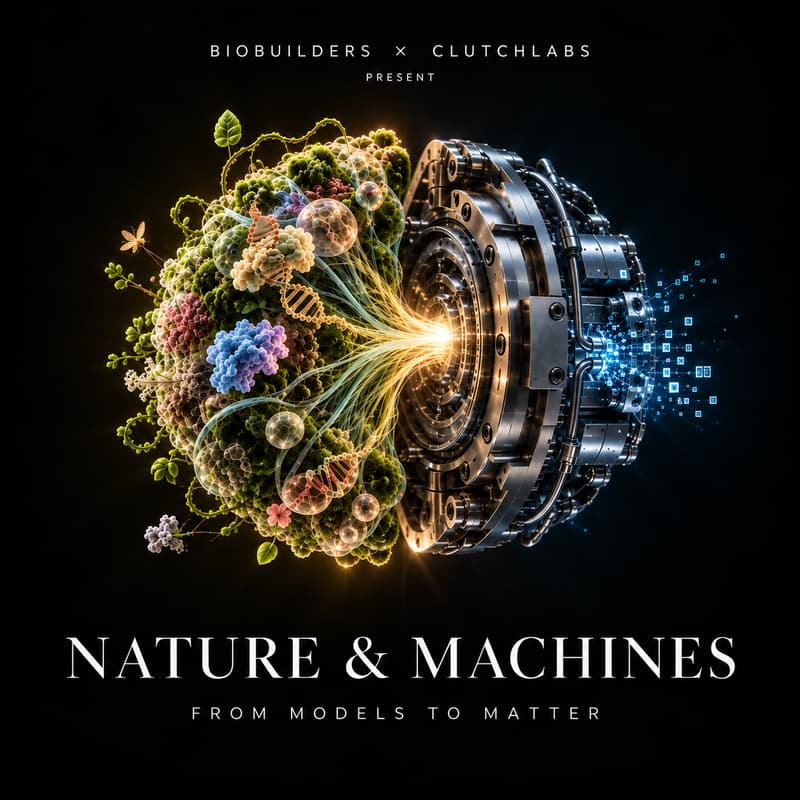
NATURE & MACHINES
What happens when intelligence gains the ability to manipulate matter?
BioBuilders × Clutchlabs × DiagnoBac's × m33
📅 11/09/2026
🕐 Starting from 7pm
📍 The Founding Co, Hyderabad.
About
An evening exploring the convergence of biology, AI, robotics and biomimetics, followed by dinner.
For the last decade, AI has learned to manipulate information. Now, models are beginning to act on the physical world.
Robots learn through interaction. AI designs molecules and biological systems. Autonomous labs connect models, machines and experiments into closed loops.
What can biology and machines learn from each other?
The Room
A room full of curious people building, researching, experimenting and asking questions at the edge of biology, AI and robotics.
Bring a project, prototype, experiment, strange idea, or simply a question you can't stop thinking about.
No speed networking. No pitch-and-run. Just interesting people and actual conversations.
We'll explore
What can machines learn from nature?
What does embodiment change about intelligence?
Can AI move from understanding biology to engineering it?
What happens when machines can design, build and run experiments?
What can biology and robotics learn from each other?
Who Should Apply?
This is an invite-only, builder-focused gathering with limited seats.
If you are actively building, researching, experimenting, or deeply exploring any of these areas, we would love to have you in the room.
Small room. Serious builders. Meaningful conversations.
Limited seats.
The idea
The most interesting breakthroughs may happen between fields that rarely talk to each other.
We're creating the room for those collisions.
Followed by dinner.
Our Hosts
BioBuilders
A community bringing together synthetic biologists, computational biologists, engineers, founders, researchers, and builders working at the intersection of biology, computation, and engineering.
Building toward physical intelligence — systems and models that can understand, learn from, and eventually act in the real world.
Building AI for intent-based biomolecular design.
Models that design nature’s microscopic machines.
Starting with NucleoFold, an AI model for designing functional DNA and RNA, with applications in molecular sensing and diagnostics.
m33
m33 is a community of ambitious deeptech builders across India, bringing together founders, engineers, researchers, and technologists working on hard problems across robotics, aerospace, biotech, AI, energy, defence, and beyond. It exists to connect builders, ideas, and opportunities, creating a strong ecosystem for people building at the frontier of technology.
Contact:
Ashwith: 7292829033
Vaibhav: 8919049271
More Information:
An evening exploring the convergence of biology, AI, robotics and biomimetics followed by dinner.
For the last decade, AI has learned to manipulate information.
The next frontier is learning to manipulate the physical world.
Robots are one way to do that. Biology is another.
Nature has spent billions of years solving problems of sensing, control, adaptation, locomotion, assembly, repair, and survival in the real world.
Now, we are beginning to engineer some of those capabilities ourselves.
Models are learning to reason and act through robots.
Generative systems are designing proteins, molecules, and biological machinery.
Autonomous laboratories are connecting models, experiments, robotics, and feedback into increasingly closed loops.
And across these fields, the same questions keep appearing:
How should intelligent systems sense?
How should they adapt?
How do they act under uncertainty?
How do they learn from the physical world?
Nature / Machines brings together builders, researchers, and scientists across biology, AI, robotics, and deep tech to explore these questions together.
This isn't about putting three industries in a room.
It's about finding the underlying engineering problems they are all beginning to encounter.