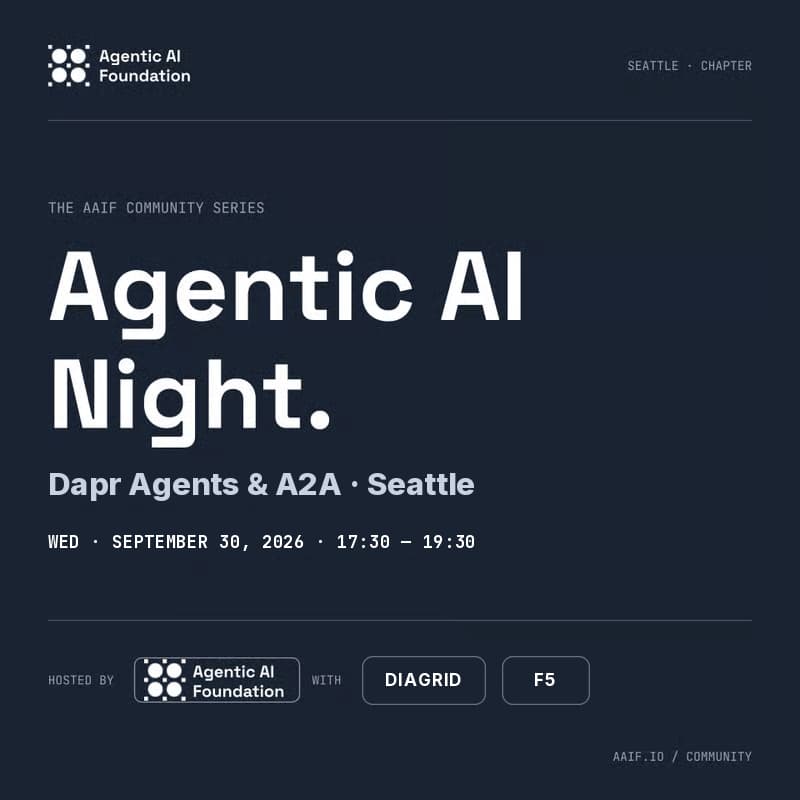

Agentic AI Night: A2A and the Agentic Stack
Everyone can build an agent. Far fewer can run one in production for six months.
This month AAIF Seattle looks at the layer underneath the prompt — the runtimes that keep agents alive across restarts, and the protocols that let agents from different vendors, teams, and stacks actually work together.
Two talks, pizza, and a room full of people building this stuff. Whether you're already running agents in production or still figuring out where the state goes, come hang out.
What We'll Cover
Durable execution and what a real agent runtime takes off your plate, plus agent-to-agent interoperability and where the A2A protocol fits alongside MCP.
Expect technical talks, live demos, and plenty of time to connect with other builders.
Agenda
05:00 pm — Doors open
05:30 pm — Pizza & networking
06:00 pm — Session 1: Dapr Agents
06:30 pm — Session 2: A2A Protocol
07:00 pm — Networking
Talk 1: Dapr Agents — The Agent Stack You Didn't Have to Write
Durable execution. Persistent memory. Swappable LLM providers. MCP tool connectivity. SPIFFE identity and mTLS. OpenTelemetry tracing with zero instrumentation. Multi-agent orchestration with messaging.
That's the Dapr Agents 1.0 feature list, and none of it is code you write. Dapr Agents is one of the most capable agent runtimes for building small, long-running, durable agents.
In this talk we'll build an agent in Python and show how much of "production-ready" comes from the runtime instead of your repo.
The Speakers
Yaron Schneider is Founder and CTO at Diagrid, and co-creator of Dapr and KEDA. He led engineering architecture for the Azure Container Apps serverless platform and the Azure Incubations team at Microsoft.
Mark Fussell is Founder and CEO at Diagrid, and co-creator of Dapr. He led product management on Azure's Service Fabric platform for 10 years and managed the Azure Incubations team where Dapr was developed.
Talk 2: The State and the Future of A2A Protocol
As AI environments evolve toward distributed multi-agent systems, connecting agents across disparate frameworks creates an unsustainable integration bottleneck. The Agent-to-Agent (A2A) protocol establishes an open, vendor-neutral standard for peer discovery, cryptographic verification, and task delegation. This session examines production architecture patterns for orchestrating composable, cross-platform agent collaboration at enterprise scale.
Speaker
Anisha Kaul is an AI Forward Deployed Engineer at Google Cloud, specializing in architecting, building, and delivering enterprise product architectures, multi-agent systems, and production-grade agentic workflows. She brings extensive technical expertise across full-stack AI development, including computer vision, multimodal evaluation, and model fine-tuning and has an extensive portfolio of machine learning publications and patented technologies for the energy industry.
Who Should Come:
AI engineers, platform and infrastructure engineers, developers, founders, researchers, open source contributors, and anyone interested in how agentic systems get built and operated in the real world.
Whether you're already shipping agents or just starting to explore the ecosystem, you'll find people to learn from and connect with.
Sponsors
Thank you to our sponsors. This event is made possible by Diagrid, founded by the creators of Dapr and KEDA, who are sponsoring the food and drinks this evening and sending Yaron Schneider and Mark Fussell to walk us through Dapr Agents. And thank you to F5 for opening their space and hosting us in Seattle.
Notes :
Parking: Street parking available, or use public transport
About AAIF
The Agentic AI Foundation (AAIF) is a community dedicated to advancing the understanding and practical application of agentic AI. We bring together engineers, researchers, founders, builders, and AI enthusiasts to explore how autonomous AI systems are designed, evaluated, and deployed.
Through reading groups, workshops, and community discussions, AAIF brings together engineers, researchers, founders, and AI enthusiasts to exchange ideas, challenge assumptions, and learn from one another.
By attending, you agree to our Code of Conduct and Privacy Policy.