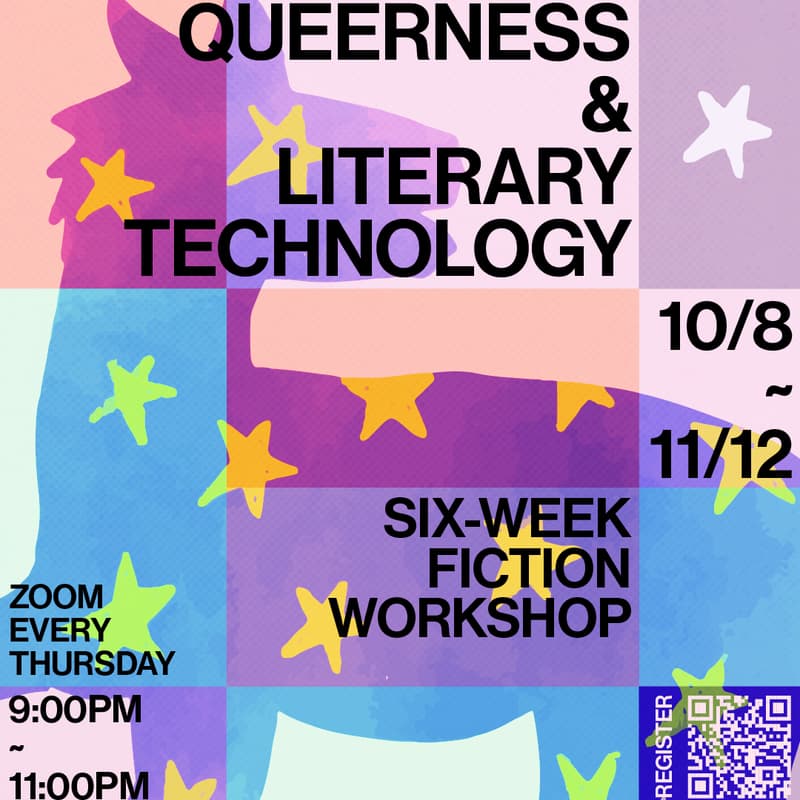

Queerness and Literary Technology : 6-Week Fiction Writing Workshop x Joss Lake
This workshop is for: Anyone exploring queerness, queer identities, trans identities, the relationship between technology and literature, folklore and fairytales, literary devices, writing rituals, and anyone wanting to develop longer works through a step-by-step process
As Carmen Maria Machado cites in her memoir In the Dream House, the Motif-Index of Folk-Literature by Stith Thompson features thousands and thousands of motifs that commonly appear in folklore. While Machado tried to make sense of her own narrative by framing it into some of the motifs, she could find none.
Literature is a type of technology, and storytelling is a machine. Both a phone and a motif are types of technology. As machines have strict engineering, some narratives follow forms and have dominated through history: The vampire who cannot find love in the sun, the wife who is locked in the house by her husband, the mermaid who must choose between a tail or a voice, the queer-coded Disney villains…
What happens when queer writers reimagine the limits of human perception and storytelling? What can marginalized writers reveal to us about ways of resisting or side-stepping dominant technological and literary discourses?
In his novel Future Feeling, Joss Lake not only blends technologies with fairytales but breaks forms. Lake said in an interview with The Believer, “When I was writing the book, it was hard to fully think of myself as transitioned or as someone comfortable in a trans identity. I needed the future. I wanted to build out a landscape where things that felt harder for me to grasp in the present could be fuller versions of themselves. The book’s future-pointing orientation exists more for reasons related to being trans than for reasons related to genre. I wanted to imagine myself in a more comfortable place.” Exploring technologies that have seeped into our lives, to more obscure practices, Lake then asked how he could bring speculative elements into the writing. “I was doing a lot of work with contemplative practices like meditation, and thinking ‘How do I bring this into fiction?’”
Fairytales follow forms, but queerness doesn’t. As we use different technologies to develop our writing, we also need to consider the ethics of using these technologies as well as the types of media we wish to be presented on.
In this six-week workshop, we will look at the writing of Chi Ta-Wei, CA Conrad, Akwaeke Emezi, Renee Gladman, Carmen Maria Machado to dig into new ways of writing about causality, gender, power, tools, and liberation. We will also complete generative exercises and craft four short pieces in which we’ll experiment with engineering new literary technologies.
Notes on the course from the instructor:
This is a process-based course, so please come ready to experiment and to think about how you are approaching your work. Language play is encouraged. We are not worried about "correctness" here: we want to explore the written word.
Required materials:
The Membranes by Chi Ta-Wei (original or translated version…your choice)
A notebook
All other texts will be provided
Writing assignments:
We will complete a number of in-class writing exercises (not to be turned in) and short (1-2 pg.) writing experiments. Please email them to me by the start of the class when they’re due.
For the cumulative assignment, you have a choice to take one of the exercises/experiments you have been working on and expand it into a longer (750-1,250 word) piece.
Writing process check-in:
At the beginning of each class, we’ll check in on how your writing (in this class, in other classes) is going and any practices or technologies that you’ve been implementing.
COURSE OUTLINE
Week 1: Ritual
In-class reading: Poems from CA Conrad’s Ecodeviance/ Somatics for the Future Wilderness
Discussion and defining “technologies”: What sorts of technologies are currently impacting your life? How can we create a more expansive definition? What sorts of technologies do you want to play with in your writing?
Writing: In-class exercise
Ritual-based writing experiment due Week 2
This series of 23 new (Soma)tic poetry rituals and resulting poems by CAConrad create what we can refer to as an "extreme present" set to reveal the creative viability of everything around us. Poetry rituals such as riding escalators and showing photographs of himself to strangers asking, “Excuse me, have you seen this person?” (Soma)tic rituals are a practice of unorthodox steps aimed at breaking us out of the quotidian and into a more political and physical spiritual consciousness of The New Wilderness.
Week 2: Fairytales/Horror
Writing process check-in
Weekly reading: Stories from Carmen Maria Machado’s Her Body and other Parties
In-class reading: Traditional fairy tales
Writing: In-class exercise
Fairy tale/horror-based writing experiment due Week 3
A wife refuses her husband’s entreaties to remove the green ribbon from around her neck. A woman recounts her sexual encounters as a plague slowly consumes humanity. A salesclerk in a mall makes a horrifying discovery within the seams of the store’s prom dresses. One woman’s surgery-induced weight loss results in an unwanted houseguest. And in the bravura novella “Especially Heinous,” Machado reimagines every episode of Law & Order: Special Victims Unit, a show we naively assumed had shown it all, generating a phantasmagoric police procedural full of doppelgängers, ghosts, and girls-with-bells-for-eyes… Her Body and Other Parties by Carmen Maria Machado is a collection of stories that demolish the arbitrary borders between psychological realism and science fiction, comedy and horror, fantasy and fabulism.
Week 3: The Future
Writing process check-in
Weekly reading: Chi Tai-Wei’s Membranes (Chapters 1-6)
Membranes discussion: Political/literary context, ecological anxiety, technological anxiety, relationships, queer identity
Writing: In-class exercise: Writing the future
First published in Taiwan in 1995, The Membranes is a classic of queer speculative fiction in Chinese. Chi Ta-wei weaves dystopian tropes—heirloom animals, radiation-proof combat drones, sinister surveillance technologies—into a sensitive portrait of one young woman’s quest for self-understanding. Predicting everything from fitness tracking to social media saturation, this visionary and sublime novel stands out for its queer and trans themes. The Membranes reveals the diversity and originality of contemporary speculative fiction in Chinese, exploring gender and sexuality, technological domination, and regimes of capital, all while applying an unflinching self-reflexivity to the reader’s own role. Ari Larissa Heinrich’s translation brings Chi’s hybrid punk sensibility to all readers interested in books that test the limits of where speculative fiction can go.
Week 4: The Future, Cont’d.
Writing process check-in
Weekly reading: Chi Tai-Wei’s Membranes (Chapters 7-13) (finish book)
In-class materials: Cyborgs, punk, interview between Ari Larissa Heinrich and Chi Ta-wei -- Columbia University Press Blog
Excerpt from Annalee Newitz’s Automatic Noodle
Writing: In class exercise: Technology is not all bad: Solar punk futures
Start thinking about cumulative assignment
Annalee Newitz’s Automatic Noodle is a cozy near-future novella about a crew of leftover robots opening their very own noodle shop.
You don’t have to eat food to know the way to a city’s heart is through its stomach. So when a group of deactivated robots come back online in an abandoned ghost kitchen, they decide to make their own way doing what they know: making food—the tastiest hand-pulled noodles around—for the humans of San Francisco, who are recovering from a devastating war. But when their robot-run business starts causing a stir, a targeted wave of one-star reviews threatens to boil over into a crisis. To keep their doors open, they’ll have to call on their customers, their community, and each other—and find a way to survive and thrive in a world that wasn’t built for them.
Week 5: The City
Writing process check-in
Weekly reading: Renee Gladman’s The Event Factory excerpts
In-class materials: Excerpt from Samuel R. Delany’s Dhalgren
Writing: In-class exercise
Optional city writing experiment
A “linguist-traveler” arrives by plane to Ravicka, a city of yellow air in which an undefined crisis is causing the inhabitants to flee. Although fluent in the native language, she quickly finds herself on the outside of every experience. Things happen to her, events transpire, but it is as if the city itself, the performance of life there, eludes her. Setting out to uncover the source of the city’s erosion, she is beset by this other crisis—an ontological crisis—as she struggles to retain a sense of what is happening.
Bellona is a city at the dead center of the United States. Something has happened there…. The population has fled. Madmen and criminals wander the streets. Strange portents appear in the cloud-covered sky. Into this disaster zone comes a young man—poet, lover, and adventurer—known only as the Kid. Tackling questions of race, gender, and sexuality, Dhalgren is a literary marvel and groundbreaking work of American magical realism.
Week 6: Potency
Cumulative piece due at the beginning of class
Writing process check-in
Weekly reading: Excerpts from Akwaeke Emezi’s Dear Senthuran
Writing: In-class exercise (letter to self)
Presentations/Celebration!
In this extraordinary memoir, Akwaeke Emezi reveals the harrowing yet resolute truths of their own life. Through candid, intimate correspondence with friends, lovers, and family, Emezi traces the unfolding of a self and the unforgettable journey of a creative spirit stepping into power in the human world. Their story weaves through transformative decisions about their gender and body, their precipitous path to success as a writer, and the turmoil of relationships on an emotional, romantic, and spiritual plane, culminating in a book that is as tender as it is brutal.
About the instructor:
Joss Lake is a novelist and educator. His first book, Future Feeling, was longlisted for the PEN/Hemingway award for debut novel. He was named one of the Strand’s “30 Writers to Watch.” He teaches at Columbia University and NYU. He was a 2022 Jacob Julien Visiting Writer at Wesleyan University and a 2024 Writer-in-Residence at SUNY-New Paltz. He runs a literary sauna series called Trans at Rest and received a Columbia University Provost’s Emerging Technology Grant to implement VR into creative writing courses. He lives in the Catskills.
Instagram: joss.e.lake
About Future Feeling:
An embittered dog walker obsessed with a social media influencer inadvertently puts a curse on a young man—and must adventure into mysterious dimension in order to save him—in this wildly inventive, delightfully subversive, genre-nonconforming debut novel about illusion, magic, technology, kinship, and the emergent future.
The year is 20__, and Penfield R. Henderson is in a rut. When he's not walking dogs for cash or responding to booty calls from his B-list celebrity hookup, he's holed up in his dingy Bushwick apartment obsessing over holograms of Aiden Chase, a fellow trans man and influencer documenting his much smoother transition into picture-perfect masculinity on the Gram. After an IRL encounter with Aiden leaves Pen feeling especially resentful, Pen enlists his roommates, the Witch and the Stoner-Hacker, to put their respective talents to use in hexing Aiden. Together, they gain access to Aiden's social media account and post a picture of Pen's aloe plant, Alice, tied to a curse:
Whosoever beholds the aloe will be pushed into the Shadowlands.
When the hex accidentally bypasses Aiden, sending another young trans man named Blithe to the Shadowlands (the dreaded emotional landscape through which every trans person must journey to achieve true self-actualization), the Rhiz (the quasi-benevolent big brother agency overseeing all trans matters) orders Pen and Aiden to team up and retrieve him. The two trace Blithe to a dilapidated motel in California and bring him back to New York, where they try to coax Blithe to stop speaking only in code and awkwardly try to pass on what little trans wisdom they possess. As the trio makes its way in a world that includes pitless avocados and subway cars that change color based on occupants' collective moods but still casts judgment on anyone not perfectly straight, Pen starts to learn that sometimes a family isn't just the people who birthed you.
Magnificently imagined, linguistically dazzling, and riotously fun, Future Feeling presents an alternate future in which advanced technology still can't replace human connection but may give the trans community new ways to care for its own.
六周工作坊:酷儿文学与技术(授课人:Joss Lake)
时间:10月8日 - 11月12日,纽约时间晚上9点 - 11:30
地点:Zoom
本工作坊适合以下人群:所有探索酷儿文学、酷儿身份、跨性别身份、技术与文学之关系、民间传说与童话、文学技巧、写作仪式的人,以及任何想要通过循序渐进的过程创作更长篇幅作品的人。
正如卡门·玛丽亚·马查多(Carmen Maria Machado)在她的回忆录《梦屋》(In the Dream House)中引用的那样,斯蒂思·汤普森(Stith Thompson)编纂的《民俗文学母题索引》(Motif-Index of Folk-Literature)收录了数以万计在民间传说中常见的故事母题分类体系(Motif)。然而,当马查多试图通过将自己经历的故事套用在这些叙事框架中来理解发生在她自己身上的事时,却一无所获。
机器有着严格的工程学结构,某些叙事也遵循特定形式并在历史中占据主导:无法在阳光下寻找爱情的吸血鬼、被丈夫锁在屋里的妻子、必须在鱼尾和声音之间做出抉择的人鱼,以及带有酷儿隐喻的迪士尼反派……
当酷儿作家重新构想人类感知和叙事的极限时,会发生什么?边缘化作家能向我们揭示哪些抵制或绕过主流技术与文学话语的方式?
在其小说 Future Feeling 中,Joss Lake不仅将技术与童话故事融为一体,更打破了现有的形式。Lake在接受 The Believer 杂志采访时表示:“当我创作这本书时,很难完全将自己视为已完成跨性别过渡的人,或是对跨性别身份感到舒适的人。我需要未来。我想构建一片景观,在其中那些我在当下难以企及的事物能够展现出更完整的自我。这本书指向未来的导向,更多是出于跨性别身份的原因,而非出于类型文学的原因。我想想象自己处于一个更舒适的境地。”在探索了渗透进我们生活的各种技术以及更隐秘的实践之后,Lake思考了如何将思辨元素引入写作中:“我当时做了很多冥想等沉思性实践,并思考‘我该如何将这些带入虚构创作中?’”
传统故事遵循既定的形式,但酷儿性却并非如此。当我们使用不同的“科技”和文学技术来推进写作时,我们也需要考量使用这些技术的道德准则,以及我们希望自己的作品在何种媒介形态上呈现。
在这为期六周的工作坊中,我们将研读纪大伟、C.A. 康拉德(CA Conrad)、阿克瓦埃克·埃梅齐(Akwaeke Emezi)、芮妮·格拉德曼(Renee Gladman)以及卡门·玛丽亚·马查多的作品,以挖掘写作因果关系、性别、权力、工具和解放的新途径。我们还将完成写作练习,并创作四篇短作,在其中实验构建全新的文学技术。
来自导师的课程说明: 本课程是一门注重过程的课程,因此请做好准备去大胆实验,并思考你是如何对待自己的作品的。我们鼓励语言实验。在这里我们不关心“正确性”:我们想要探索的是文字本身。
必备材料:
纪大伟的《膜》(原版或译本皆可,由你决定)
一本笔记本
所有其他文本将由课程提供
课堂作业与作品:
我们将完成若干课堂写作练习(无需提交)以及短篇(1-2页)写作实验。请在作业截止课时开始前通过电子邮件发送给导师。
最终作品,你可以选择将一直在写的某项练习/实验拓展为一篇更长(750-1,250字)的作品。
写作进程打卡: 在每节课开始时,我们将打卡了解你的写作进展(包括本课程及其他课程)以及你一直在应用的技术或实践。
课程大纲
第一周:仪式
课堂阅读: 选自 C.A. 康拉德 Ecodeviance / Somatics for the Future Wilderness 的诗歌
讨论与界定“技术”: 目前有哪些技术在影响你的生活?我们如何建立一个更具扩展性的定义?你希望在写作中玩转哪些技术?
写作: 课堂练习
作业: 基于仪式的写作实验(第二周提交)
这23个全新的身体(Soma)诗歌仪式及由此诞生的诗歌,创造了一个我们可以称之为“极端当下”的境地,意在揭示我们身边万物的创作可行性。诗歌仪式包括搭乘自动扶梯,以及向陌生人展示自己的照片等一系列看似简单对的行为。身体仪式是一种非传统步骤的实践,旨在将我们从日常琐碎中解放出来,进入对“新荒野”的政治性与身体性精神意识中。
第二周:童话/恐怖
写作进程打卡
每周阅读: 选自卡门·玛丽亚·马查多的《她的身体与其他派对》(Her Body and Other Parties)中的故事
课堂阅读: 传统童话
写作: 课堂练习
作业: 基于童话/恐怖的写作实验(第三周提交)
一位妻子拒绝了丈夫关于解开她脖子上绿色缎带的央求;一位女性在瘟疫慢慢吞噬人类之际回顾了自己的性经历;一位商场售货员在店铺的舞会礼服缝隙中发现了令人毛骨悚然的秘密;一位女性因手术减肥却引来了不受欢迎的寄宿客。在精妙绝伦的中篇小说《极其邪恶》(Especially Heinous)中,马查多重构了《法律与秩序:特殊受害者》的每一集:我们曾天真地以为这部剧已经展现了一切,她却生成了一出充满分身、幽灵和长着铃铛眼睛的女孩的幻境警匪剧……卡门·玛丽亚·马查多的《她的身体与其他派对》是一粉碎了心理现实主义与科幻、喜剧与恐怖、幻想与寓言小说之间任意划定的边界的部短篇小说集。
第三周:关于未来
写作进程打卡
每周阅读: 纪大伟《膜》(第1-6章)
《膜》讨论: 政治/文学语境、生态焦虑、技术焦虑、人际关系、酷儿身份
写作: 课堂练习:书写未来
《膜》于1995年在台湾首次出版,是中文酷儿思辨小说(Speculative Fiction)的经典之作。纪大伟将反乌托邦母题——传家宝宠物、防辐射战斗无人机、阴森的监控技术——融入对一位年轻女性探索自我理解的敏感刻画中。这部富有远见且崇高的作品预言了从健身追踪到社交媒体饱和的一切,因其酷儿和跨性别主题而脱颖而出。《膜》展现了当代中文思辨小说的多样性与独创性,探索了性别与性取向、技术主导以及资本政权,同时对读者自身扮演的角色应用了毫不动摇的自我反思性。韩瑞奇(Ari Larissa Heinrich)的译本将纪大伟混合了朋克特质的敏锐感带给了所有对探寻思辨小说边界感兴趣的读者。
第四周:关于未来(续)
写作进程打卡
每周阅读: 纪大伟《膜》(第7-13章)(读完全书)
课堂材料: 赛博格、朋克、韩瑞奇与纪大伟的访谈——哥伦比亚大学出版社博客
课堂阅读节选: 选自安娜莉·纽威茨(Annalee Newitz)的 Automatic Noodle
写作: 课堂练习
提示: 开始构思最终作业
安娜莉·纽威茨的 Automatic Noodle 是一部温馨的近未来中篇小说,讲述了一群被废弃的机器人开办属于自己的面馆的故事。打动一座城市内心的途径是通过它的胃,因此,当一群被停用的机器人在一间废弃的阴暗厨房里重新上线时,他们决定用自己所掌握的技能闯出一条路:为旧金山正从毁灭性战争中复苏的人类制作食物——当地最美味的手拉面。然而,当他们的机器人小店开始引发轰动时,一波有预谋的一星差评威胁着要演变成一场危机。为了维持营业,他们必须寻求顾客、社区以及彼此的支持——并在一个并非为他们而建的世界中找到生存与繁荣的方法。
第五周:城市
写作进程打卡
每周阅读: 芮妮·格拉德曼《事件工厂》(The Event Factory)节选
课堂材料: 选自萨缪尔·R·德拉尼(Samuel R. Delany)的《达尔格伦》(Dhalgren)
写作: 课堂练习
作业: 城市写作实验(选做练习)
一位“语言学家旅行者”乘飞机抵达拉维卡(Ravicka),这是一座空气黄昏的城市,一场定义不明的危机正导致居民纷纷逃离。尽管她精通当地语言,却很快发现自己处于每一种体验的边缘。事情在她身上发生,事件在演变,但仿佛这座城市本身、以及这里生活的上演,都在逃离她的理解。在出发寻找城市侵蚀根源的过程中,她陷入了另一种危机——存在论危机——因为她在努力维持对所发生事情的认知感。
贝罗纳(Bellona)是一座位于美国正中心的城市。那里发生了某些变故……人口已经逃离。疯子和罪犯在街上游荡。奇异的征兆出现在阴云密布的天空中。在这片灾难之地,迎来了一位同是诗人、情人兼冒险家的年轻男子。《达尔格伦》探讨了种族、性别和性取向问题,是一部文学奇迹,也是美国魔幻现实主义的开创性作品。
第六周:潜能
作业: 最终作业在课前提交
写作进程打卡
每周阅读: 选自Akwaeke Emezi 的 Dear Senthuran 节选
写作: 课堂练习(写给自己的一封信)
活动: 展示与庆祝!
在这部回忆录中,Akwaeke Emezi揭示了他们自身生活中令人揪心却又坚定不移的真相。通过与朋友、恋人和家人坦诚、亲密的通信,Emezi勾勒出自我的展开,以及一个创造性灵魂在人类世界中步入权力的难忘历程。他们的故事穿插了关于性别和身体的变革性决定、他们作为作家走向成功的陡峭之路,以及在情感、浪漫和精神层面上的人际关系动荡,最终汇集成一本既温柔又残酷的作品。
关于导师: Joss Lake 是一位小说家和教育家。他的首部作品 Future Feeling 入围了PEN/Hemingway 的首作小说奖的长名单。他被《Strand》杂志评为“最值得关注的30位作家”之一。他在哥伦比亚大学和纽约大学任教。他曾担任卫斯理大学2022年度 Jacob Julien 客座作家,以及 SUNY-New Paltz 2024年度驻校作家。他主持名为“Trans at Rest”的文学桑拿系列活动,并获得了哥伦比亚大学教务长新兴技术基金,将虚拟现实(VR)引入创意写作课程。他现居卡Catskills。
关于 Future Feeling:
一位对社交媒体网红心怀执念、愤世嫉俗的溜狗师,不小心将咒语降临在了另一位年轻男子身上。为了拯救他,溜狗师必须踏上一场前往神秘维度的冒险之旅。这部令人惊叹、颠覆传统的小说深刻探讨了幻象、魔法、科技、亲族关系与正在涌现的未来。
故事发生在20__年,Penfield R. Henderson 陷入了人生低谷。每当他不靠帮人溜狗赚钱,或是应对那位B级明星炮友的约炮电话时,他就会窝在布什维克破旧的公寓里,痴迷地盯着 Aiden Chase 的全息投影。艾登也是一名跨性别男性兼网红,在Instagram上记录着自己那顺遂得多、堪称完美的跨性别转型历程。在一场现实中的偶遇让,Penfield感到格外愤恨之后,他联合了自己的室友:一位女巫和一位吸大麻的黑客发挥各自的才能向Aiden施咒。他们联手盗取了艾登的社交媒体账号,并发布了一张彭菲尔德养的芦荟“爱丽丝”的照片,上面附有一条诅咒:凡瞩目此芦荟者,必被推入 Shadowlands,一个令人生畏的情感领域,每一位跨性别者都必须穿越它才能实现真正的自我认知。然而,咒语却意外绕过了Aiden,将另一位名叫布Blithe的年轻跨性别男子送进了Shadowlands。负责监管所有跨性别事务的半慈善机构 “The Rhiz” 命令Penfield与Aiden组队将他带回。两人追踪布莱斯来到加州一家破旧的汽车旅馆并将他带回纽约。在那里,他们试图劝说布Blithe不再只用代码说话,并笨拙地向他传授自己仅有的一点点跨性别经验。在这个拥有无核牛油果、车厢颜色会根据乘客共同情绪变化,却依然对任何非异性恋者抱有偏见的全新世界里,随着三人的共同前行,Penfield开始明白:有时,家人并不局限于赋予你生命的人。
Future Feeling 构思奇绝、语言华丽且充满狂欢般的乐趣。它呈现了一个另类的未来:在那里,尖端科技依然无法替代人与人之间的连接,却可能为跨性别群体提供照顾彼此的全新方式。