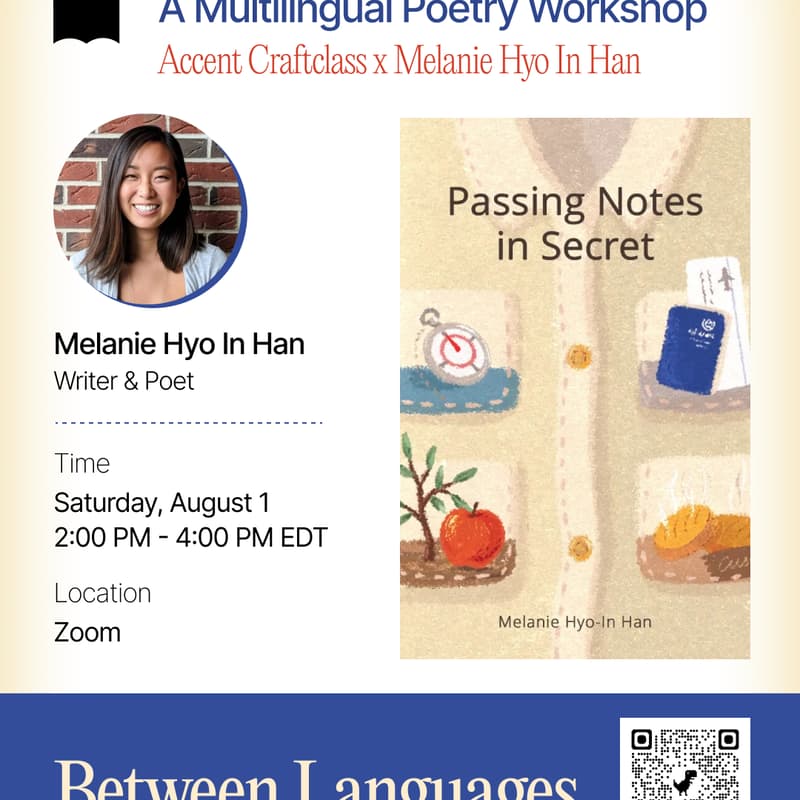

Accent Craftclass x Melanie Hyo In Han | Between Languages — A Multilingual Poetry Workshop
What does it mean to write in more than one language or in the space(s) between them? What happens when a word refuses to be translated? How about when the act of switching languages becomes the poem itself?
In this workshop, poet and translator Melanie Hyo-In Han invites participants to explore the craft and politics of multilingual poetry. Drawing on her own practice as a writer born in Korea, raised in East Africa, and shaped by multiple languages and cultures, Melanie will guide participants through key concepts in multilingual poetics and offer hands-on writing prompts to generate new poems.
Together, we will read and discuss poems that move across linguistic boundaries, exploring how multilingualism functions as formal and aesthetic strategy. We'll look at how poets use white space, fragmented syntax, code-switching, and invented language to embody the experience of living between worlds. We'll ask: when does choosing not to translate become an act of artistic defiance? When does it become an act of care?
Participants will be invited to draw on any language(s) of their choice, whether fluent or forgotten, inherited or learned. Whether you speak two languages or ten or feel the ghost of a language you never fully acquired, this workshop offers a space to explore what those languages make possible on the page.
Key concepts:
Translanguaging: moving between linguistic systems
Code-switching: shifting between languages
The untranslatable
Hybrid and fragmented forms
Writing prompt(s) sneak peek:
The languages you know, have lost, or wish you had
Words that resist translation
How your body remembers sound
"The first word I ever forgot was…"
"I live between these words and worlds…"
The workshop includes guided close readings, a collaborative warm-up activity, time for independent writing, and a group share and reflection. No formal background in poetry or linguistics is required, only curiosity and a willingness to play with language in all its forms. This workshop is open to writers at any stage, including complete beginners. Participants are welcome (and encouraged!) to write in any language. There are no right or wrong ways to engage with the material. Every language is welcome here.
Discussion Text and Questions: "Language Studies: 'Ahooyawpe' / From the Air" by Casandra López
How does the poet reimagine the relationship between language and technology? What does it mean that her phone autocorrects her Indigenous language away?
The poem moves between Tongva words and English without providing a glossary or translation. How did you experience the untranslated words? Did "not understanding" change how the poem landed for you?
How does the act of naming (or teaching her phone to speak her language) function as both resistance and tenderness? What does it mean to "gentle parent" a technology?
Notice the wide, scattered spacing of words across the lines. How does the visual arrangement of the poem on the page contribute to its meaning? What might it be enacting?
The poem ends with "Wehee'pore yaayt / May the two of us awaken." Who or what do you think the "two of us" refers to? How does that final image reframe everything that came before?
Whose languages get autocorrected, spell-checked, or flagged as errors? What does that say about which languages technology is built to serve?
Is there a word or phrase in your own language(s) that you've ever had to defend, explain, or fight to keep? What did that feel like?
Reading List:
Poetry Collections
Theresa Hak Kyung Cha's Dictee
Layli Long Soldier's Whereas
Ocean Vuong's Night Sky with Exit Wounds
Don Mee Choi's DMZ Colony
Franny Choi's Soft Science
M. NourbeSe Philip's Zong!
Essay
Gloria Anzaldúa's Borderlands/La Frontera: The New Mestiza ("How to Tame a Wild Tongue")
Born in Korea and raised in East Africa, Melanie Hyo-In Han recently moved from the U.S. to the U.K. She is the author of Passing Notes in Secret (boats against the current, 2025), Abecedarian: Banff, Canada (kith books, 2025), My Dear Yeast (Milk & Cake Press, 2023), and Sandpaper Tongue, Parchment Lips (Finishing Line Press, 2021), as well as the translator of several collections of Spanish poetry (Hebel Ediciones).
Her work has been supported by fellowships from Banff Centre for Arts and Creativity, Gladstone's Library, The Society of Authors, Sundress Academy for the Arts, the Kees Eijrond Foundation, and Casa Uno. She has received awards from The International Human Rights Festival, "Boston in 100 Words," Valiant Scribe, The Lyric Magazine, and elsewhere.
Currently, she teaches undergraduate literature and creative writing at the University of Surrey. She is the Co-Editor-in-Chief of Flora Fiction and Two Languages Prize Editor at Gasher Press and holds a PhD in Creative Writing and an MFA in Poetry and Translation.
Learn more at melaniehan.com.