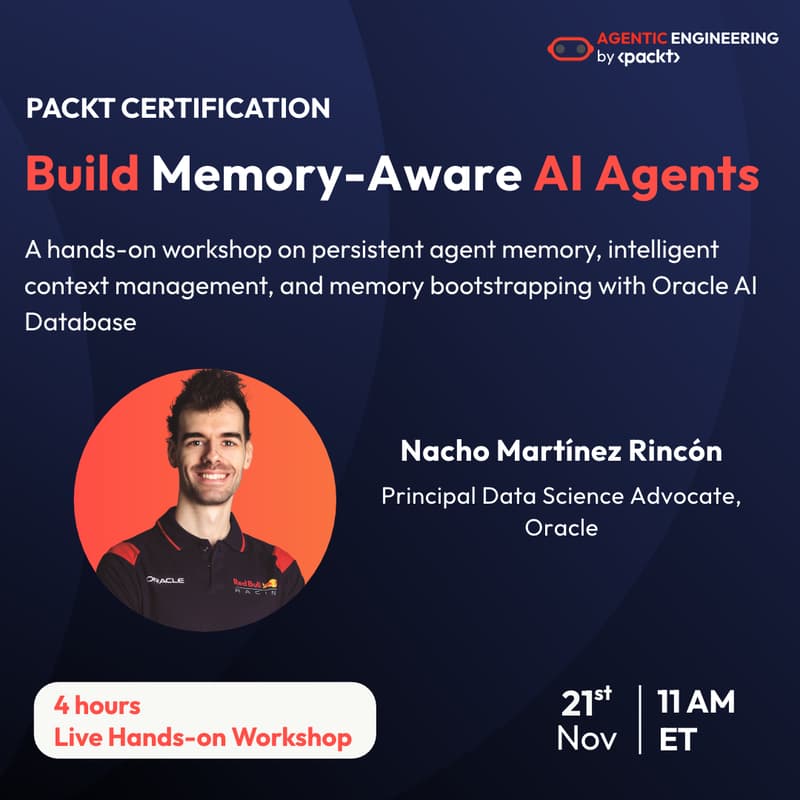

Build Memory-Aware AI Agents
Build agents that remember more than the current conversation
Giving an AI agent tools is relatively easy. Giving it the ability to remember what matters, carry context across sessions, retrieve the right knowledge at the right moment, and avoid overwhelming its context window is a much harder engineering problem.
In this intensive four-hour workshop, Nacho (jasperan) Martínez Rincón, AI Engineer and Developer Advocate at Oracle, will show you how to move from a stateless agent to a memory-augmented architecture you can actually run and extend.
Working live with the Oracle Agent Memory Package, you’ll explore how production-oriented agent memory can be structured into distinct memory stores, build persistent conversational memory, and see how the skillbox/toolbox pattern can dynamically retrieve the tools and instructions an agent needs instead of loading everything into every prompt.
You’ll then take memory one step further by generating synthetic conversations, workflows, entities, knowledge, skills, and tools to bootstrap an agent with useful operating context from its very first interaction.
This isn't just a discussion about memory architecture. You'll work through hands-on labs and leave with working code, reusable notebooks, and an architectural model you can apply to your own agent systems.
Instructor:
Nacho Martínez Rincón
Nacho is an AI Engineer and Developer Advocate at Oracle focused on autonomous agents, AI infrastructure, and developer education. With more than seven years of experience in machine learning and cloud technologies, he builds practical AI systems and open-source tools spanning RAG, multi-agent architectures, and real-time AI applications. He is also an active speaker and community contributor, sharing expertise on scalable AI and emerging technologies through conferences, workshops, and open-source projects.
What You Will Be Able to Do After the Workshop
By the end of the workshop, you will be able to:
Build a memory-augmented AI agent using the Oracle Agent Memory Package and Oracle AI Database.
Design an agent memory architecture using seven typed memory stores: conversational, knowledge base, workflow, toolbox, entity, summary, and tool log.
Create persistent conversations that can survive reconnections and continue across sessions.
Automatically extract useful memories from agent interactions and retrieve them when needed.
Implement the skillbox/toolbox pattern to keep an agent's active context bounded as its collection of tools and capabilities grows.
Retrieve relevant tools and skills dynamically rather than placing every tool definition into every LLM call.
Bootstrap agent memory with synthetic data, giving a new agent useful operating context without waiting for months of real interactions to accumulate.
Evaluate where different kinds of memory belong and explain your architecture in an engineering or design review.
What you will work on
During the workshop, you will create:
An FDE skill-stack self-assessment
A personal strengths-and-gaps heatmap
An employer-fit and target-company map
A 90-day regulated AI-agent deployment plan
A security and governance checklist
An evaluation and reliability scorecard
A deployment risk register
A 90-day FDE career action plan
Why Attend?
You will leave with a memory-augmented agent that actually runs. Not a slide deck — a notebook on your laptop with persistent threads, automatic memory extraction, and a context card going into every LLM call.
Memory is the part of agent engineering nobody teaches well. This workshop puts the seven typed memory stores (conversational, knowledge base, workflow, toolbox, entity, summary, tool log) on screen, then maps them to a real database schema.
The skillbox / toolbox pattern is your defence against context-window collapse. Once you have 30 tools, jamming all their schemas into every turn is unworkable. You will leave knowing how to retrieve only what is relevant — in-database, with one SQL statement.
Synthetic data lets your agent start with operating context. The closing lab generates synthetic memories and bulk-loads them into Oracle so a fresh agent has workflows, entities, and prior threads to retrieve against. We discuss honestly what synthetic memory can and cannot stand in for — it bootstraps operating context, not ground truth about users.
Prerequisites
You should be:
Comfortable working with Python 3.10+.
Familiar with basic LLM API usage, including chat completions and tool calls.
Comfortable working in a notebook-based development environment.
You do not need Oracle DBA experience.
For the hands-on exercises, you will need:
A laptop with Docker or Podman installed.
Python 3.10+.
Jupyter.
An API key for OpenAI or another LiteLLM-supported provider.
Access to a coding agent such as Claude Code or Codex.
The complete workshop environment will be set up during the live session.