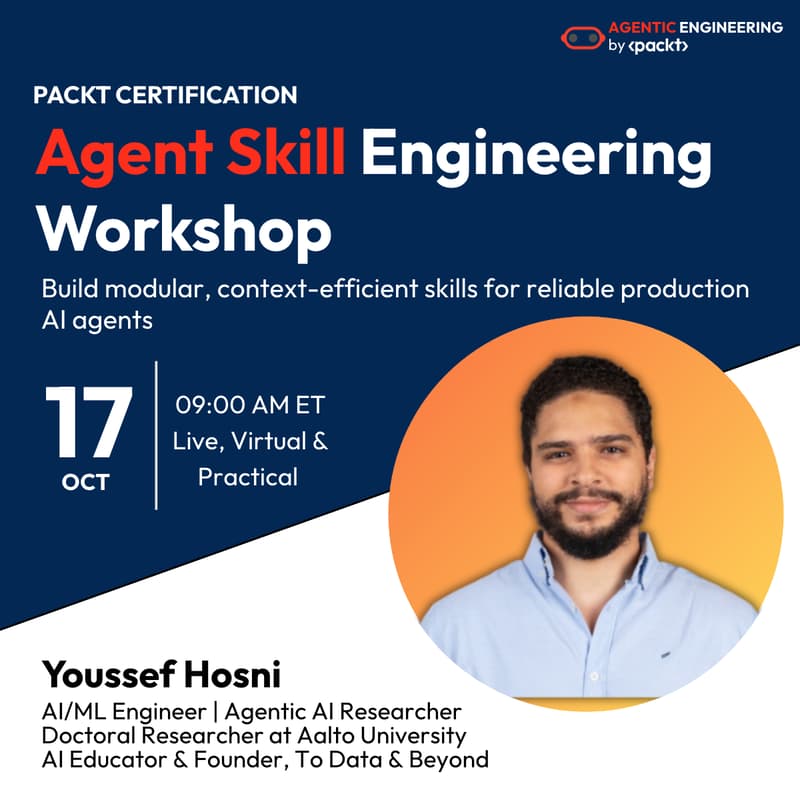

Agent Skill Engineering Workshop
AI agents quickly become difficult to maintain when every instruction, workflow, tool rule, and piece of context is packed into one growing prompt.
Agent Skill Engineering Workshop is a one-day, hands-on workshop for software and application developers who want a better way to build agentic systems.
You’ll learn how to break complex agent behavior into focused, reusable skills that can be discovered and loaded when needed, instead of forcing the model to carry everything in context all the time.
Using Claude and Claude Code for the hands-on implementation, you’ll design, package, compose, test, and evaluate Agent Skills while learning patterns that transfer to modern agent architectures beyond a single platform.
By the end of the day, you won’t just understand Agent Skills. You’ll have built a reusable skill system you can adapt to your own applications and development workflows.
Why Agent Skill Engineering?
Getting an agent to work once is easy.
Getting it to work reliably, repeatedly, and without an ever-growing prompt is much harder.
As agentic applications grow, developers run into familiar problems:
Prompts become monolithic and difficult to maintain
Too much context is loaded for every task
Instructions get duplicated across agents and workflows
Capabilities are difficult to reuse across applications
Changes to one workflow unexpectedly affect another
Agent behavior becomes increasingly difficult to test and debug
Permissions and tool access become harder to reason about
Agent Skills provide a different architectural model.
Instead of treating the prompt as the application, you package individual capabilities into small, scoped, reusable units that agents can discover and invoke when required.
This workshop teaches you how to engineer those capabilities properly.
What You'll Learn
During the workshop, you'll learn how to:
Distinguish between prompts, tools, workflows, agents, and skills
Break complex agent behavior into well-defined capabilities
Design skills with clear inputs, outputs, and responsibility boundaries
Use progressive disclosure to keep agent context focused
Reduce context overload with selective skill loading
Package instructions and supporting resources into reusable skills
Build tool-aware skills for real application workflows
Compose multiple skills into larger agent systems
Design skills that can be maintained and versioned over time
Test skills for correctness, reliability, and failure handling
Evaluate latency and context-cost trade-offs
Apply permissions, trust boundaries, and production guardrails
What You'll Build
This is a build-along workshop, not a five-hour presentation.
During the day, you'll create:
A task-specific Agent Skill
Turn a repeatable development task into a capability an agent can discover and execute.
A reusable file-based Skill package
Structure instructions, metadata, resources, and supporting files so the capability can travel across projects.
A tool-enabled Skill
Connect an agent capability to tools or APIs while keeping responsibilities and permissions clearly bounded.
A multi-Skill workflow
Compose several focused capabilities into a larger agent workflow without falling back to one giant system prompt.
A production evaluation checklist
Assess skills for reliability, context usage, failure handling, permissions, security, and maintainability.
You'll also leave with templates for Skill design, packaging, context management, and evaluation that you can reuse in your own projects.
Workshop Agenda
Session 1: From Prompt Engineering to Skill Engineering (60 minutes)
Why large prompts become brittle
Why reusable agent capabilities matter
Prompts vs tools vs workflows vs skills
Capability boundaries and modular agent design
Where Skills fit in modern agent architecture
Session 2: Engineering Your First Skill (60 minutes)
Anatomy of an Agent Skill
Writing precise Skill instructions
Defining responsibility and scope
Context-efficient Skill design
Progressive disclosure
Hands-on: Build your first Skill
Session 3: Packaging and Reusing Skills (60 minutes)
File-based Skill architecture
Supporting resources and instructions
Skill discovery and routing
Building reusable Skill libraries
Hands-on: Package one Skill and reuse it across two workflows
Session 4: Tool-Aware Skills and Multi-Skill Workflows (60 mins)
Connecting Skills to tools and APIs
Designing safe tool boundaries
Multi-step Skill execution
Composing multiple capabilities
Orchestration patterns
Hands-on: Build a tool-enabled multi-Skill workflow
Session 5: Testing Skills for Production (60 minutes)
Evaluating correctness and reliability
Testing failure scenarios
Context and latency trade-offs
Permissions and trust boundaries
Versioning and maintainability
Tracing failures
Production guardrails
Enterprise rollout patterns
Q&A and Office Hours
Work directly with the instructor on your Skill architecture, implementation questions, and use cases.
Who Should Attend?
This workshop is designed primarily for people building software and applications with AI agents, including:
Software developers
Application developers
AI application engineers
Full-stack and backend developers
Claude and Claude Code users
Platform and developer productivity engineers
Automation engineers
Solutions and software architects
Technical leads building agentic applications
It is especially useful if you've already experimented with AI agents but are finding that prompts and workflows become harder to manage as your application grows.
Level
Beginner to Intermediate
You do not need previous experience building Agent Skills.
Basic programming experience and familiarity with LLMs, APIs, prompts, or AI coding tools is recommended.
Why This Workshop Is Different
Most agent workshops teach you how to connect an LLM to a tool and call it an agent.
This workshop focuses on the engineering problem that appears after the prototype works:
How do you structure agent capabilities so they remain reusable, context-efficient, testable, and maintainable as the application grows?
You'll learn a practical architecture for moving from:
Monolithic prompts → modular capabilities
Always-loaded context → progressive disclosure
One-off instructions → reusable Skills
Agent demos → maintainable agent systems
Your Instructor
Youssef Hosni is an AI/ML engineer, applied AI researcher, and educator working across generative AI, agentic systems, LLM applications, and production AI.
He is an AI/ML Engineer at Solita and a doctoral researcher at Aalto University, where his research includes LLM applications, agentic AI architectures, digital twins, smart cities, and predictive maintenance.
Through To Data & Beyond, Youssef teaches tens of thousands of practitioners about AI agents, context engineering, RAG, LLM fine-tuning, agentic workflows, and production generative AI.
His work spans both research and production engineering, including generative AI products, multi-agent systems, retrieval-augmented applications, conversational analytics, and AI-powered developer workflows.