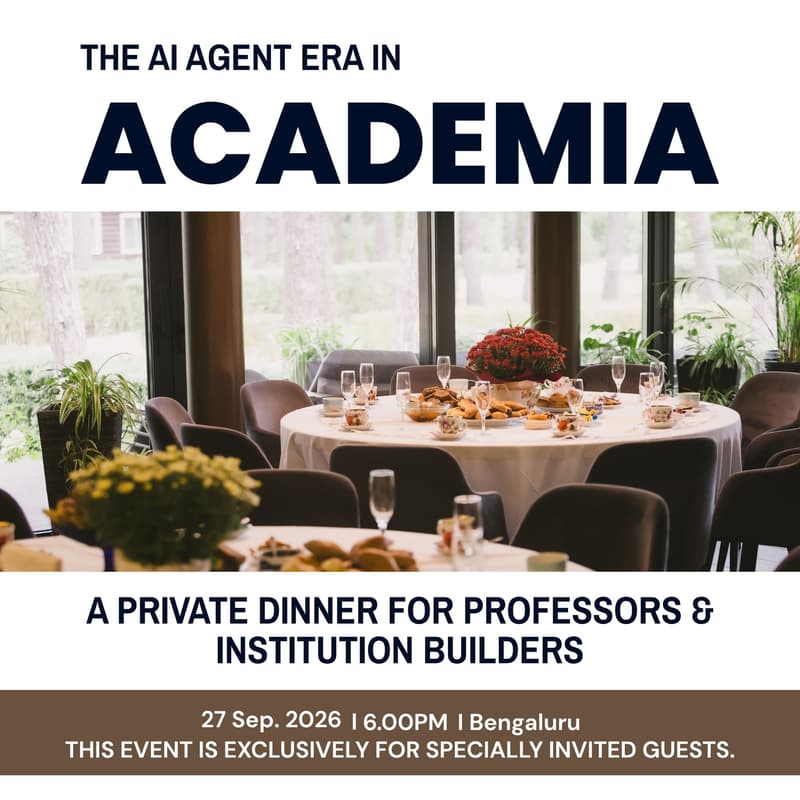

The AI Agent Era in Academia: A Private Dinner for Professors & Institution Builders
The syllabus hasn’t changed. The work already has.
An invite-only, closed-door dinner for Bengaluru’s engineering professors, HODs, deans, placement leaders and academic heads navigating one of the biggest shifts in engineering employment in two decades.
Hosted by Abhishek Srivastava, Founder & CEO, The CareerTrek Company, and Deepak Chawla, Founder, HiDevs.
The Question Every Engineering Institution Must Answer
The conversation around AI in higher education has largely focused on one question:
“What should we teach students about AI?”
But the more important question is:
“What kind of work will our students actually be hired to do?”
That creates three urgent questions for engineering institutions:
1. What is the industry expecting from engineers in an AI-first workplace?
The role of an entry-level engineer is changing.
AI is increasingly becoming part of how software is designed, built, tested, analysed and deployed.
The differentiator is moving beyond simply writing code toward the ability to build with AI, integrate systems, use tools intelligently, evaluate outputs and solve real engineering problems.
Institutions therefore need visibility into the work itself before deciding what students need to learn.
2. What skills will students need to perform that work?
If engineering work changes, the skill stack must change with it.
Students will increasingly need a combination of:
Strong engineering and computational fundamentals
AI-assisted development
Agent and workflow orchestration
API and tool integration
Retrieval and knowledge systems
Data reasoning
Testing and verification of AI-generated outputs
Product and problem-solving ability
Systems thinking
Communication and documentation
Ability to build and demonstrate working solutions
The challenge is no longer simply adding an “AI subject.”
It is about understanding what an industry-ready engineer should be able to do.
3. Where is the actual skill gap?
Most institutions already have strong academic foundations.
The gap often appears between:
What students study → What students practise → What students can independently build → What employers can actually verify.
Traditional classroom assignments and semester projects may not always provide enough evidence of a student's ability to work in modern AI-enabled engineering environments.
At the same time, institutions cannot completely redesign university curricula every six months.
The real question therefore becomes:
How do we build the missing industry layer around the existing curriculum?
That is the conversation this dinner is designed to unlock.
What We Will Unpack Over Dinner
The Future of Engineering Work
What will software engineers, data engineers and AI engineers actually be expected to do inside companies over the next few years?
Not just which technologies they will know, but what their day-to-day work could look like.
The New Engineering Skill Stack
Which capabilities are becoming essential as AI moves from a productivity tool to an active participant in engineering workflows?
Mapping the Campus-to-Industry Gap
Where do today's students typically stand against those expectations?
What is already being covered well inside colleges, and what remains missing?
From Subjects to Proof-of-Work
If employers increasingly want evidence of capability, what should students be able to build, demonstrate and explain before they graduate?
Building the Industry Layer Around the Curriculum
How can institutions introduce practitioner-led build programs, AI labs, industry challenges, project cohorts and proof-of-work experiences without waiting for complete syllabus revisions?
A New Way to Curate Engineering Programs
Instead of starting with:
“Which course should we add?”
Can institutions start with:
Future Work → Required Skills → Existing Capability → Skill Gap → Learning Experience → Proof-of-Work
Evening Flow
6:00 – 6:30 PM | Arrival & Curated Networking
Coffee and focused conversations among HODs, Deans, Placement Heads and Academic Leaders dealing with similar questions around engineering talent and AI readiness.
6:30 – 6:40 PM | Opening Provocation
If AI Changes the Work, Should We Still Prepare Engineers the Same Way?
A short framing of the evening around three questions:
What work is changing?
What skills will that work require?
Where is the gap between campus preparation and industry expectations?
6:40 – 7:05 PM | What Will Engineering Work Actually Look Like?
Deepak Chawla, Founder, HiDevs
A practitioner-led view of the AI-first technology workplace.
Discussion around:
How AI is changing software and engineering workflows
From coding tasks to AI-assisted execution
Agents, APIs, retrieval systems and automated workflows
Where human engineers remain critical
7:05 – 7:30 PM | From Engineering Skills to Proof-of-Work
Abhishek Srivastava, Founder & CEO, The CareerTrek Company
A discussion on translating changing industry expectations into practical student experiences.
Exploring:
What employers can actually evaluate
Moving beyond classroom assignments
Industry-led projects and build experiences
Creating demonstrable evidence of student capability
7:30 – 8:00 PM | The Provocation: How Do We Build the Industry Layer Around the Curriculum?
An open discussion on how institutions can complement the existing curriculum through:
Practitioner-led programs
AI and agent labs
Industry challenges
Project-based cohorts
Proof-of-work portfolios
Industry and ecosystem partnerships
8:00 – 8:20 PM | The Room Speaks
Every professor, dean and academic leader shares in 60 seconds:
What is the biggest challenge your institution is facing around AI readiness, engineering skills or student placements this academic year?
8:20 – 9:30 PM | Private Dinner & Executive Strategy
High-trust, Chatham House Rule dinner conversations exploring institutional challenges, emerging engineering skill requirements and potential industry-academia collaboration models.
Who Should Request an Invitation
Deans of Academic Affairs & Engineering HODs
CSE, ISE, AI/ML & ECE Department Heads
Placement Directors & Industry Relations Heads
College Principals & Directors
Academic Leaders of Autonomous Institutions
Engineering Education & Industry Partnership Leaders
Note: Due to the private nature of the venue and the depth of conversation, this roundtable is capped at 25 confirmed attendees.