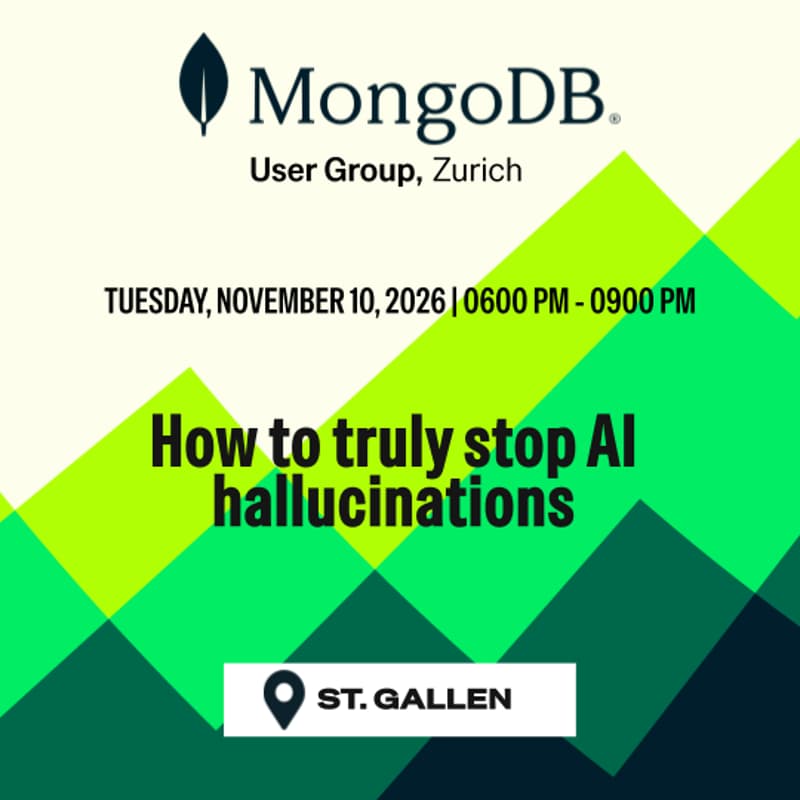

MUG Zürich NOV 2026 - How to Truly Stop AI Hallucinations
"Grill Me" vs. RAG Plumbing: How to Truly Stop AI Hallucinations in MongoDB
Generative AI applications frequently suffer from factual fabrications and hallucinations. When a Large Language Model (LLM) produces incorrect information, the immediate developer reaction is often to adjust the prompt—applying interrogation skills like Matt Pocock’s "Grill Me" or research-backed frameworks like Chain of Verification (CoVe)
How can engineering teams leverage autonomous AI agents and Retrieval-Augmented Generation (RAG) with MongoDB Vector Search while keeping software secure and compliant?
Agenda📆
18:00 – 18:15: Arrival, Welcome & Community Kickoff
18:15 – 18:50: Stop AI Hallucinations
18:50 – 19:30: Let's discuss about MongoDB's role in this game
19:30 - 20:30: Vibe Coding: Exploring the Benefits, Risks, and Impact of AI-Assisted Software Development
20:30 – 21:00: Food, Drinks & Open Networking
Session Details📝
1. How to Truly Stop AI Haluncinations in MongoDB
Speaker: Peter Gyoergyfalvay, Software Architect and Developer at Helvetia Insurance Company
This speake argues that most hallucinations in Generative AI and RAG (Retrieval-Augmented Generation) systems are not caused by the LLM itself, but by poor retrieval architecture. While prompt engineering techniques such as Chain of Verification (CoVe) can improve reasoning, they cannot compensate for missing or irrelevant information retrieved from the knowledge base. The author recommends measuring chunk relevance and context adherence to identify the root cause of hallucinations. To improve reliability, RAG systems should focus on better data modeling, semantic chunking, metadata filtering, hybrid search, reranking, and output guardrails, with MongoDB Vector Search serving as a key technology for optimizing retrieval quality and reducing hallucinations.
2. Vibe Coding: Exploring the Benefits, Risks, and Impact of AI-Assisted Software Development
Speaker: Stefan Käfer, Software Architect and Developer at Helvetia Insurance Company
Vibe Coding is transforming software development by enabling developers to build applications through natural-language interaction with AI. This session explores the opportunities and risks of AI-assisted coding, including productivity gains, code quality, maintainability, security concerns, and the evolving role of software engineers in an AI-driven world.
What you'll walk away with🍃
Practical techniques to reduce AI hallucinations in RAG applications using MongoDB Vector Search, semantic chunking, metadata filtering, hybrid search, and reranking.
A clear understanding of how to distinguish between retrieval problems and LLM reasoning problems, and how to measure retrieval quality using chunk relevance and context adherence.
Insights into the opportunities and challenges of Vibe Coding and AI-assisted software development, including productivity gains, code quality, maintainability, and security considerations.
A better understanding of how AI is reshaping the role of software engineers and the skills needed to build reliable, production-ready AI-powered applications.
Practical lessons and real-world experiences from software architects working with Generative AI and modern development practices.