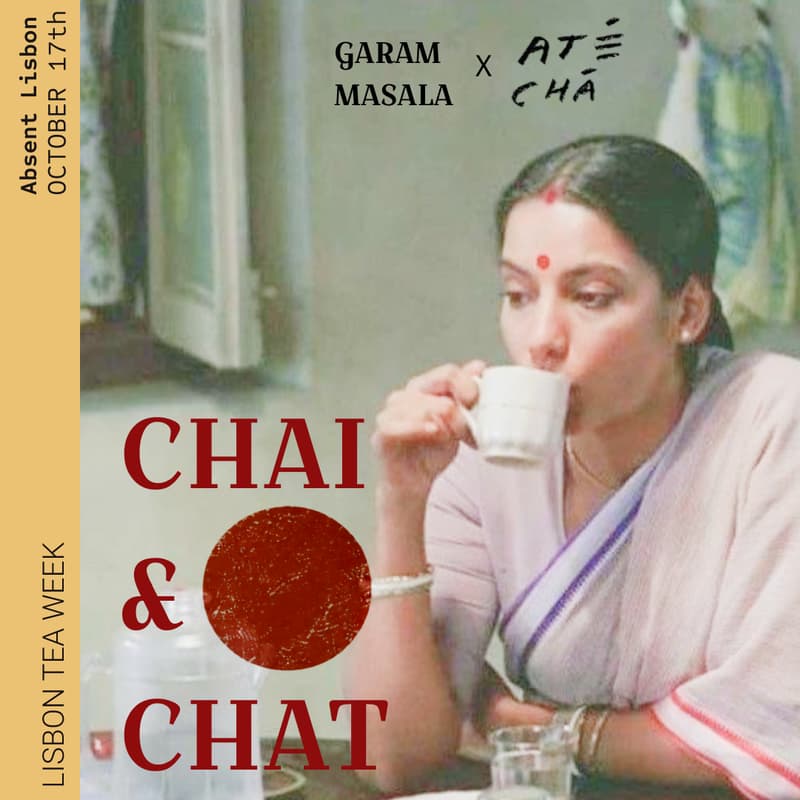
Chai & Chat: Garam Masala x ATÉ CHÁ for Lisbon Tea Week
CHAI & CHAT
Garam Masala × ATÉ CHÁ for Lisbon Tea Week
Before the music begins, join us over a cup of chai at Absent Lisbon - Offline Café & Third Space
Chai is something many of us know intimately: brewed in our homes, offered to guests, shared between friends, poured at roadside stalls, and used as an excuse to sit together a little longer. Behind the chai is also a bigger story.
For Lisbon Tea week x Garam Masala collaboration, we bring you 'Chai & Chat', we’ll gather around the kettle to explore chai through three interconnected lenses: its colonial history, its place within Ayurveda and traditions of spice and wellbeing, and the social life it has taken on today.
It’s an informal conversation over chai.
A space to listen, exchange stories, ask questions, and think about how history, medicine, migration, ritual, and community can all meet in a cup of tea.
Then, suitably caffeinated, we’ll move into Garam Masala Ep7 RANGEELA: a night of karaoke, sangeet, and community for the evening. Tickets are available here. https://luma.com/ys4hc0v2
The three talking points
1. Chai & Colonialism — How did tea become “Indian”?
Tea has deep histories in Asia, but the enormous tea industry that developed in colonial India was closely tied to the British Empire. After Britain had become heavily dependent on tea imported from China, the East India Company and later British colonial enterprises sought to establish large-scale tea production in India, particularly in Assam and Darjeeling. That expansion involved the appropriation of land, plantation economies and highly exploitative systems of labour.
There’s an interesting contradiction here: India became one of the great centres of global tea production before tea drinking became an everyday habit for much of the Indian population. In the early 20th century, the tea industry increasingly promoted tea domestically, including through railway stations, factories and public campaigns. Indian consumers then transformed the drink themselves — adding milk, sugar, ginger, cardamom and other spices in different regional and household combinations.
So the conversation isn’t simply “the British invented chai” — they didn’t. It’s about how colonial commodity production, older South Asian traditions, local tastes and eventual cultural appropriation of the commodity by Indians collided to create what we now recognize as chai.
2. Chai & Ayurveda — What is happening inside the cup?
There isn’t one ancient Ayurvedic formula called “masala chai” that corresponds neatly to the drink we know today. A more careful connection is that many ingredients commonly put into chai — ginger, cardamom, cinnamon, cloves, black pepper, fennel and tulsi, among others — have long histories of use within South Asian food and Ayurvedic traditions.
Ayurveda understands foods and spices through qualities and their effects on digestion and bodily balance rather than simply through modern categories like calories or vitamins. Ginger, for example, is traditionally associated with warming and digestive qualities; cardamom appears in culinary and medicinal traditions; spice combinations can change depending on season, constitution and context.
That gives you a really interesting distinction to discuss: chai as a contemporary everyday beverage versus the much older medicinal and culinary knowledge represented by some of the ingredients inside it. You can also compare traditional understandings with what modern nutritional or pharmacological research can—and cannot—actually substantiate, rather than presenting every traditional claim as a medically proven benefit.
3. Chai Today — Why does a cup of tea mean so much socially?
This is where the conversation can become personal. Chai isn't only something consumed; making chai can itself be a social act.
“Come for chai” rarely means only come consume this beverage. It can mean sit down, tell me what happened, meet my family, take a break, gossip, argue, welcome someone into the house, conduct business, or stay another twenty minutes.
Across South Asian diasporas, chai can take on another layer. The smell, particular preparation, glass or cup, preferred biscuit, or argument about how much ginger belongs in it can become shorthand for home and memory. At the same time, chai has entered global café culture, where words like “chai,” “chai latte” and “wellness” can detach the drink from the histories and communities that shaped it.
We will leave you with the question:
What happens when chai travels? What remains, what changes, and how can sharing it create community somewhere new — including here in Lisbon?