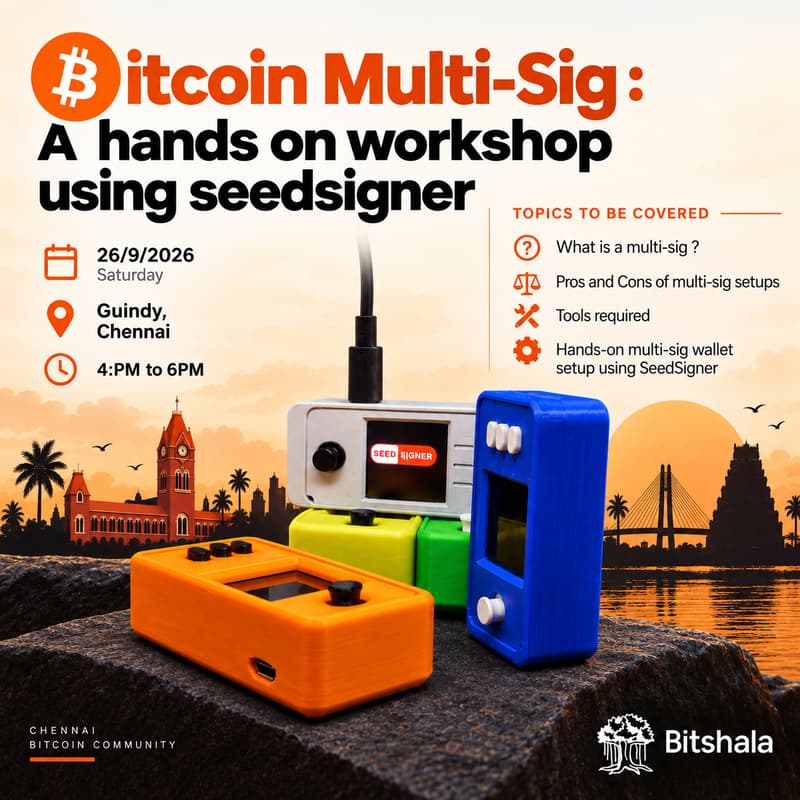

Understanding Bitcoin Multisig — By Building One | Chennai
Limited Seats | First Come First Seat
A single Bitcoin key is wonderfully simple — until losing or compromising that one key means losing everything.
Multi-signature changes that assumption. Instead of asking one key to protect your bitcoin, you can define a policy where multiple independent keys must cooperate before the bitcoin can move.
But that introduces a different set of questions: Who holds the keys? What exactly does “2-of-3” mean? What information needs to be backed up? What happens if one signer disappears? And how do separate signing devices actually coordinate a transaction?
This workshop is about answering those questions by building a multisig wallet ourselves.
We’ll use SeedSigner and a wallet coordinator to go from independent keys → multisig wallet → receiving bitcoin → creating a transaction → collecting signatures.
By the end, “2-of-3 multisig” should no longer be an abstract wallet feature. You should understand what is actually happening.
What we’ll work through
Why have more than one key?
We’ll start with the problem multisig is trying to solve — and why distributing control can remove some risks while introducing entirely new ones.
What does 2-of-3 actually mean?
We’ll break down signers, keys, quorum and the spending policy so you understand what Bitcoin is enforcing rather than simply clicking through a wallet setup.
The tools in a multisig setup
What does SeedSigner do? What does the coordinator do? What information does each device know, and which information actually needs to remain secret?
Build a multisig wallet
This is the hands-on part. We’ll create independent signing keys using SeedSigner and combine them into a multisig wallet.
Receive and spend from it
We’ll follow an actual transaction workflow: construct the transaction, move it between the coordinator and signers, collect the required signatures, and see when it becomes ready to broadcast.
Where multisig can go wrong
More keys do not automatically mean more security. We’ll discuss backups, lost signers, wallet configuration information, operational complexity and the trade-offs introduced by multisig.
What to expect
This is a hands-on workshop, not a two-hour presentation.
We’ll spend enough time on the concepts to understand what we’re doing, but the point is to actually construct a multisig wallet and walk through the signing process.
You don’t need to already understand descriptors, PSBTs or Bitcoin Script. But you should have a basic understanding of Bitcoin wallets, seed phrases and signing transactions.
Is this for you?
This session will make sense if:
You’ve used a Bitcoin wallet and now want to understand what multisig actually changes.
You’ve heard “2-of-3” recommended for self-custody but don’t want to deploy something you don’t understand.
You like understanding what your wallet is doing underneath the interface.
You’re interested in the trade-offs between simplicity, redundancy and security, rather than assuming more keys automatically means better custody.
Prior multisig experience isn’t required. Basic familiarity with Bitcoin wallets is.
One idea to leave with
Multisig isn’t about adding more keys. It’s about deciding how much authority any one key should have.