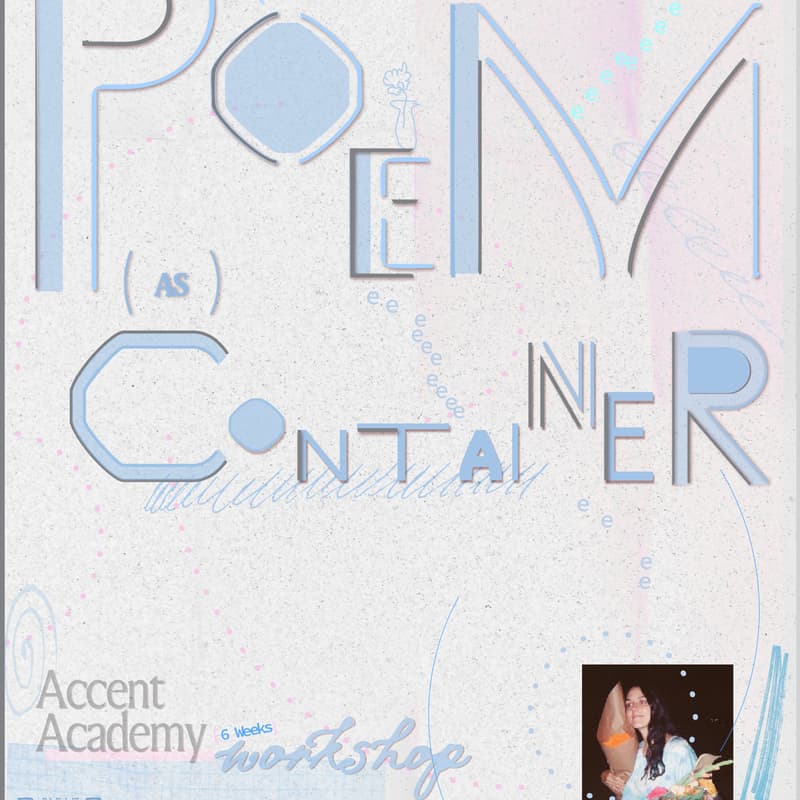

Six Week Workshop x Courtney Bush | Poem as Container
Poet Rainer Diana Hamilton once said they were mad that you can't put an actor in a poem. You can mention one, but you can’t put one in. Courtney mentioned this quote in our early email exchanges, which kept me returning to that itch of wanting the poem to hold more than what language allows, that desire of building a peculiar environment that lets the impossible feel inevitable and let magic emerge organically.
As writers and readers, we keep entering spaces where world building is both the medium and the outcome; if you thought of yourself as an architect employing language as a constructive material, what would you want the room to hold? What strange, appealing layout would you hope to bring into life? What is the process of figuring out the initial floorplan and tweaking it? In Terrance Hayes’s classroom, he asks everyone to think about which part of the house does a poem live in: is it in the attic, the kitchen, the basement, or by the windowsill? What is the furniture like? What is the temperature and the smell like?
In this 6-week workshop with poet and filmmaker Courtney Bush, we will approach poems as containers, building them, breaking them, writing our way in, out, and through these vessels that we mold for our voices.
We will discuss strategies that the different writers and artists use to build the containment structures of their work. We will discuss the way form (and other aspects) of an artwork decide how much of the world can fit. We will see if those strategies make sense in our own writing.
We will also workshop student poems during the second half of each session. We will discuss all aspects of the poem, but will give special attention to the question of getting more world into the work, aka, finding the poem's max capacity. Every student will have the opportunity to workshop twice.
We will talk a lot about the importance of how we feel when we work/ read/ write. I believe it's important that making art and using our creative energy feels good. I believe we don't consider our experience enough. We should be having fun making our strange projects. The work will be better if we are having fun.
All readings will be provided in pdf forms. Many of these will be excerpts from larger works. We will also watch some films that shouldn't be too difficult to access.
SYLLABUS
Week 1
Introductions, Discussion of syllabus, themes, and goals of the course.
We can (if we want!) think of a poem simply as a container. What does it/ can it contain? Ultimately, hopefully, some portion of the disorder that is the world. Stanza means room, after all. A room has volume. How much can we fit inside? How much do we want to? What could come in if we build a capacious, inviting vessel? More importantly, how do we build it? This is where form comes in.
We will look at two poems which employ interesting forms to create space. We will look at the visual work of and an interview with Yuji Agematsu, a visual artist who builds small, repetitive structures to quite literally hold and mark aspects of the world: detritus from the street, the passage of time, etc. We will also read and think about a brief excerpt from performance artist/dancer/teacher Mary Overlie's book Standing In Space, about an exercise she does with her acting students to invite them to experiment and expand their understanding of what can be brought into a work of art.
Workshop Group A
Reading/Texts:
Visual works of Yuji Agematsu
Yuji Agematsu interviews
Mary Overlie's "Grazing" from “Standing In Space: The Six Viewpoints Theory and Practice”
Juliet Gelfman Randazzo’s “heehee”
Nora Treatbaby’s “Repetition of Mistakes I Always Make Because Every Mistake Is The Same”
I think repetition has a strong power, as long as you don’t take it for granted. It’s about how to repeat without the formulaic use of repetition.
— YUJI AGEMATSU
Yuji Agematsu is an artist who works across various media, including sound, photography, and the arrangements of objects—not exactly sculpture. Active in experimental music for many decades, Agematsu often performs abstract compositions in conjunction with the presentation of images from multiple slide projectors.
Since 1985, Agematsu has been foraging daily on the streets of New York, finding castoffs he eventually transforms in his studio in Dumbo into a little sculpture that he encloses in the cellophane wrapper of a cigarette pack. After the year ends, he places each assemblage on a shelf or in a vitrine, which is organized like a calendar to mark the day it was collected.
Mary Overlie created the Six Viewpoints as an answer to the question "What are dance and theater made of?" She sought out a technical language to discuss the artistic forms similar to that of the specific language used to describe painting. What followed was the development of a comprehensive language that simultaneously uncovered a philosophical depth to performance when deconstructed.
The seed of the entire work of The Six Viewpoints is found in the simple act of standing in space. From this perspective the artist is invited to read and be educated by the lexicon of daily experience. The information of space, the experience of time, the familiarity of shapes, the qualities and rules of kinetics in movement, the ways of logics, that stories are formed and the states of being and emotional exchanges that constitute the process of communication between living creatures.
From Our Air by Nora Treatbaby
Immersed in a tangled weave of contemporary life where big box stores and suburban parking lots coexist alongside the instructive silence of juniper trees and a pulsing waterfall, Our Air sketches the possibilities of eco and social interdependence during late-stage capitalism.
With sincere curiosity and a sprinkling of levity, these poems advocate for the world-building potential available in a material commitment to gentle friendship with all networks of life on Earth.
Week 2
Collage Non Sequitur Fragment
This week we look at excerpts from books that use the techniques of collaging, non sequitur and fragment as formal devices. Sometimes this may look, in a sneaky way, like "no form." We will discuss the freedom of movement made possible by these techniques. We will discuss the effects for a reader and the experience of writing this way, as we imagine it or have experienced it. I want to pay special attention to the "break," where one seemingly unrelated thought meets another.
Workshop Group B
Reading:
Tan Lin’s 7 Controlled Vocabularies
Ted Berrigan’s Sonnets
Lucy Ives The Hermit
Rachel James An Eros Encyclopedia
Lyn Hejinian My Life
“Logo” from Seven Controlled Vocabularies by Tan Lin
Seven Controlled Vocabularies models a generic book, a kind of field guide to the arts, wherein distinctions between various aesthetic disciplines are relaxed or dissolved and where avant-garde notions of difficulty are replaced with more relaxing and ambient formats such as yoga, disco, and meditation. Each of the book's seven sections is devoted to a particular art form—film, photography, painting, the novel, architecture, music, and theory—and includes both text and found photographs as it explores the idea of what it means to be a book in an era when reading is disappearing into a diverse array of cultural products, media formats, and aesthetic practices.
From The Sonnets by Ted Berrigan
Like Shakespeare’s sonnets, Berrigan’s poems involve friendship and love triangles, but while the former happen chronologically, Berrigan’s happen in the moment, with the story buried beneath a surface of names, repetitions, and fragmented experience. Reflecting the new American sensibilities of the 1960’s as well as timeless poetic themes, The Sonnets is both eclectic and classical — the poems are monumental riddles worth contemplating.
The poet Alice Notley writes in her introduction to his selected work: "Ted always used to say that The Sonnets has a plot very like Shakespeare's Sonnets involving friendships and triangular love relationships; but where Shakespeare's plot is patterned chronologically Ted's is patterned simultaneously."
From The Hermit by Lucy Ives
The Hermit is a catalog of thoughts concerning art and experience. Layering fragments of dreams, lists, games, conversations, poems, and notebooks, Lucy Ives offers an intimate look into one writer's practice—"The worst is my imagination: lushly underscoring everything."
From An Eros Encyclopedia by Rachel James
In her debut book, Rachel James narrates the desiring subject’s nuanced and entangled intimacies with histories of power. How, in other words, under patriarchy, against misogyny, within capitalist strictures, is knowledge shaped, contained, and transferred? Tracing traditions of theater, pedagogy, and faith, An Eros Encyclopedia offers up desire and the attunement to its many objects as the atmosphere of a life—a method to navigate, perceive, and relate against the illusion of separation.
Week 3
More Voices
One way of getting more "world" into an artwork is to incorporate more voices. We can do this in many ways, by grafting in voices other than our own, by appropriating text and overheard language. This week we will look at works that employ only other voices. We will discuss what is added to a text by breaking apart or multiplying the subject position "I." The excerpts we'll read include language overheard in cabs, language from the internet of the early 2000s, and language from stand-up comedy sets.
Workshop Group C
Readings:
Cliff Fyman’s Taxi Night
Rob Fitterman’s This Window Makes Me Feel
Sasha Debevec-McKenney's "Cento For The Night I Tried Standup"
From Taxi Night by Cliff Fyman
Cliff Fyman’s Taxi Night is a splendid and powerful book-length poem in four parts. The real-life patter and ambience of his fares reach the hackie, Fyman, as he transports a rainbow cast of denizens around the boroughs from 5 p.m. until 5 a.m. The first two sections are transcribed from overheard cellphone combat, or a jiving fare who tries to play Fyman verbally, or more than a few nutcases. The last two sections increasingly are transcribed from Fyman’s own silent, deeply inner verbatim.
From This Window Makes Me Fell by Rob Fitterman
Week 4
Tight Frames
We will examine, in these texts, how employing a tight frame seems to counterintuitively give a poet permission to digress, and makes a reader trust that the poem, though including a wide array of disparate bits of the world, has an architecture. How much work does this proposed architecture do? These poems announce, very clearly, their narrow scope, and then feel free to explode it. We will think about how we might use these strategies in our own writing.
Workshop Group A
Readings:
Khadijah Queen’s I’m So Fine: A List of Famous Men and What I Had On
Sasha Debevec-McKenney’s "What Am I Afraid Of?"
Brandon Brown’s Top 40
Sei Shōnagon's Pillow Book
From I’m So Fine: A List of Famous Men and What I Had On by Khadijah Queen
Like the wavering foliage which inspired William Wordsworth’s autobiographical epic, “America’s Top 40 Countdown” is the catchy Beatrice of Brandon Brown’s new book. Writing through the Top 40 pop songs on the chart of September 14, 2013, Brown’s poems track the life of a song as it resounds through an organism. This organism bathes, reads, writes, likes, fights, loves, hates, and fucks; the soundtrack never stops.
From The Pillow Book of Sei Shonagon
A common custom of the time period, courtiers used to keep notes or a diary in a wooden pillow with a drawer. This "pillow book" reflects the confident aesthetic judgments of Shonagon and her ability to create prose that crossed into the realm of the poetic.
Week 5
Investigations
This week, we will look at a film and several pieces of writing that purport to be investigations of some kind. We will discuss the way an investigation can be the inciting, propulsive engine to a piece. We will discuss the ways that the premise of the investigation also creates a sense of urgency and architecture which allows for a writer or artist to digress, move freely and intuitively, while maintaining a sense of purposefulness and forward motion. There is always
something for the writer to return to. Because of this, she can always keep going further.
Workshop Group B
Readings/Texts:
Film: Sophie Calle's Double Blind/No Sex Last Night
Fanny Howe's "Catholic"
Moyra Davey's "Fifty Minutes"
Amy Ching-Yan Lam's Baby Book
Stills from Double Blind/No Sex Last Night by Sophie Calle
In Double Blind/No Sex Last Night, Sophie Calle and Greg Shephard document their trip across America and record their Las Vegas drive-thru wedding as they try to save their crumbling relationship.
Stills from “Fifty Minutes” by Moyra Davey
Moyra Davey began writing and filming Fifty Minutes after feeling boxed in by her practice of photography. After years of avoiding the human figure in her work, she found herself increasingly removed from the live subject, and at an impasse. This work, her first effort with the moving image since the early 1990s, represented an effort to “make a video that would take root in words.” Here, her words focus largely on the stiff relationship with her analyst, who she visits for years before an ever-lengthening commute and the challenges of being a new mother push the already-strained relationship to its end. We see the artist pacing her apartment while reciting the film’s script, an embodied motif which would later become a hallmark of her filmic practice.
Baby
Baby Book describes the vivid tactility of growth and death—how everything is constantly, painfully remade—offering a vision against the stuck narratives of property and inheritance. Power is located in the senses, in wind: multiple and restless.
Week 6
Inspiration in Strange Places
This week, we will look at works we might consider "inspired" that take forms other than poetry or art in the typical sense. Bennet Miller's The Cruise documents a New York City tour guide who has invested himself and innovated the genre of tour-guiding, infusing it with a new perspective and joy. Kevin Killian does this while writing Amazon Reviews. A.S. Hamrah by cataloguing bleak news items from Hollywood trade publications. We will also look at a guide to the cemeteries of California which is brimming with "the chaos of the world," though its genre does not necessarily require it. I want this week to be about the joy of embedding ourselves creatively in spaces that don't require it. There is a joy in doing this, and a freedom, and it can happen anywhere.
Workshop Group C
Readings/Texts:
Film: Bennett Miller's The Cruise
Kevin Killian's Selected Amazon Reviews
A.S. Hamrah's Last Week In End Times Cinema
Julie Culbertson and Tom Randall's Permanent Californians: An Illustrated Guide to the Cemeteries of California
Stills from The Cruise by Bennett Miller
Timothy "Speed" Levitch, an eccentric New York City tour bus guide, takes tourists around the island of Manhattan and shares an archive of beautifully distorted information about the city.
From Selected Amazon Reviews by Kevin Killian
A book-length selection from Kevin Killian's legendary corpus of more than two thousand product reviews posted on Amazon. An enchanting roll of duct tape. Love Actually on Blu-ray Disc. The Toaster Oven Cookbook, The Biography of Stevie Nicks, and an anthology of poets who died of AIDS. In this only book-length selection from his legendary corpus of more than two thousand product reviews posted on Amazon, sagacious shopper Kevin Killian holds forth on these household essentials and many, many, many others.
These customized batches of misfortune and upheaval record a full year of wrong thinking, bad decisions, and man-made disasters from the world of filmmaking. Set against the backdrop of the crazed push for AI, the wildfires in Los Angeles, and the reelection of Donald Trump, the general disaster of current commercial cinema in the age of streaming platforms, theater closures, and the dead-end reliance on IP franchising becomes apparent. As the Hollywood film industry plunged into near irrelevance, these weekly roundups tracked every passing mistake, every easily avoided blunder, every up-to-the-minute example of unnecessary garbage as it emerged from the content mills of our newly tech-based movie business.
Stardust in L.A... Literary greats in San Francisco... Movie moguls and musicians, admirals and eccentrics, rogues and lawmen - all these "permanent" Californians are chronicled in piquant detail as Judi Culbertson and Tom Randall tour the most interesting cemeteries of Los Angeles and San Francisco, as well as Carmel, Salinas, and San Diego. They provide 11 walking tour maps and 100 stunning photos of statuary; gravestones and mausoleums, gardens, and plaques with such goodbyes as "Too bad, we had fun".
Instructor Bio:
Courtney Bush is a poet and filmmaker from the Mississippi Gulf Coast who lives and works in childcare in Brooklyn, NY. She is the author of the poetry collections Every Book Is About The Same Thing (Newest York Arts Press, 2022), the National Poetry Series selection I Love Information (Milkweed Editions, 2023), A Movie (Lavender Ink, 2025), The Lamb With The Talking Scroll (forthcoming, b l u s h lit, 2025), and the novel Learning (Joyland Editions, 2026). Her films, often made with collaborators Jake Goicoechea and Williams Carington, have been screened locally and internationally. Her solo films can be found on YouTube. She is also the writer of a strange, long, free monthly newsletter/art project called The Courtney Report.