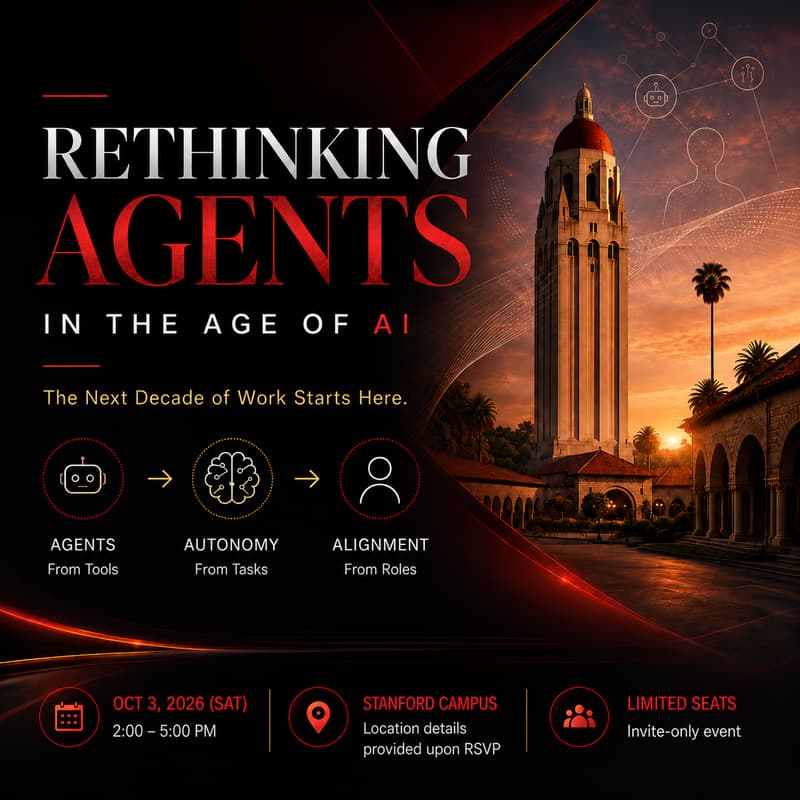

Rethinking Agents: Special Edition — What Happens When AI Starts Building With You?
Rethinking Agents: Special Edition — What Happens When AI Starts Building With You?
Featuring speakers from OpenAI and 1Password
Co-host by Stanford Entrepreneurs and LOOMUS.AI
Event Venue
Stanford, CA
The exact address will be shared with attendees after registration is approved.
About Event
Rethinking Agents in the Age of AI — The Next Decade of Work Starts Here
Episode 02 of “Rethinking the World in the Age of AI” — a six-part series
Every era has one question it can’t stop asking.
Ours is this:
What happens when intelligence stops being scarce?
Across six sessions, this series follows that question wherever it leads — from the search box to AI agents that work alongside us, from the infrastructure powering intelligence to robots entering the physical world, from AI accelerating scientific discovery to the question that ultimately belongs to everyone:
What should we build?
Six episodes. One story:
01 · Rethinking Search — The Next Decade of Search Starts Here
02 · Rethinking Agents — The Next Decade of Work Starts Here
03 · Rethinking Infrastructure — The Next Decade of Compute Starts Here
04 · Rethinking the Physical World — The Next Decade of Robotics Starts Here
05 · Rethinking Science — The Next Decade of Discovery Starts Here
06 · Rethinking What We Build — The Next Decade of Building Starts Here
Episode 01 asked how AI is changing the way we discover information.
Episode 02 asks what happens when AI starts doing the work.
Episode 02 · Special Edition asks what happens when AI doesn’t just assist you — but starts building with you.
Episode 02 · Special Edition
This special edition of Rethinking Agents goes deeper into one of the clearest examples of agentic AI in practice: Codex.
As AI moves beyond answering questions toward planning, executing, using tools, and completing increasingly complex tasks, the relationship between humans and software is beginning to change again.
We are moving from:
Prompting → Delegating
Writing every step → Defining the outcome
Using software → Working with agents
To explore what this shift looks like from inside the frontier, we’re joined by Kiriti Badam, Member of Technical Staff at OpenAI, where he works on Codex.
Featured Speaker
Nancy Wang — CTO, 1Password | $6.8B Identity Security Leader | Trusted by 30%+ of the Fortune 100
CTO of 1Password; leads engineering, applied AI, and the Developer & AI business
Driving 1Password's shift from password management to identity security for humans, machines, and AI agents
Shipped Unified Access and Credential Broker (public preview); built governed credential access into Claude, Codex, Cursor, Kiro, and GitHub workflows
Core principle: secrets stay in 1Password, released only at runtime, scoped to the task, never entering the model context
Founded and scaled AWS Data Protection into a multi-billion-dollar business — exabytes of data, 200,000+ organizations
Earlier: cloud and SaaS platforms at Rubrik; infrastructure at Google
Venture Partner at Felicis (AI infrastructure and security); board and advisory roles at Chalk and Mercor
The question she keeps asking: not whether agents can do useful work, but whose identity they use, what authority they carry, and whether we can prove what happened
Kiriti Badam - OpenAI · Building Codex
Member of Technical Staff at OpenAI, building Codex — OpenAI's coding agent
Previously worked on OpenAI's customer support agents
Focus: how AI systems move from generating answers to completing work someone depends on
Founding engineer at Kumo.AI (Forbes AI 50): took the product from idea to a multi-tenant platform training hundreds of models a day
Scaled Kumo from single-node to distributed compute on Spark, Kubernetes, and Temporal across hundreds of terabytes
Built an in-house feature store on RocksDB for graph neural network training
At Google: distributed storage behind Google Ads — key-value systems across 40 regions, fault-tolerant pipelines processing petabytes daily
Teaches a course on building generative AI applications with a problem-first approach: understand the problem first, the tools come later
From Software That Waits to Agents That Act
For decades, software has waited for humans to tell it what to do.
Open the app.
Click the button.
Write the prompt.
Execute the task.
AI agents are beginning to change that relationship.
Instead of simply responding to instructions, increasingly capable AI systems can reason, plan, use tools, maintain context, coordinate across systems, and take actions toward a goal.
We are beginning to move from:
Tools → Collaborators
Tasks → Outcomes
Software → Autonomous Systems
And that shift could reshape much more than productivity.
It could change how companies are built, how teams operate, how software is designed, how organizations allocate work, and ultimately what it means to work alongside machines.
We are moving from an era where humans operate software to one where humans increasingly delegate to intelligence.
Join us at Stanford for this Special Edition of Episode 02: Rethinking Agents from Rethinking the World in the Age of AI, as we bring together builders, researchers, founders, investors, and operators to explore the rapidly emerging world of AI agents — from Codex and agentic software development to what it means for the next decade of work.
AI Agents Are Still Early
Many systems remain unreliable.
Long-running tasks remain difficult.
Memory is imperfect.
Permissions, security, evaluation, accountability, and alignment are still open problems.
But the direction is becoming increasingly clear:
AI is moving from answering questions to taking actions.
That transition could become one of the defining platform shifts of the next decade.
For founders, it raises a new question:
What businesses become possible when intelligence itself becomes a programmable resource?
For companies:
What does an organization look like when every employee can delegate work to AI agents?
For researchers:
How do we build autonomous systems that remain reliable, controllable, secure, and aligned with human intent?
And for all of us:
What becomes uniquely human when machines can increasingly reason, coordinate, and act?
Whether you’re building AI products, investing in frontier technologies, conducting research, operating a company, or simply curious about where AI is headed, this forum is an opportunity to hear from and connect with people thinking seriously about what comes next.
The next decade of work may not be defined by humans versus AI.
It may be defined by how humans and intelligent agents learn to work together.
This Is Episode 02 — Special Edition
The story started with search.
Now intelligence leaves the search box — and starts taking action.
This special edition goes deeper into that transition — looking at what happens when AI agents move from assisting with individual tasks toward becoming systems we can increasingly delegate real work to.
From here, we’ll follow the story deeper into the infrastructure powering these systems, into the physical world, into scientific discovery, and ultimately into the question of what we choose to build.
This is only the beginning.
Free, and For the Community
This series is completely free and non-profit.
No tickets. No paywall. Just people who care about where AI is going, in one room.
It’s part of a larger belief we act on at Loomus.ai:
Intelligence should be accessible to everyone, everywhere.
That’s why we’ve also used AI agents to build free learning tools for communities where access to frontier AI resources is still limited — including Vietnam and beyond — curating AI research papers and organizing them into knowledge graphs so that anyone, anywhere, can follow the frontier.
We believe the future of AI should not only be discussed behind closed doors.
It should be explored by researchers, founders, students, builders, investors, and communities together.
Founders: The Stage Is Open
If you’re building a startup, come show the community what you’re building.
No sponsorship required.
No pay-to-play.
Just bring something interesting, useful, or ambitious.
Founders help founders.
Join the Loomus Volunteer Community
Behind every great event is a team of people who help bring it to life.
As Loomus continues to organize AI events, founder gatherings, community programs, conferences, and larger summits, we’re building a long-term volunteer community for people who want to get involved, contribute, and grow with us.
Whether you’re a student, recent graduate, working professional, or simply someone excited about AI, technology, and community building, we’d love to hear from you.
Prior event experience is welcome, but not required.
If you’re interested in meeting people across the AI and startup ecosystem, gaining hands-on experience, and helping us bring future Loomus events to life:
Apply to join the Loomus Volunteer Community:
Open Google Form
For any questions about volunteering, please contact:
Siena
siena@loomus.ai
Ideas or Collaborations?
We’re always open to hearing from founders, researchers, community builders, partners, and anyone who wants to contribute to the conversation.
DM Sophie Ren on LinkedIn:
Rethinking Agents: Special Edition
Stanford
The Next Decade of Work Starts Here.
THE STORY BEHIND THESE SESSIONS
I'm Sophie Ren. I build thousands of AI agents and I love watching them. Six times a year I put a few thousand people in a room together - in Silicon Valley, in Paris, in Milan, and next May at an AI × Art festival in Sicily.
I do both for the same reason. The models have already read everything we've written down. That's the floor now, not the ceiling. What I want is what isn't in there yet - the thing nobody has tried, or has tried and never said out loud. That kind of knowledge can't be collected. It gets made, and it gets made between people, in real time, in a room. That's the part I find thrilling, and I think it's where the real value has moved.
Monet painted the same pond for thirty years. At some point it stopped being a pond and became something that had never existed — not a better painting, a new object in the world. That moment and the moment a room finally cracks a problem are the same moment: the tree of human knowledge grows a branch.
Everything a model knows came from a branch that grew before it. I don't want to watch the next one grow. I want to grow it, and I want to find the people who want to grow one too.
Bring what you're stuck on.
— Sophie