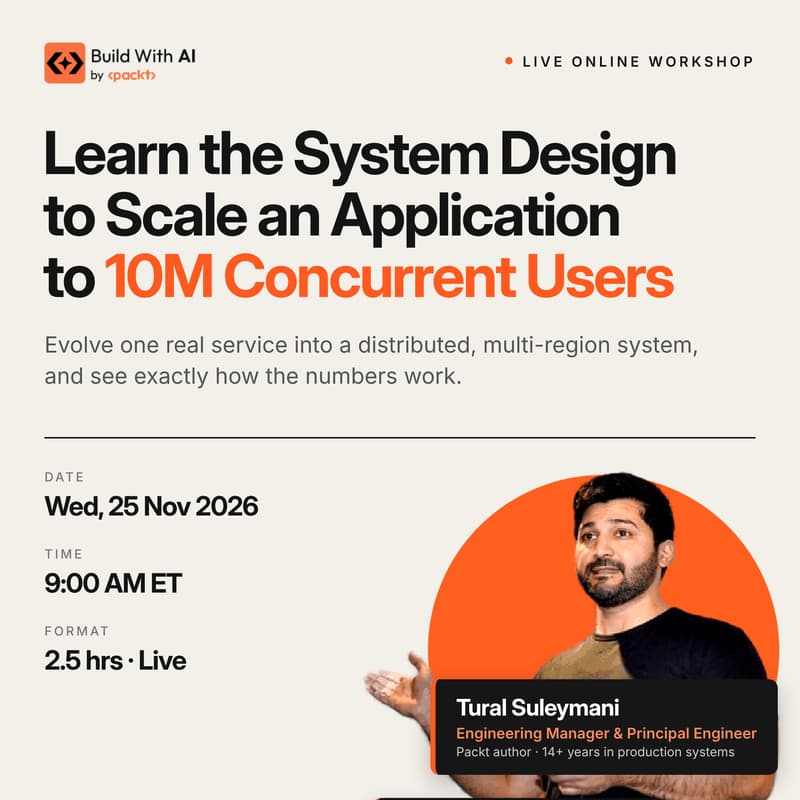

Learn the System Design to Scale an Application to 10M Concurrent Users
Most developers and engineers never design for millions of users at work, and most system-design content stops at the diagram. In this 2.5-hour live deep dive, two-time Microsoft MVP and Packt author Tural Suleymani takes one real, open-source .NET service, a game matchmaking system, and scales it on screen to 10 million concurrent users. You'll turn "10M users" into requests per second, memory and server counts, and see which assumptions move the answer.
You'll watch two servers double-match the same player, then fix it with idempotency and atomic updates. Then you'll split the service by region, handle a hot spot and decide what users see when a database or a whole region fails. Examples are in .NET; every idea applies to Java, Go or Node.
You leave with the codebase, a capacity-sizing sheet and the recording. Already saw the free September intro? This goes deeper into the maths, the concurrency fixes and failure handling
Why a matchmaking system?
Matchmaking looks simple: join a queue, get matched, play. At scale, it hits nearly every hard problem in system design:
Massive request volume: every waiting user keeps asking “am I matched yet?” At 10M users that’s about 3.7M requests per second.
Race conditions: two servers matching the same user, or a cancel arriving at the moment of a match.
Hot spots: one popular game in one region overloading part of the system.
Failures: what users should see when a database or a whole region goes down.
These patterns apply to any high-traffic web application.
What you’ll be able to do after this workshop
Estimate capacity with confidence: turn “10 million concurrent users” into requests per second, memory, server count and headroom, and know which assumptions matter most.
Draw the right service boundaries: decide when Domain-Driven Design is worth it and when simple CRUD is enough.
Build for concurrency: prevent duplicate requests, double-matching and overload using idempotency, atomic updates and distributed locks.
Design for scale and failure: evolve one service into independently scalable, region-isolated parts that degrade gracefully.
Defend your decisions with numbers: turn vague goals like “fast” and “reliable” into measurable requirements.
What you’ll get
A reusable capacity-sizing method you can rerun on your own systems
A practical DDD decision guide: when to use it, when not to, and how it maps to code
A step-by-step blueprint for a distributed, multi-region architecture, covering partitioning, routing, scaling, monitoring and failure handling
Access to the full open-source codebase, with unit tests, integration tests, Docker Compose and Kubernetes/Azure deployment docs
Live Q&A with the engineer who built it
Who should attend
Senior backend engineers who want to design systems that scale, not just build features
Software architects and tech leads who own reliability, trade-offs and platform growth
Engineering managers and staff/principal engineers who review designs and performance plans
Experienced developers preparing for senior system-design interviews or stepping into architecture roles
Prerequisites: comfortable with any object-oriented language, REST APIs, dependency injection, databases and basic distributed-systems ideas. DDD or Kubernetes experience helps but isn’t required. Examples are in .NET, but the concepts apply to any stack. Nothing to install.
A note on the numbers
The 10M figure is a design model built on clearly stated assumptions (3-second polling, 30-second average queue wait), not a production benchmark. You’ll see how the numbers change when the assumptions do, and that reasoning is the skill you take away.
Meet your instructor
Tural Suleymani
Two-time Microsoft MVP · Principal Engineer · Packt author
Tural has 14+ years of experience designing and delivering production systems in C#/.NET, Java and JavaScript. He specialises in distributed architecture, microservices, Domain-Driven Design, test-driven development and event-driven systems. He has led architecture decisions on reliability and trade-offs, and introduced testing, CI/CD and observability practices across engineering teams. He is the author of Hands-on Microservices with JavaScript (Packt) and built the codebase used in this workshop.
He is a two-time Microsoft MVP, runs a YouTube channel with about 12,000 subscribers, and teaches Apache Kafka on Udemy. His open-source projects, including this workshop's codebase, are on GitHub.
Website: https://turalsuleymani.com/ GitHub: TuralSuleymani