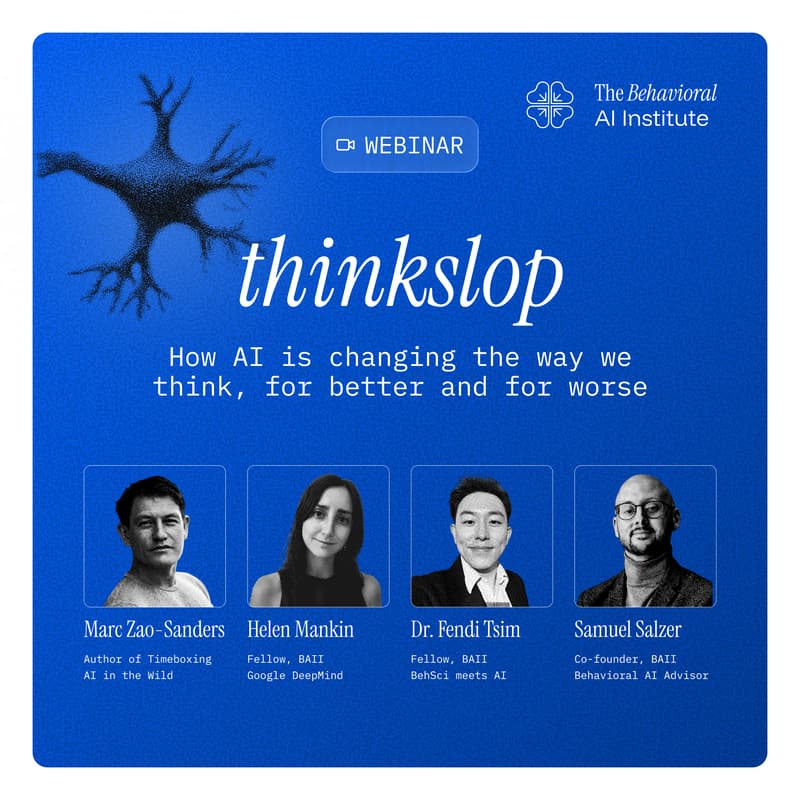

Thinkslop: How AI is changing the way we think
Where does thinking stop being yours?
In at least a quarter of the leading ways people use AI today, they are handing over part of the thinking itself.
Marc Zao-Sanders calls this thinkslop, to distinguish it from the low-quality output usually described as AI slop. Thinkslop happens earlier, at the point where someone stops engaging with a problem because a passable answer can arrive in seconds, with almost no effort.
But that is only half the picture. AI can also help people think better. The important question is increasingly not whether we use these tools, but how: as support for our thinking, or as a substitute for it.
Most of the public debate still swings between two extremes: that AI carries no meaningful cognitive cost, or that relying on it will inevitably erode our ability to think. For people actually using and deploying these tools, neither position is particularly useful.
This session brings together three perspectives on what happens in between.
Marc Zao-Sanders, creator of AI in the Wild, studies how people are actually using AI at scale, including where it is beginning to replace parts of the thinking process itself.
Helen Mankin brings the perspective of organisational psychology and behavioural science, with a focus on how people learn, make decisions and adapt their behaviour inside organisations.
Fendi Tsim researches human-AI interaction, cognitive offloading and how we decide which parts of a task should be delegated to AI, supported by AI, or kept with the human.
Together, they’ll examine the harder question underneath the debate: where should we draw the line?
Agenda
Why we are asking this: Samuel Salzer on the two positions the public argument is stuck between.
What the data shows: Marc Zao-Sanders presents the 2026 findings from AI in the Wild.
Panel "Where is the line?": Marc, Helen and Fendi, moderated by Samuel Salzer.
Audience questions: Open floor, with live polling.
Speakers
Marc Zao-Sanders
AI in the Wild
Marc leads AI in the Wild, a longitudinal study of how people use AI in practice. Its third edition analysed 12,637 real-world use cases and was published in Harvard Business Review in 2026.
Helen Mankin
Honorary Fellow, Research | BAII
Applied behavioral scientist at Google DeepMind researching how frontier AI reshapes organizations, team dynamics, and human potential. Previously led R&D for organisational diagnostics at MindGym.
Dr Fendi Tsim
Honorary Fellow, Research | BAII
Behavioural scientist with a PhD from Warwick Business School, bridging behavioural economics, game theory, and cognitive psychology. Co-founder of BehSci Meets AI.
Samuel Salzer
Co-founder & Operations Director | BAII
Applied behavioral scientist designing large-scale, AI-driven interventions that have reached 350M+ users. Founder of Habit Weekly and co-founder of Nuance Behavior.