AI coding is fast. The enterprise isn't ready. The gap isn't productivity — it's traceability. Learn how to make it traceable.
AI coding is fast. The enterprise isn’t ready. The gap isn’t productivity — it’s traceability. Learn how to make it traceable.
What this session is about
In most enterprises, AI coding tools can now move faster than your governance, leaving requirements, models, and deployments disconnected.
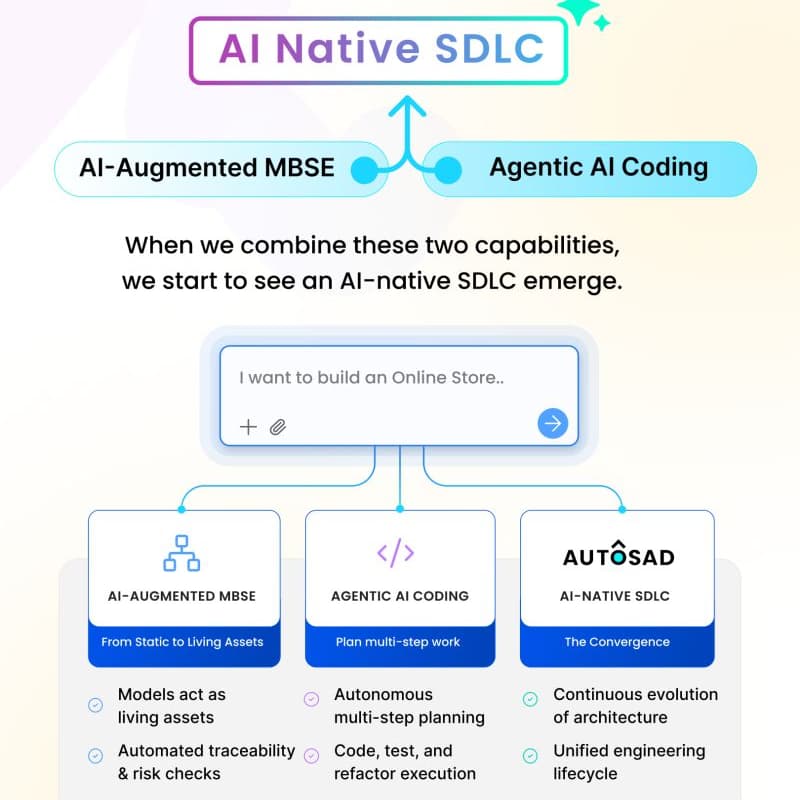
In this workshop, you’ll use the AUTOSAD Methodology — AI‑Augmented, Governed Model‑Based System Design — to make the entire flow from intent to implementation traceable and auditable.
How AUTOSAD.ai frames traceability
We’ll work through the AI SDLC lifecycle
Intent — Human‑Driven: Capture architecture intent and requirements using the W6H framework (Who, What, When, Which, Where, Why, How ), so every downstream artifact can be tied back to declared intent.
Model‑Based System Design (Iterative & Governed): Create data, application, use‑case, and deployment models as living assets under governance, establishing the backbone of your trace graph.
Implementation — Agent‑Driven: Use AI agents to generate system models, screens, code, and deployment plans, with human supervision and platform controls that preserve traceability at every step.
Development → User Acceptance → Deployment: Connect AI‑augmented code generation to validation, approval, and production release, ensuring that each commit and release is traceable to models and requirements.
What you’ll do, hands on
During the session, you will:
We wil start from a small but realistic requirements set, expressed via W6H, and map it into AUTOSAD’s MBSE model layers (data, application, use case, deployment).
We will use AUTOSAD to drive agentic implementation from those models, observing how code, screens, and deployment plans stay anchored to governed model elements.
Explore traceability views that connect intent → models → AI‑generated changes → deployments, so you can answer “who changed what, why, and under which constraint.”
Learn how this methodology can plug into your existing SDLC tooling (repos, pipelines, tickets) to give architects and teams a repeatable pattern for AI‑native traceability.
Who should attend
Enterprise and solution architects responsible for requirements, models, and governance.
Engineering managers and tech leads deploying AI agents for coding and system design.
Platform and SDLC owners who need to make AI‑augmented development explainable, auditable, and production‑ready.
Outcomes you can expect
By the end of the workshop, you will:
Have a concrete, visual understanding of how AUTOSAD’s AI‑Augmented, Governed MBSE lifecycle creates traceability from intent to deployment.
Leave with a pattern you can adapt inside your organization to align AI coding speed with enterprise‑grade control.
Be able to show stakeholders an end‑to‑end example of AI‑native SDLC traceability grounded in models, not just logs.