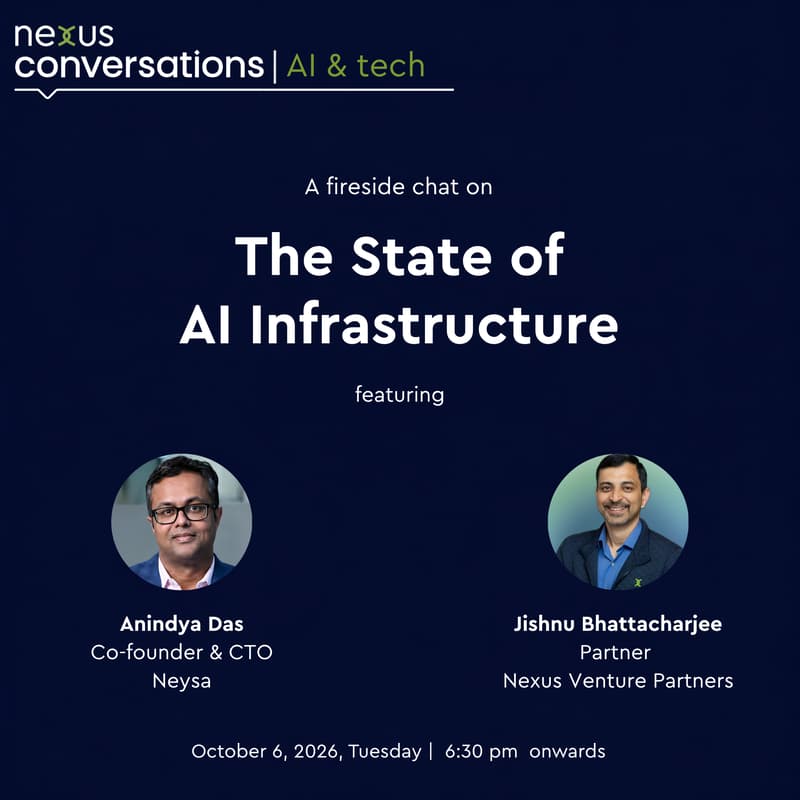
AI Tuesdays: The State of AI Infrastructure, from Racks to Reasoning
Every AI product eventually becomes an infrastructure problem. Tokens are getting cheaper, but they still run on GPUs, power, networks, and the software that keeps it all reliable. In 2026, that layer is the scarcest part of the stack. Hyperscalers are spending more than ever and still can't build fast enough. GPU and memory prices are rising, not falling.
India sits at a fascinating point in this story. It generates nearly a fifth of the world's data but hosts only a sliver of global data centre capacity. That gap is now drawing some of the largest cheques in Indian tech history: hyperscaler buildouts, the IndiaAI Mission, and a new generation of homegrown AI clouds.
Neysa is among the most ambitious of them: it is home to one of India's largest GPU rollouts, and along the way it has built a full-stack AI cloud spanning GPU compute, inference, orchestration, and AI security.
The conversation
For this edition of AI Tuesdays, we are going under the hood of the full AI stack, from silicon to applied AI, with someone who builds it every day.
Join us for a candid fireside chat between Anindya Das, Co-founder & CTO of Neysa, and Jishnu Bhattacharjee, Partner at Nexus Venture Partners.
Anindya has spent more than two decades designing and scaling cloud and network infrastructure, including years as a technology leader at Netmagic and NTT, before co-founding Neysa.
What we'll explore
From GPUs to a cloud: What separates renting out GPUs from running a production AI cloud? Where do orchestration, observability, security, and uptime actually get hard?
Building through a compute crunch: How do you secure capacity when lead times stretch into quarters, Hopper is being retired, and memory costs are spiking? How do you choose between NVIDIA, AMD, and custom silicon? What does that mean for pricing and planning?
The inference shift: As agentic and reasoning workloads burn far more tokens, where do bottlenecks move: serving engines, latency, or cost per token?
Models and post-training: Most companies won't train a model from scratch; they'll adapt open-weight models to their own data and domain. What does post-training really demand from infrastructure, and when is it worth doing over simply prompting a frontier model?
Built for inference: Inference has overtaken training as the bulk of AI compute. Does that change how you design clusters: which GPUs, where they sit, and how you keep them busy?
Applied AI in production: Banks running fraud and credit checks, retailers auditing stores with vision models, telcos deploying voice agents. What do these workloads demand from the infrastructure, and what breaks between pilot and production?
Sovereign by design: Data residency, regulated industries, and the IndiaAI Mission. Is sovereignty a durable moat, or a feature hyperscalers will match with local regions?
Competing with hyperscalers: Where can a focused AI cloud win against AWS, Azure, and Google, and where can't it?
From India to the world: Can Indian compute serve global labs and enterprises? What does "exporting infrastructure" actually look like?
What builders should take away: How AI startups should think about compute strategy, including renting vs. reserving, open-weight vs. frontier APIs, and hedging across providers.
Who it's for
AI infrastructure and platform engineers, ML and inference engineers, SREs, AI founders and CTOs, AI PMs, researchers, and anyone building on or buying serious compute and inference.
Format
A sharp, opinionated fireside chat. Doors open at 6:30 PM, and the conversation starts at 6:45 PM sharp. Open discussion and networking follow.
Seats are intentionally limited to keep the room high-signal. Apply to attend!