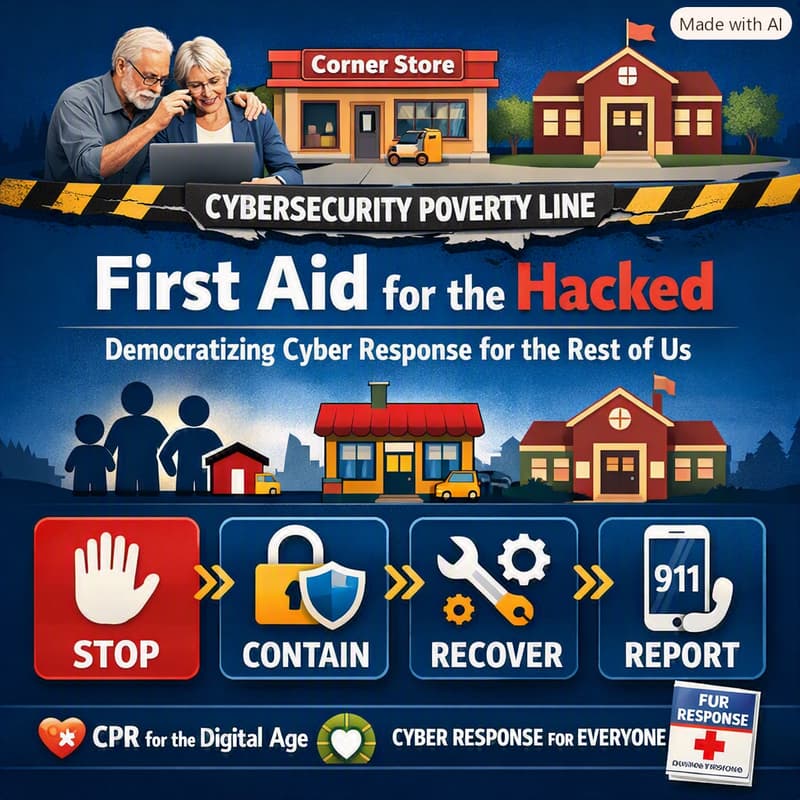
First Aid for the Hacked: Democratizing Cyber Response for the Rest of Us
In 2025 alone, more than $20 billion was lost to internet crime — and the losses land hardest on the people least equipped to recover: the corner store, the retiree, the small clinic, the local school. World-class incident response exists, but for a breached family or a two-person business it might as well not: it's a $400-an-hour phone call and a contract full of jargon. The knowledge to survive the first hour after an attack isn't scarce — it's gated.
This Tech Talk borrows a concept from public health — the "cybersecurity poverty line" — to reframe response as a public good rather than a luxury purchase. Just as we democratized physical first aid with CPR, AEDs, and 911, I argue we can democratize cyber response: calm, plain-language guidance for the moment it happens, free to the people who need it most. Drawing on the work behind HackFirstAid, I show what that looks like in practice — and why protecting the smallest makes everyone safer.
What attendees take away
Why the "cybersecurity poverty line" leaves most households and small organizations undefended — and what that costs everyone
A simple, repeatable model for the first hour after an incident: Stop, Contain, Recover, Report
Concrete ways to help make cyber response accessible in their own communities
Speaker bio
Travis Barlow has spent 25+ years in incident response and is the founder of the Atlantic Security Conference (AtlSecCon), one of Canada's leading security events. His latest project, HackFirstAid, grew from a simple conviction: the worst time to figure out what to do after a hack, scam, or breach is while it's happening to you. HackFirstAid delivers calm, plain-language cyber response guidance — free for households and tailored for the small businesses, schools, and organizations that traditional incident response leaves behind.
#TechTalkAtlantic #HalifaxTech #AI #Robotics #AtlanticCanada
Follow us:
Website: https://techtalkatlantic.com
Linkedin: techtalk-atlantic