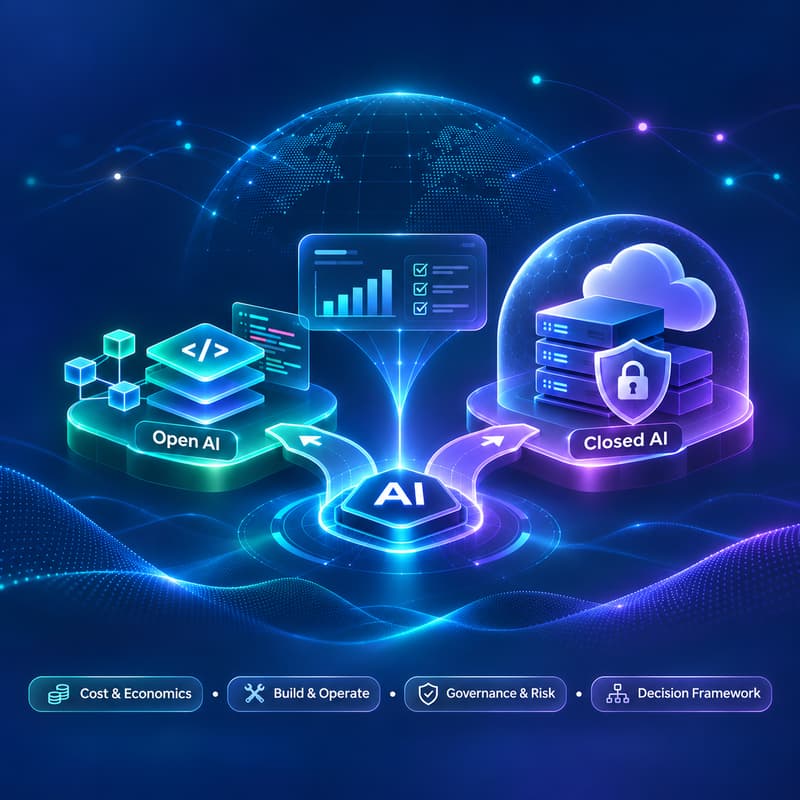
Open vs. Closed AI: Choosing the Right Strategy for Your Organization
Should your organization build AI using open-weight models or rely on proprietary AI services? While much of the debate focuses on model capabilities and pricing, the decision goes far beyond the model itself.
From infrastructure and engineering costs to data control, vendor dependency, governance, and long-term scalability, organizations need to understand the trade-offs before committing to an AI development strategy.
In this webinar, we'll explore the economics of open and closed AI, what it takes to build and operate AI solutions beyond the prototype, and how organizations can make informed decisions based on their business needs, technical capabilities, and governance requirements.
Agenda
Understanding open vs. closed AI: The differences between proprietary AI services, managed open-weight models, and self-hosted AI models.
The economics of open and closed AI: How AI providers make money, the hidden costs of running AI systems, and when each deployment option makes financial sense.
Building AI solutions beyond the model: Data readiness, architecture, evaluation, model portability, and deciding whether to build, buy, or partner.
AI governance across deployment options: How governance responsibilities, data control, operational risks, and accountability differ across open and closed AI systems.
Choosing the right AI strategy: A decision framework for evaluating AI options based on cost, performance, organizational capabilities, and long-term competitive advantage.
How Omdena builds and governs AI solutions: How Omdena and its agentic AI delivery platform, Umaku, help organizations move AI from prototype to production with greater visibility and accountability.
The future of open and closed AI: Omdena's perspective on how organizations may build, deploy, and govern AI by 2030.
Attendees will also have the opportunity to download our latest white paper on open and closed AI, which includes detailed cost comparisons, governance frameworks, and recommendations for AI decision-makers.
Who should attend
Founders, CEOs, CTOs, CIOs, and Chief AI Officers
Heads of AI, Data Science, and Engineering
AI architects and technology leaders
AI product and digital transformation leaders
AI governance, risk, and compliance professionals
AI consultants and business decision-makers