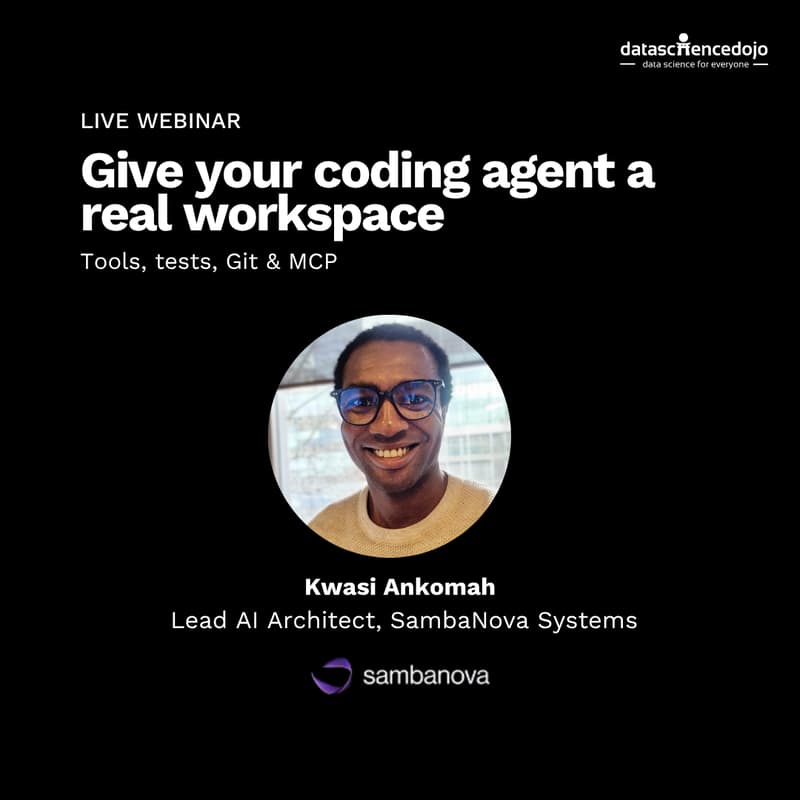

Give your coding agent a real workspace: Tools, tests, Git & MCP
A coding agent that can only plan is a coding agent that can’t ship. Real software work happens in a repository: reading files, running code, executing tests, and committing changes. Until an agent can do all of that safely, it remains a clever assistant rather than a contributor.
What You Will Learn?
You will see how to give a coding agent the core capabilities it needs to work like a developer – file access, code execution, test runs, and Git operations – and how to design those tools so the agent uses them reliably.
The session covers sandboxing the agent’s workspace so it can act freely without putting your systems at risk, and extending its reach with developer tools exposed over MCP. By the end of the session, the agent opens a PR-style diff that passes CI – a concrete, end-to-end demonstration of an agent doing real engineering work.
Why Tools and Workspaces Matter?
Most of an agent’s capability comes not from the model but from what it can touch. A strong model with weak tools produces confident plans that never get executed, while a well-equipped agent can verify its own work by running code and tests.
At the same time, giving an agent real power introduces real risk. File writes, shell commands, and Git access all need guardrails. The teams getting value from coding agents are the ones that pair broad tool access with strong isolation, so the agent can move fast without breaking anything outside its sandbox.