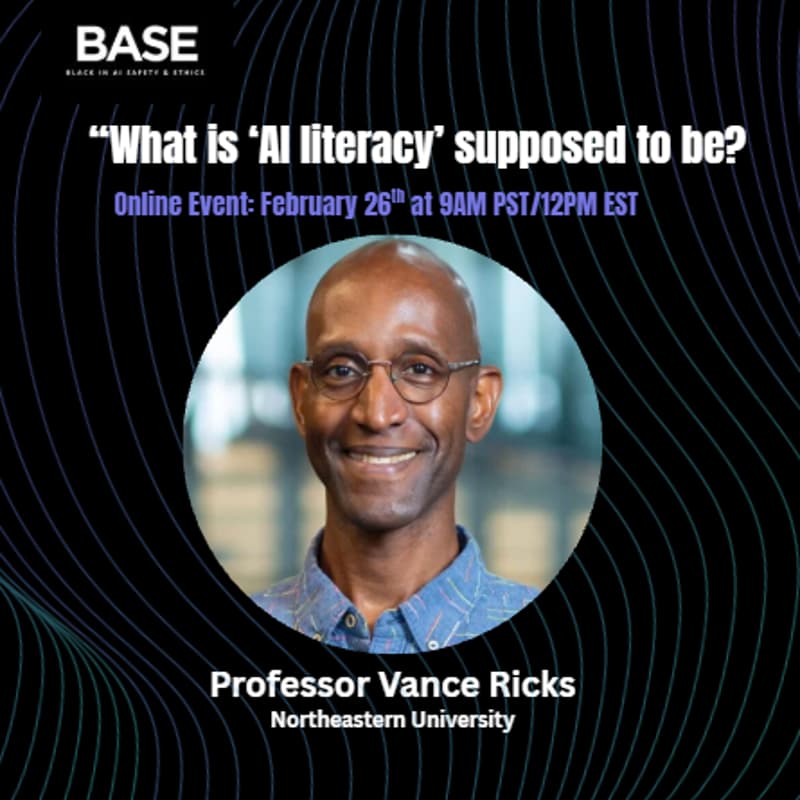
“What is ‘AI literacy’ supposed to be?” ft Professor Vance Ricks
Join us for our second research webinar, featuring experts sharing insights from their latest work in AI safety, governance, and ethics.
This month, we are excited to have Dr. Vance Ricks giving a talk on the considerations of what makes one AI literate.
Speaker Overview:
Vance Ricks is a Teaching Professor holding joint appointments in the College of Social Sciences and Humanities (CSSH) and Khoury College of Computer Sciences. Ricks earned his doctorate in philosophy from Stanford University. Before joining Northeastern, Ricks was an associate professor of philosophy at Guilford College. He has published on parasociality and on the implications of social networks for friendship and for gossip. He has co-authored publications on autonomous vehicles and on faculty policies regarding the use of generative AI systems. His teaching and research focus on technology and moral philosophy broadly speaking.
Current research projects are on computer ethics pedagogy and (separately) on parasociality and social robots. He has helped redesign several courses in Northeastern’s introductory- and intermediate-level CS curriculum to embed the teaching of moral reasoning and ethical issue spotting in those courses. He has helped to design and deliver ethics modules based on the values analysis in design / value sensitive design (VSD) framework.
Talk Overview:
Do you think of yourself as “AI literate”? The original forms of literacy are about the abilities to read and write in at least one language, thus connecting literacy to creating/producing. Later concepts like “information literacy” and “media literacy” are about “reading” as a kind of savviness: awareness of the constructed nature of our information, entertainment, and news media environments. In that sense, someone could be highly media literate without themselves creating or producing any media, and maybe having principled reasons for strictly limiting the media that they do choose to engage with. Is the same thing true about AI literacy?