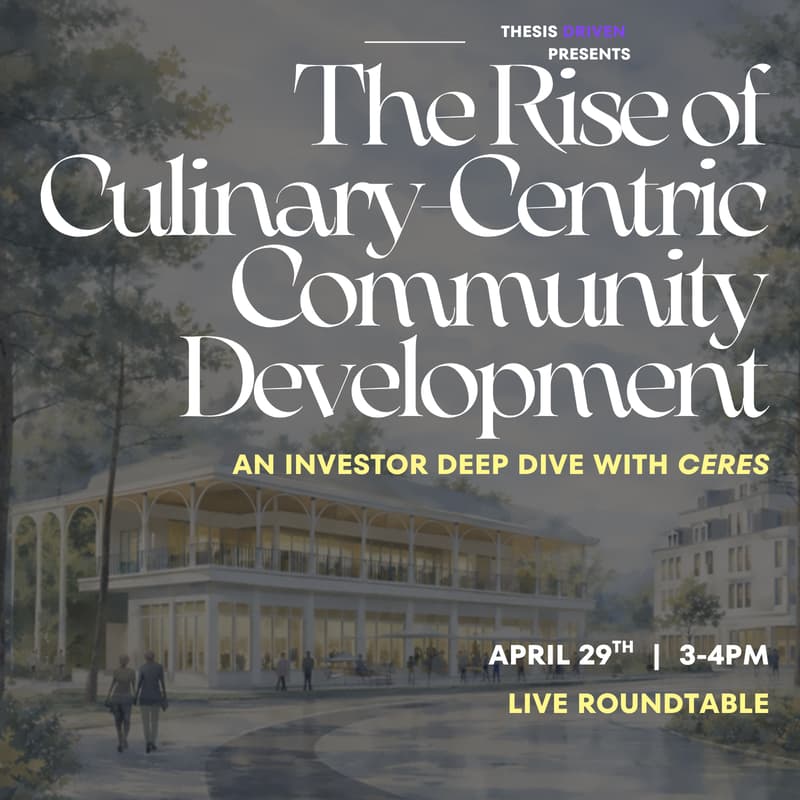

The Rise of Culinary Centric Community Development: A Deep Dive on CERES
Date & Time: Wednesday, April 29th | 3PM - 4PM EST
Hosted by: Thesis Driven
For decades, the American residential developer's playbook has followed a predictable formula: buy land, build homes, add a clubhouse and a pool, maybe a golf course. The amenity package is an afterthought — a checkbox on a marketing brochure. And yet the most successful community developments of the past twenty years have been the ones that organized around something deeper than square footage and finishes.
Serenbe proved it in Chattahoochee Hills, Georgia, where a biophilic community built around nature trails, organic farmland, and walkable hamlets has drawn over 1,000 residents and recently announced a $298 million expansion. Wellness real estate has exploded from $119 billion globally in 2015 to $438 billion in 2023, with projections reaching $912 billion by 2028. Buyers are paying 10 to 25 percent premiums for communities that prioritize health, nature, and connection. But most wellness developments still lead with fitness centers and spa amenities — overlooking the single most powerful social connector humans have: food.
The European model offers a different template. In towns like Malton, Yorkshire, a dying market town was revitalized by clustering food and beverage concepts — restaurants, distilleries, markets, cookery schools — until it earned the title "Food Capital of Yorkshire" and saw home values rise 49% in five years, nearly double the national average. These "gourmet clusters" prove that food doesn't just attract residents. It creates economies.
CERES Chattahoochee Hills is the first purpose-built American community designed around this insight. Developed by Dominique Love, Ellen Buckley, and their team at WGL, CERES replaces the traditional amenity package with an integrated culinary ecosystem: edible landscaping woven into every streetscape, orchards and a vertical farm, a five-acre truffle orchard, a cookery school modeled on Ireland's famed Ballymaloe, and a chef incubator that rotates emerging restaurant concepts every 18 to 24 months — seeding the surrounding region with food businesses and building a gourmet cluster organically. Located adjacent to Serenbe and 30 minutes from Atlanta, with Phase I construction launching in 2026 and 10% of homesites already reserved, CERES is a test case for whether food — not fitness — is the next great organizing principle for residential development.
Join us for a 60-minute live conversation with the CERES team as we explore how culinary-centric design is redefining what a residential community can be — and why the model may be replicable across the American Sunbelt.
In this session, we'll cover:
Why wellness real estate is the fastest-growing segment in global property — and why food is its most underexploited dimension
The European "gourmet cluster" model and how CERES is bringing it to the U.S.
Inside the CERES platform: chef incubators, edible landscapes, truffle orchards, and a cookery school
The vision for scaling culinary-centric communities across the Sunbelt
Speakers Include:
The Team
Dominique Love - Founder & CVO, CERES
Ellen Buckley - Managing Partner, CERES
The Interviewers
Paul Stanton, Thesis Driven
Brad Hargreaves, Thesis Driven
Register now to hear how CERES Chattahoochee Hills is pioneering a new model of residential development — one built around the thesis that the most enduring community amenity is the one people use three times a day.