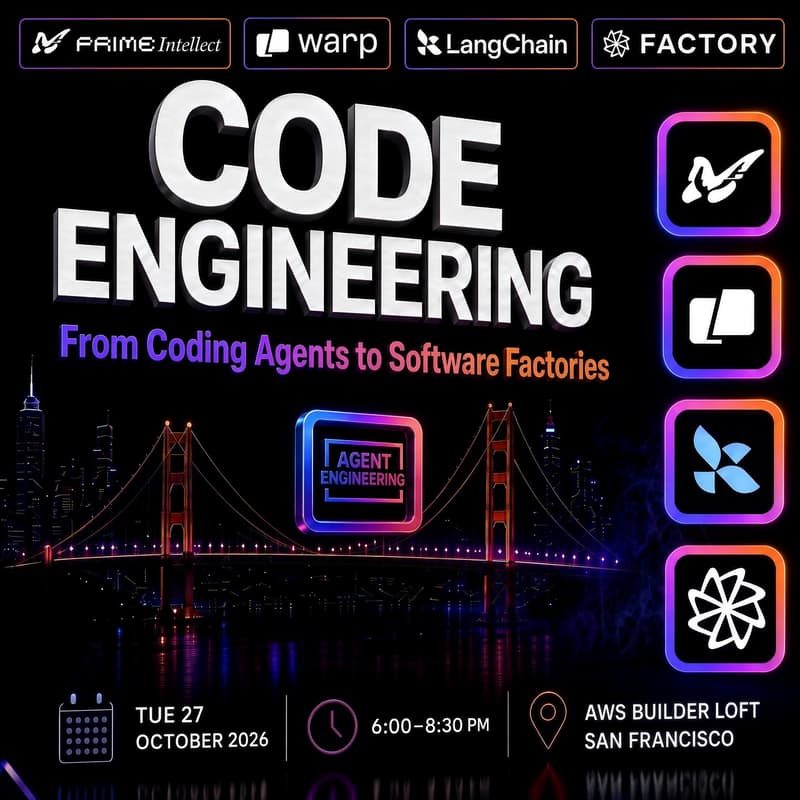

Code Engineering: From Coding Agents to Software Factories
Code Engineering: From Coding Agents to Software Factories
Following the strong response to Harness Engineering: State of the Art in Agent Harnesses, which attracted more than 1,000 people on Luma and 300 people attended an event at AWS Builder Loft. Some 🎥 the snapshot from the event here
The Agent Engineering HQ returns to San Francisco 🌉 for the next event in the *.engineering series. Our Next event will be on the Coding agents and related tools with amazing companies innovating in this space.
💻 Code Engineering : Coding Agents, Software Factories, Recursive Improvement and more
Coding agents can now navigate large repositories, plan changes, write and refactor code, execute tools, run tests, and work asynchronously. The next challenge is turning these capabilities into reliable systems that operate across the full software development lifecycle. Some of the agent engineering practices around coding agents are Context Engineering. Memory Engineering. Harness Engineering. Eval Engineering. Loop Engineering. Graph Engineering. Recursion Engineering
Code Engineering provides a common framework for the transition from coding agents to Software Factories? Coding agent harness landing almost every week now and this space is changing super fast.
This event will bring together engineers and companies building coding agents, agent harnesses, execution infrastructure, verification systems and Software Factories to investigate these questions.
🎙️Speakers
Talk 1: Prime Agent: A Self-Improving RLM and Continual Harness
🎙️Speaker: Seth Karten (@sethkarten)
Research @ Prime Intellect | Lead on Prime Agent & Continual Harness
Title: Prime Agent: A Self-Improving RLM Harness with Swarm Communication
Abstract:
Language models are sequential processors, but long-horizon agency requires external information and computation beyond model weights and active context. The harness itself is the layer between the LLM and the world that adds persistent state, tools, and compute. In this talk, I argue that as these responsibilities expand, the harness is becoming a self-improving and regularizing agentic operating system.
Prime Agent is an open-source harness for long-horizon evaluation and coding-agent workflows. A persistent Python REPL follows the Recursive Language Model abstraction for programmatic context processing and test-time compute, while Continual Harness preserves histories, memories, skills, prompts, and subagent specifications across trajectories. Recursive subagents coordinate through direct agent-to-agent communication.
This talk will highlight Prime Agent’s results and present expanded evaluations of harnesses, swarm topologies, and multi-agent communication. It will propose a two-axis framework for evaluating an agentic OS: memory scaling from active context to persistent and refined state, and computation scaling from a single session to programmatic tools, recursive agents, and communicating swarms. Across basic software engineering, long-horizon tasks, autoresearch, and swarm benchmarks, we ask how effectively additional memory and computation produce verified progress under a set of standardized metrics for harnesses.
Talk 2: Warp Factories and Agents
🎙️Speaker: Ben Holmes (@BHolmesDev)
Agent Infrastructure @ Warp
Title: Your agent needs a skill to improve its skills
Abstract: We just found out our orchestration agent was wasting hundreds of tool calls this past month. The reason? One bad instruction in our message passing skill.
Peeling back the curtain, there are dozens more examples you probably have in your own agent skills too. As you scale these agents to longer-running workloads, those gaps add up to real token cost.
To solve it, you'll need a feedback loop for agentic self-improvement. I'll show you how to build one: a system that evaluates past agent conversations, finds failure points, and turns those findings into skill improvements you'd want to merge. We'll set up the evaluation loop from scratch, and show how to automate it as part of a software factory.
You'll walk away with the skills you need (pun intended) to close the loop and let your agentic system improve itself.
Talk 3: Building agents that work like coding agents
🎙️Speaker: Sydney Runkle (sydneyrunkle)
Product Manager for Open Source at LangChain
Coding agents have made by far the greatest impact on an industry yet, and there's a lot to learn from the primitives they use to be effective. We're building an agent harness that borrows those primitives and generalizes them so that you can build agents that work like coding agents for any domain.
Talk 4: Reducing Coding Harness Latency with the Software Factory
🎙️Speaker: Andrey Risukhin
Recursive Self Improvement @ Factory
Title: Reducing Coding Harness Latency with the Software Factory
Abstract: Agents tasked with improving a coding harness can stall when experiment history gets lost or siloed, authentication failures delay evaluations, and headline metrics replace trace analysis. We’ll show how Factory’s Software Factory combines agent-accessible evals, shared experiment tracking, and effectiveness signals to reduce our coding harness latency.
Topics
The technical program will examine:
Harness design for long-horizon coding agents
Persistent memory, skills, and recursive subagents
Coding-agent primitives that transfer to other domains
Evals, experiment tracking, and harness latency
Software factories: infra, permissions, metrics, and self-improvement loops
Format
The event will combine concise technical presentations coding agent companies and infra companies supporting the coding agents and software factories.
Agenda
This is tentative agenda and will evolve as speakers and talk finalised.
6:00–6:40 PM: Registration, networking and refreshments
6:40–6:50 PM: Opening and Welcome
6:50–7:50 PM: Code Engineering thesis talks
7:50–8:25 PM: Closing synthesis
Continue the discussion with speakers, founders and other practitioners.
Who should attend?
This event is designed for:
Software, platform, AI/ML and Agent engineers
Coding-agent and harness developers
CTOs and engineering leaders and Founders of developer tools companies.
Researchers working on software-engineering agents
Organizations deploying coding agents in production
Presented by Agent Engineering HQ, the *.engineering event series for agentic AI engineering.