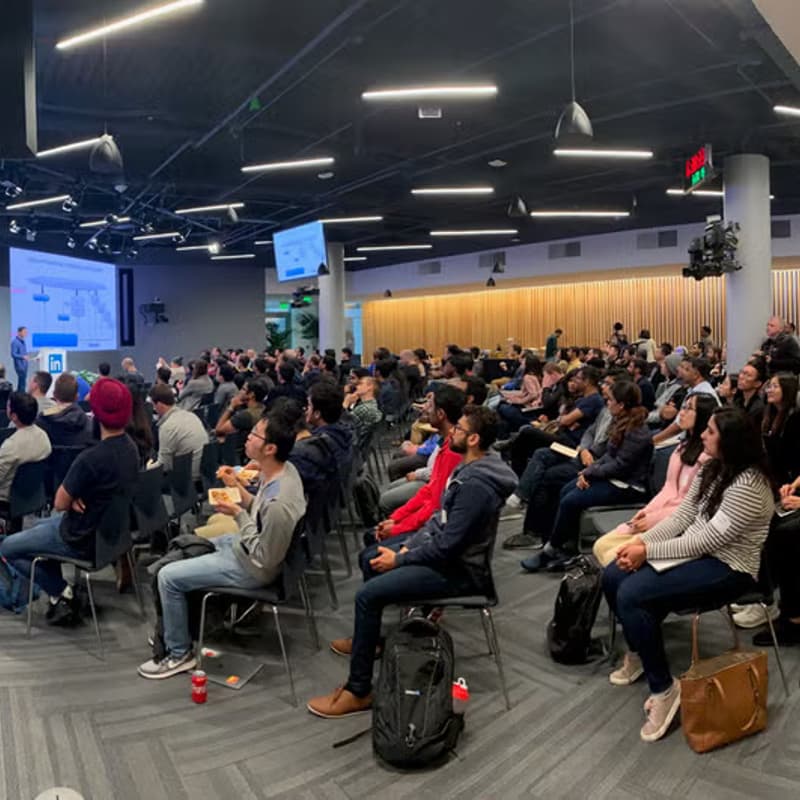
Stream Processing Meetup
Stream processing and real time event processing is everywhere. This group's goal is to showcase some of the cutting edge developments that are happening in stream processing in the Industry. The focus of the meetup will be Apache Kafka, Apache Flink, Change Data Capture and such. This is hosted by Linkedin.
📍 Building 1000, 1st Floor, Engage Room
🗓️ Thursday, December 8, 5:30–8:30 PM
Featured Speakers
Min Zhou: [OpenAI] Title: Scaling big data infrastructure at OpenAI
Revanth Chandupatla & Khetanshu Chauhan: [Walmart] Title: Say What, Not How: Declarative Streaming Across Engines and Clouds
Xinyi Yan: Ultra Large Scale Evolution: Flink SQL at Million Scale QPS and 10TB State At Stream Processing Meetup
Agenda:
5:30 - 6:00: Networking (with catered food)
6:00 - 6:05: Welcome
6:05 - 6:40: [OpenAI] Title: Scaling big data infrastructure at OpenAI
Min is a Software Engineer at OpenAI with over 20 years of experience in distributed systems, cloud infrastructure, and high-performance backend platforms. Key focus areas include large-scale distributed databases, the Hadoop/Spark ecosystem, Flink. Prior to OpenAI, Min built and scaled production infrastructure at LinkedIn, Databricks, Amazon.
Abstract:
OpenAI’s offline data infrastructure spans several exabytes across Azure and AWS, running hundreds of thousands of Apache Spark jobs each day. At this scale, tens of millions of short-lived Kubernetes pods per day, sustained S3 scan throughput exceeding 10 TB/s, and sustained shuffle throughput of hundreds of TB/s create challenges that go far beyond scaling individual jobs.
This talk shares how OpenAI addresses scalability across four interconnected layers: Kubernetes, cloud infrastructure, observability, and operations. It discusses the bottlenecks encountered, the engineering decisions used to address them, and the tradeoffs of operating a large-scale, multi-cloud data platform. Particular attention will go to managing short-lived workloads, navigating cloud resource constraints, maintaining visibility into system behavior, and keeping operational complexity manageable as the platform grows
6:40 - 7:15: [Walmart] Title: Say What, Not How: Declarative Streaming Across Engines and Clouds
- Revanth Chandupatla is a Principal Engineer at Walmart, focused on large-scale streaming platforms, distributed systems, and data infrastructure. His work spans Apache Spark, Apache Flink, Kafka Connect, and lakehouse architectures, with an emphasis on making complex platforms simpler, more reliable, and cost-efficient. He leads initiatives in serverless workload placement and AI-assisted platform operations, combining deterministic workflows with LLM-powered reasoning. As an Open-Source contributor, Revanth has contributed to Spark Operator, Dr. Elephant, Geomesa, Hudi projects. He enjoys sharing practical lessons from building and operating streaming systems at Walmart’s scale.
- Khetanshu Chauhan is an Engineering Manager at Walmart Global Tech, leading a team building large-scale real-time data streaming platforms. She focuses on distributed systems, simplifying the experience of building and managing data pipelines, and making data infrastructure scalable, reliable, and cost-efficient.
Abstract:
Creating streaming pipelines declaratively with equivalency of streaming experts. This talk presents a declarative platform where users describe what they need, and the system designs the topology, placing each stage on the right engine and cloud. Pipelines compile to an engine-agnostic intermediate representation, so they can change engines or clouds without a rewrite. Code-generated functions, native dead-letter handling, unified observability, and shared "process once, serve many" execution make cost efficiency a property of the platform. Managed runtimes handle stateless and stateful workloads at scale. Attendees leave with a blueprint for declarative streaming across engines and clouds.
7:15 - 7:50: Xinyi Yan: Ultra Large Scale Evolution: Flink SQL at Million Scale QPS and 10TB State At Stream Processing Meetup
Xinyi is a Software Engineer on the Stream Processing team at LinkedIn, contributing across multiple layers of the Flink ecosystem. Key focus areas include Flink state management, early fatal error detection, runtime optimizations, and end2end upgrade testing. Prior experience includes extensive work in distributed systems, the Hadoop and HBase ecosystems, and serving as a PMC member for Apache Phoenix.
Abstract:
Operating Flink SQL Interval Joins at a massive scale, processing million QPS and managing upwards of 10TB of state, introduces extreme system stress. When joining streams with massive volume asymmetry (up to a 600x gap), we faced state explosions. A minor delay on a slow stream would instantly overflow the fast stream's buffer due to the "watermark trap." In a single giant job, our network shuffle became a heavy bottleneck. We initially hit severe disk I/O limits and compaction delays with RocksDB, and while switching to an in memory HashMap backend gave us raw speed, it eventually failed at 1.6M QPS due to crippling Garbage Collection (GC) pauses and OOM risks.
In this session, we’ll share our journey of how we defeated these 10TB state explosions and engine limits. We evolved from a single monolithic job into a disaggregated architecture using deterministic hash sharding and pre-aggregation. By combining Flink's native enhancements with Skip Shuffle optimizations, we bypassed the network bottleneck entirely. This localized workload distribution not only solved our throughput issues but allowed us to improve our stability.
Key takeaways include:
Preventing state buildup using Watermark Alignment (Flink 1.18+) to cap drift synchronization, ensuring small topics aren't outpaced by high-volume streams.
Architectural upscaling via deterministic hash sharding to fan out monolithic state into independent jobs, dropping the state footprint per TaskManager from 66GB to 12GB.
The RocksDB Redemption: How reducing the state-per-worker allowed us to move away from heap bound HashMap limits and thrive on RocksDB without disk bottlenecks.
Skip Shuffle optimization: Bypassing the network compute tax (serialization, memory bloat, and cascading stalls) by forcing localized stateful operations.
Operational dividends: Minimizing blast radius through fast per-shard failure isolation, and enabling rapid recovery.
We'll close with the lessons learned from our system trade offs, and an open Q&A on managing ultra large scale state.
Event Partners
🌟 Lead Sponsor: LinkedIn
Past meetup talks are available at: Watch on YouTube