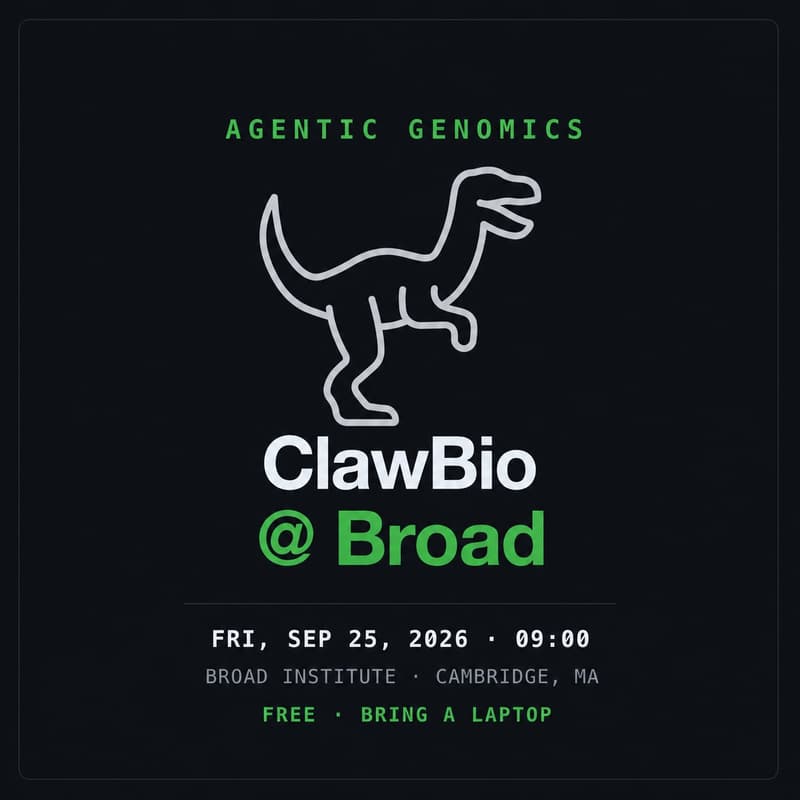


ClawBio, developing your own genomic agent from scratch
One day. Real genomic questions. Build agents that do useful scientific work, then show the room what they found.
AI agents can plan multi-step work, call tools, run analyses and recover from failure. Biology is where that gets hard: results must be reproducible, evidence must be traceable, and an agent must know when it cannot support a claim.
ClawBio is open-source infrastructure for that work. Its versioned skills make an agent's methods inspectable, reproducible and open to challenge.
Boston is modelled on the latest ClawBio hackathon in Berlin, with the format improved using what we learned there: setup before arrival, one clear help route, faster team formation and more protected build time.
Everything runs through Slack
The ClawBio Slack community is where we work before, during and after the event. Register for the event to receive access for setup, introductions, team formation, help, demos and follow-up. The join link is not posted publicly.
#boston-general: introductions, announcements, timetable and resources
#boston-help: the single route for setup, access, data, tool and testing problems
#boston-teams: ideas, team formation, challenge selection and working links
#boston-demos: demos, evidence, limitations and what happens next
Registered participants will receive a short technical preflight through Slack. Complete it before arrival so that the day can be spent building.
What you will build
Choose a published challenge brief or bring a biological question that we can scope with you. Challenge directions include:
End the diagnostic odyssey
Build a cancer target you would defend
Ask whose genome a method fails on
Bring your own question
Your team will build an agent that can do useful scientific work, expose its evidence and state what it cannot claim. A GitHub contribution is welcome when it fits the project, but the day is about useful work and learning, not chasing a pull request count.
What you get
A full day focused on one real scientific problem
A team of four to five people formed around shared interests
Practical support with ClawBio, agent workflows and reproducible bioinformatics
A chance to demo what you built and make the evidence visible
A community workspace that remains active after the event
Who should come
Bioinformaticians and computational biologists
Genomics researchers and clinical scientists
Software engineers and research software engineers
Machine learning practitioners interested in scientific agents
Students, founders and builders with a serious biological question
No previous ClawBio or AI coding-agent experience is required. You should be comfortable reading or running code. Bring a laptop and charger. Teams will be formed on the day.
Programme
All times are Boston local time (EDT).
08:30 Doors open: check in, get connected and meet the community.
09:00 Prompt start: introduction to agentic biology and ClawBio from Manuel, a practical first-skill demonstration from Mo, and an explanation of judging from Robert.
Morning: form teams around cancer targets, the diagnostic odyssey, genomic equity or your own biological question. Start building as soon as your team is formed, with organiser support and at least three hours protected for hands-on work.
Lunch: flexible, coordinated by each team. Bring your own food; no catering is provided. Plan your work and lunch to be ready to present at 14:00.
Before 14:00: finish building and upload your demo materials or post a link in
#boston-demos.14:00 Team presentations begin. Choose the format that works for your team: a live demonstration, slides, a video or another format. Show what runs and what you could not establish.
After presentations: jury feedback, recognition and community next steps. The jury will consider: does it run, would you trust it, is it reusable, and did it actually need agents?
16:00 Close.
Practical details
Friday 25 September 2026, 09:00 to 16:00 EDT. Doors open at 08:30.
Broad Institute | 300B
300 Binney St, Cambridge, MA 02142
Registration is free and required. Please bring your laptop, charger and your own lunch. Catering is not provided. Only public or synthetic data may be used during the hackathon.
Organised by Manuel Corpas and Mohammad Tanhaemami.
Sponsors and community partners
We welcome community partners who can share the event with relevant Boston researchers and builders, or contribute prizes or model credits for participants. Support must benefit the community and does not control the scientific content. Contact the organisers through Luma if your organisation can help.